Sony BRAVIA 8 vs 8 II vs XR8B: Which One Wins?
The question
bravia 8 vs 8 ii vs xr8b
Choose BRAVIA 8 II for stronger HDR; BRAVIA 8 and XR8B suit 77-inch buyers, with XR8B sharing the original’s panel.
Choose BRAVIA 8 II for the strongest HDR picture, and BRAVIA 8 or XR8B when you want a 77-inch screen. XR8B is a variant of the original BRAVIA 8, not another name for the QD-OLED BRAVIA 8 II.
All three are capable TVs; none deserves a blanket avoid recommendation. However, BRAVIA 8 and XR8B are the wrong choices if your priority is the most vivid HDR presentation among these three: their WOLED panel does not provide the BRAVIA 8 II’s QD-OLED color performance. RTINGS’ BRAVIA 8 review and BRAVIA 8 II review establish that distinction.
| Deciding specification | BRAVIA 8 | BRAVIA 8 II | BRAVIA XR8B |
|---|---|---|---|
| US 65-inch model | K-65XR80 | K-65XR80M2 | K-65XR8B |
| Panel technology | WOLED | QD-OLED | WOLED |
| Screen sizes | 55, 65, 77 inches | 55, 65 inches | 55, 65, 77 inches |
| Maximum 4K refresh rate | 120Hz | 120Hz | 120Hz |
Model and refresh-rate details appear in Sony’s specifications for BRAVIA 8, BRAVIA 8 II, and XR8B. RTINGS documents the panel types and BRAVIA 8/8 II size ranges; Sony also lists the XR8B’s three sizes. Model suffixes can differ outside North America, so match the full local product name before ordering.
XR8B is a BRAVIA 8 variant, with documented omissions
RTINGS identifies XR8B as using the same panel and processor as BRAVIA 8. It reports equivalent performance apart from software differences and notes that XR8B omits XR Contrast Booster and the bundled Sony Pictures Core credits. That supports treating XR8B as a BRAVIA 8 alternative, rather than a picture upgrade. RTINGS’ model-variant explanation.
Sony’s documentation reveals another distinction that short comparisons often miss. BRAVIA 8 lists XR Triluminos Pro and XR Contrast Booster 15. XR8B lists Live Color and Dynamic Contrast Enhancer, without those two XR labels. BRAVIA 8 II lists XR Triluminos Max and XR Contrast Booster 25. Sony BRAVIA 8 specifications, XR8B specifications, and BRAVIA 8 II specifications.
Those omissions are checkable; their individual visual effects are not quantified by the cited documentation. Do not interpret “15” and “25” as measured contrast ratios, or assume the missing label proves a particular percentage loss in brightness. The sources reviewed here do not provide a separate XR8B-versus-XR80 measurement isolating those features.
Choose the original BRAVIA 8 if retaining those explicitly listed processing features matters to you. Consider XR8B if you want the same underlying WOLED platform and accept the documented omissions. Neither the newer model year nor the letter B makes XR8B a QD-OLED television.
BRAVIA 8 II wins for HDR, but picture mode matters
TechRadar measured BRAVIA 8 II at 1,439 nits peak in Cinema mode, versus 1,067 nits in Standard. Its earlier BRAVIA 8 measurement reached 817 nits in Standard. Comparing Standard with Standard therefore gives an approximately 31% peak-brightness increase, calculated from those published results. Comparing 1,439 with 817 would mix picture modes. TechRadar’s BRAVIA 8 II measurements.
That is a useful reason to choose BRAVIA 8 II for HDR films. Bright reflections, lights, and other highlights have more brightness available, while QD-OLED supplies the stronger color performance identified by RTINGS. It is the meaningful picture upgrade in this comparison.
Just want the recommendation?
Skip to the picksThe improvement does not mean every scene becomes proportionally brighter. TechRadar measured BRAVIA 8 II’s fullscreen brightness at 183 nits in Cinema and 250 nits in Standard, versus 182 nits in Standard for BRAVIA 8. Peak brightness and fullscreen brightness answer different questions; neither figure should stand in for the other. TechRadar’s brightness results.
A 77-inch requirement changes the winner
BRAVIA 8 II stops at 65 inches in the documented range. BRAVIA 8 and XR8B offer 77-inch versions, so either can win when screen size matters more than the QD-OLED improvement.
At the same aspect ratio, a 77-inch screen has approximately 40% more area than a 65-inch screen, calculated as (77 ÷ 65)² − 1. That is a physical difference you cannot recover through picture processing. A larger image can make subtitles easier to read and distant action easier to follow from your existing seat.
For a larger room, decide whether 65 inches is sufficient before ranking panel technologies. Choosing a 65-inch BRAVIA 8 II solely because it has the best HDR can miss the more important requirement. For a 77-inch purchase, the remaining decision is BRAVIA 8’s documented processing features versus XR8B’s omissions.
Daylight viewing weakens the case for 8 II
BRAVIA 8 II’s HDR advantage does not automatically make it the best daytime television. RTINGS reports that strong ambient light raises its black levels toward gray with a slight purple tint, and that its SDR brightness is insufficient to overcome glare in strongly lit rooms. RTINGS’ bright-room assessment.
If you mostly watch evening films with controllable lighting, that limitation carries less weight. If you watch daytime sports opposite uncovered windows, avoid choosing from a peak-HDR number alone. The relevant questions are how much light reaches the screen and whether you can reduce it.
A room that demands a larger, brighter display also warrants comparing OLED with Mini LED. The related LG G5 77 versus Sony BRAVIA 9 75 comparison addresses that alternative decision.
Gaming does not remove the HDMI bottleneck
All three support 4K at 120Hz, VRR, and ALLM; BRAVIA 8 II does not add a higher refresh-rate ceiling. Sony’s specifications confirm these shared features. Its XR8B documentation also makes a useful distinction: ALLM is supported on HDMI 1–4, but VRR is limited to HDMI 3 and 4. ALLM on a port does not mean that port supplies every gaming feature. Sony XR8B specifications.
RTINGS confirms that BRAVIA 8 and BRAVIA 8 II place their two HDMI 2.1 bandwidth inputs on ports 3 and 4, with port 3 also serving eARC. Connecting an eARC soundbar therefore leaves only one of those inputs free for a directly connected gaming source. BRAVIA 8 input testing and BRAVIA 8 II input testing.
For one console, that layout is straightforward. For two consoles plus an eARC soundbar, plan the connection arrangement before buying; moving to BRAVIA 8 II does not solve the shortage. Choose it for the HDR picture improvement. Choose BRAVIA 8 or XR8B when their screen size and WOLED capabilities better match what you actually watch.
The bottom line
Neither is wrong; the use case separates them:
Top pick
Buy this
Sony BRAVIA 8 II 65 Inch QD-OLED TV K-65XR80M2
Its QD-OLED panel provides stronger HDR color performance, and TechRadar measured 1,067 nits peak in Standard mode versus BRAVIA 8’s 817 nits.
The strongest choice for HDR films when 65 inches fits your room. Its limitations are the 120Hz ceiling and only two HDMI 2.1 bandwidth inputs.Available at Amazon(paid link) — opens Amazon in a new tab. Price and availability shown there.The alternative
It depends
Sony BRAVIA 8 77 Inch OLED TV K-77XR80
BRAVIA 8 offers a 77-inch version, while the documented BRAVIA 8 II range stops at 65 inches.
Consider it when you need 77 inches and want the original model’s documented XR processing features. It lacks BRAVIA 8 II’s QD-OLED panel.Available at Amazon(paid link) — opens Amazon in a new tab. Price and availability shown there.
Recommended products
Ordered by how well each one fits the situations above. Each link below is a paid link.
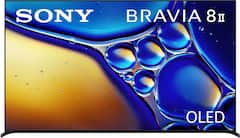
Sony BRAVIA 8 II 65 Inch QD-OLED TV K-65XR80M2
Buy — Its QD-OLED panel provides stronger HDR color performance, and TechRadar measured 1,067 nits peak in Standard mode versus BRAVIA 8’s 817 nits.
The strongest choice for HDR films when 65 inches fits your room. Its limitations are the 120Hz ceiling and only two HDMI 2.1 bandwidth inputs.Available at Amazon(paid link) — opens Amazon in a new tab. Price and availability shown there.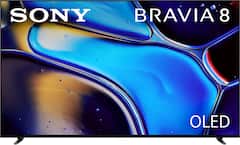
Sony BRAVIA 8 77 Inch OLED TV K-77XR80
Consider — BRAVIA 8 offers a 77-inch version, while the documented BRAVIA 8 II range stops at 65 inches.
Consider it when you need 77 inches and want the original model’s documented XR processing features. It lacks BRAVIA 8 II’s QD-OLED panel.Available at Amazon(paid link) — opens Amazon in a new tab. Price and availability shown there.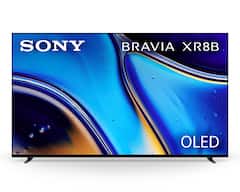
Sony BRAVIA XR8B 65 Inch OLED TV K-65XR8B
Consider — RTINGS identifies the same panel and processor as BRAVIA 8, while Sony’s specifications omit XR Contrast Booster and XR Triluminos Pro.
Consider it for BRAVIA 8’s underlying WOLED platform when the omitted processing features and bundled credits do not matter. It is not the QD-OLED upgrade.Available at Amazon(paid link) — opens Amazon in a new tab. Price and availability shown there.
Sources
Pages consulted while researching this article. None of these are affiliate links.
- RTINGS: Sony BRAVIA 8 OLED Review — rtings.com
- RTINGS: Sony BRAVIA 8 II OLED Review — rtings.com
- Sony: K-65XR80 Specifications — sony.co.uk
- Sony: K-65XR80M2 Specifications — sony.com
- Sony: K-65XR8B Specifications — sony.com
- Sony: BRAVIA XR8B Features and Screen Sizes — electronics.sony.com
- TechRadar: Sony BRAVIA 8 II Review and Brightness Measurements — techradar.com