TCL QM8K 85-Inch: Bright-Room Verdict
The questionWhere do these come from?
Best Buy
Need help and yes it’s another “which one would you choose” post. Getting ready to buy a new TV. Fairly bright room. Using Apple TV as streaming device.
The 85-inch TCL QM8K is the best fit for a bright mixed-use room, provided no window or lamp sits directly opposite its glossy screen.
The 85-inch TCL QM8K is the one to buy for a bright mixed-use room where sports, streaming and PS5 gaming all matter. It combines unusually high brightness with better processing and faster gaming motion than its closest Hisense rival, although a window or lamp directly opposite the glossy screen remains its clearest weakness.
This is not an OLED-style choice built around perfect blacks and viewing in controlled light. It is a high-output Mini-LED television that can keep daytime sports visible, clean up compressed streams and retain local dimming in Game Master mode. Its balance is more useful than winning one isolated brightness benchmark.
| Model | Verdict | Bright-room and sports evidence | Main catch |
|---|---|---|---|
| TCL 85QM8K | Buy | 144Hz panel; TechRadar measured 2,268 nits on a 10% HDR window and 584 nits full-screen in Filmmaker Mode | Direct lights still produce mirror-like reflections; fast sports can show edge artifacts |
| Hisense 85U8QG | Consider | TechRadar measured 3,337 nits on a 10% HDR window and 733 nits full-screen in Filmmaker Mode | HDR is over-brightened, while fast players can leave visible blur trails |
| Sony BRAVIA 7 K-85XR70 | Consider | Excellent upscaling and cleaner motion make it compelling for low-quality sports feeds | Direct reflection handling and off-axis viewing are poor fits for some bright rooms |
The measurements above come from smaller samples in each model family, not the 85-inch units. RTINGS tested the 65-inch QM8K and says its findings also apply to the 75- and 85-inch versions, while noting that zone count and brightness rise slightly with size. Its U8QG review likewise used a 65-inch VA sample and identifies the 85-inch version as another VA-panel model with 3,168 advertised dimming zones. That makes the results useful for choosing a family, but not a promise that every 85-inch panel will reproduce the same number. RTINGS documents the QM8K size differences and the U8QG variants separately.
Why the QM8K wins the mixed-use decision
Peak brightness alone would point toward the Hisense U8QG. That is the wrong single-number test for this decision. A football field, basketball court or hockey rink occupies much more of the screen than a small HDR highlight, so full-screen brightness, reflection behavior, uniformity, motion and broadcast processing all matter.
TechRadar’s lab recorded 2,268 nits on a 10% HDR pattern and 584 nits full-screen from its QM8K sample in Filmmaker Mode. Standard Mode increased those readings to 3,176 and 629 nits. The same reviewer found that ordinary ambient lighting did not materially damage contrast, though a lamp aimed at the screen remained visible. The review also found impressive upscaling from older programs and low-resolution sources. TechRadar’s QM8K measurements and viewing tests support the bright-room case without relying on TCL’s advertised maximum.
RTINGS reaches a similar overall verdict: the QM8K becomes bright enough to overcome indirect glare, preserves color saturation under ambient light and does a strong job smoothing low-bitrate content. Its direct-reflection result is less flattering—the glossy coating reduces a reflection’s intensity but does not remove the mirror image of a facing window. Room geometry therefore matters more than another few hundred nits. Curtains or moving a lamp off-axis will help; brightness cannot erase a reflected object from a dark scene.
TCL specifies a native 144Hz panel, Google TV, four HDMI inputs and support for Dolby Vision IQ, HDR10+, HDR10 and HLG on the 85QM8K. Independent testing found that only two HDMI inputs carry the full high-bandwidth gaming feature set. TCL’s 85QM8K specifications confirm the panel and platform, while RTINGS verified the supported signals.
Sports are good, but motion is not perfect
The QM8K’s sports advantage is brightness plus competent processing, not flawless motion. RTINGS observed blur and color artifacts around fast-moving players and objects. TechRadar likewise called motion average before adjustment.
There is a useful, specific correction: open the Motion menu, select Custom Motion Clarity, and start with both Judder Reduction and Blur Reduction at 2. TechRadar reported that this reduced blur and judder without adding an obvious soap-opera effect. Treat 2 as a starting point rather than a universal calibration; increase it only if a particular broadcast still looks rough.
Uniformity also deserves attention during the return window. An 85-inch panel makes dirty-screen effect easier to see on a football pitch, hockey rink or slow camera pan. Play a real game rather than relying only on gray test slides. Mild variation is normal for a large LCD, but stationary dark bands visible throughout play justify an exchange.
Just want the recommendation?
Skip to the picksThe Sony BRAVIA 7 is the sports-first alternative when compressed cable or streaming feeds matter more than reflection control. RTINGS found its upscaling, artifact removal and sports motion superior, with only minor transition artifacts. What the BRAVIA 7 gets wrong for a room with a facing window is direct-reflection handling; it also loses image quality from wide seats. RTINGS’ BRAVIA 7 testing makes it a conditional choice, not the better all-purpose bright-room television.
Streaming quality favors the TCL over raw brightness
Google TV gives the QM8K broad app support, Chromecast and recommendations across services. The interface includes advertising, but the underlying platform is mature and does not require an external streamer for mainstream services.
More importantly, RTINGS found great low-quality-content smoothing and proper upscaling without excessive sharpening. Some fine detail is lost when smoothing aggressive compression, but that is usually preferable on an 85-inch screen to exposing every macroblock in a poor stream. The QM8K also tracks intended HDR brightness more accurately than the Hisense U8QG.
The U8QG gets HDR brightness tracking wrong for viewers who want movies and premium streams to retain their intended tonal balance: RTINGS found that it over-brightens nearly every HDR scene. That extra punch can look appealing in daylight, but it is not the same as better processing. The TCL also produced more uniform blacks and less haloing in RTINGS’ direct comparison.
PS5 support is complete where it matters
A PS5 cannot output 144Hz, so the QM8K’s headline refresh rate is not the deciding console feature. What matters is verified support for 4K at 120Hz, 1440p at 120Hz, HDMI Forum VRR, HDR and Auto Low Latency Mode. RTINGS confirmed all of them and found that ALLM automatically invokes the low-lag Game Master mode.
The two high-bandwidth HDMI inputs are enough for a PS5 and one other modern console, but connection planning matters if an eARC sound system occupies one of them. The Hisense U8QG offers three HDMI 2.1 inputs and is the narrower choice for someone connecting several high-refresh sources without an HDMI switch.
Do not choose the U8QG merely because its native panel reaches 165Hz: that brings no benefit to a PS5 capped at 120Hz. RTINGS measured excellent console compatibility on both televisions and found the TCL slightly faster at 120Hz with clearer pixel transitions. The U8QG remains attractive for a high-refresh gaming PC, but its slower transitions can make fast 60fps motion look less distinct.
TCL also released firmware V8-0012T02-LF1V321.001899 with a new Boost brightness option. RTINGS retested the set and found that Boost changed some test-window results while making only a small difference in most real scenes. That is a useful warning against buying—or configuring—the television around a laboratory maximum. The RTINGS changelog and firmware retest provide the checkable version number.
The room condition that can reverse the verdict
Choose the TCL 85QM8K when daylight enters from the side, seating extends moderately off-center, and the television must handle sports, ordinary streams and PS5 gaming without specializing in only one. Choose the Hisense 85U8QG instead when maximum light output and a third HDMI 2.1 input outweigh faithful HDR tracking and motion clarity. Choose the Sony BRAVIA 7 when low-quality sports feeds are the priority and every important seat faces the screen, with no uncovered window or bright lamp reflected in it.
None of these three deserves a blanket skip; all are capable 85-inch Mini-LED televisions, and the real separator is processing versus raw brightness versus reflection geometry. For the broad bright-room mix described here, the QM8K makes the fewest meaningful compromises.
The bottom line
Two good answers to different versions of the question:
Top pick
Buy this
TCL 85-Inch Class QM8K Series QD-Mini LED 4K UHD Smart Google TV 85QM8K 2025 Model
TCL
Its native 144Hz panel supports the PS5’s 4K 120Hz, VRR and ALLM modes, while independent testing found better HDR processing and faster 120Hz response than the U8QG.
This is the subject TV and the top pick for a bright mixed-use room because it balances very high output, competent stream processing and full PS5 support. Its glossy screen still shows a window or lamp positioned directly opposite it.Available at Amazon(paid link) — opens Amazon in a new tab. Price and availability shown there.The alternative
It depends
Hisense 85-Inch Class U8 Series Mini-LED ULED 4K UHD Google Smart TV 85U8QG 2025 Model
Hisense
TechRadar measured 3,337-nit peak and 733-nit full-screen HDR output in Filmmaker Mode, but RTINGS found inaccurate HDR brightness tracking and slower motion transitions.
This direct rival is worth considering when maximum brightness or three HDMI 2.1 inputs is the priority. It is less suitable for faithful HDR streaming or crisp fast motion because it over-brightens HDR and leaves visible blur trails.Available at Amazon(paid link) — opens Amazon in a new tab. Price and availability shown there.
Recommended products
Ordered by how well each one fits the situations above. Each link below is a paid link.
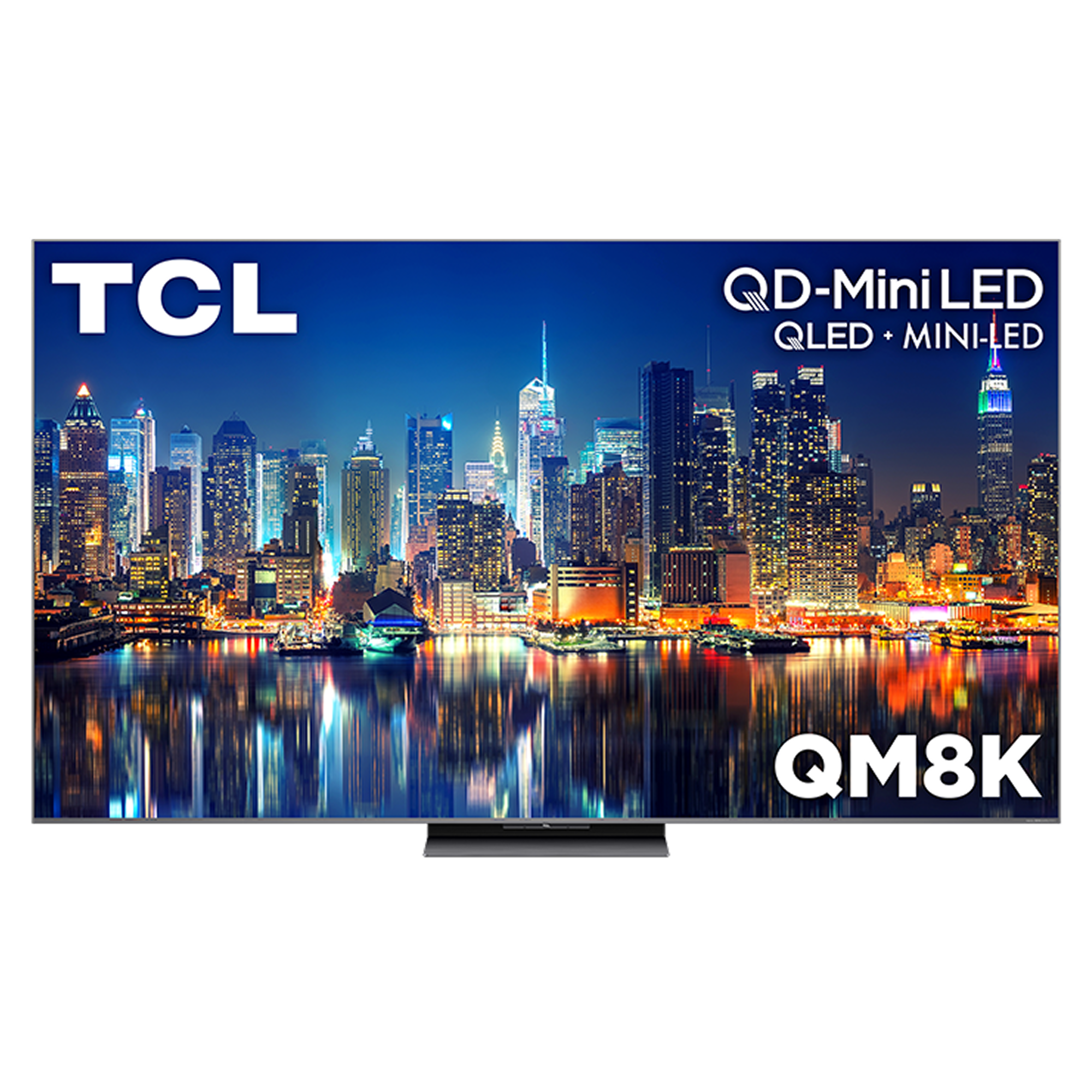
TCL 85-Inch Class QM8K Series QD-Mini LED 4K UHD Smart Google TV 85QM8K 2025 Model
TCL
Buy — Its native 144Hz panel supports the PS5’s 4K 120Hz, VRR and ALLM modes, while independent testing found better HDR processing and faster 120Hz response than the U8QG.
This is the subject TV and the top pick for a bright mixed-use room because it balances very high output, competent stream processing and full PS5 support. Its glossy screen still shows a window or lamp positioned directly opposite it.Available at Amazon(paid link) — opens Amazon in a new tab. Price and availability shown there.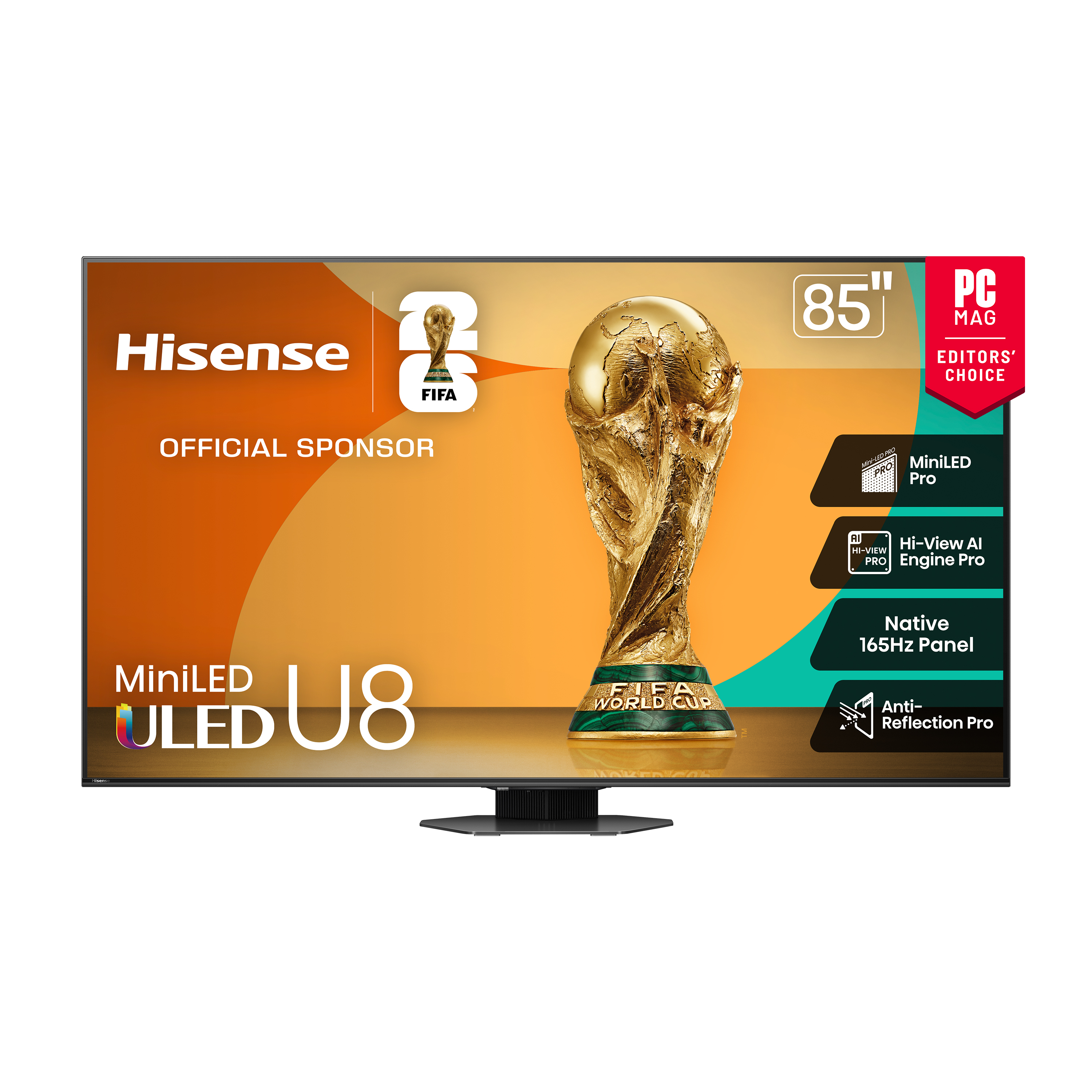
Hisense 85-Inch Class U8 Series Mini-LED ULED 4K UHD Google Smart TV 85U8QG 2025 Model
Hisense
It depends — TechRadar measured 3,337-nit peak and 733-nit full-screen HDR output in Filmmaker Mode, but RTINGS found inaccurate HDR brightness tracking and slower motion transitions.
This direct rival is worth considering when maximum brightness or three HDMI 2.1 inputs is the priority. It is less suitable for faithful HDR streaming or crisp fast motion because it over-brightens HDR and leaves visible blur trails.Available at Amazon(paid link) — opens Amazon in a new tab. Price and availability shown there.
Sony 85 Inch Mini LED QLED 4K Ultra HD TV BRAVIA 7 K-85XR70 2024 Model
Sony
It depends — RTINGS found fantastic upscaling and minimal sports-motion artifacts, but documented inadequate direct-reflection handling and image degradation from side seats.
This alternative is for sports-first viewers who need excellent upscaling and cleanup of compressed feeds. Its narrow viewing angle and inadequate handling of direct reflections make it a weaker match for wide, window-filled rooms.Available at Amazon(paid link) — opens Amazon in a new tab. Price and availability shown there.
Sources
Pages consulted while researching this article. None of these are affiliate links.
- TCL QM8K TV Review — RTINGS — rtings.com
- TCL QM8K Review — TechRadar — techradar.com
- TCL 85-Inch QM8K Specifications — us.tcl.com
- Hisense U8QG TV Review — RTINGS — rtings.com
- Hisense U8QG Review — TechRadar — techradar.com
- Hisense 85-Inch U8QG Specifications — hisense-usa.com
- Sony BRAVIA 7 TV Review — RTINGS — rtings.com