Sony Bravia 8 at 8 Feet: 55 or 65 Inches?
The question
OP regrets buying a 43 inch Bravia 3, watches mostly at night from 8 feet, may move the TV to a bedroom later, and wants a better choice under around 1000 with some flexibility. They need a clear exchange path and size recommendation.
At eight feet, choose the 55-inch Sony Bravia 8 for nighttime viewing; keep a 43-inch Bravia 3 only for a closer secondary room.
The 55-inch Sony Bravia 8 is the sensible upgrade at an eight-foot viewing distance, especially when most viewing happens at night. It gives you about 65% more screen area than a 43-inch set and replaces the Bravia 3’s frame-dimmed LCD with an OLED panel capable of displaying black without illuminating neighboring pixels.
Skip the Sony 43-inch Bravia 3 K-43S30 for an eight-foot, mostly nighttime main seat: its roughly 22-degree horizontal viewing angle is small, while independent testing found that its lack of local dimming leaves dark scenes looking gray. Keep an existing one for a closer bedroom or secondary room rather than buying it for this use.
| Model | Verdict | What decides it | Catch |
|---|---|---|---|
| Sony Bravia 8 K-55XR80 | Buy | 54.6-inch OLED; about 28° at eight feet | Large bright HDR scenes dim under ABL |
| Sony Bravia 8 K-65XR80 | Consider | 64.5-inch OLED; about 33° at eight feet | 56.88-inch cabinet width reduces room flexibility |
| Sony Bravia 3 K-43S30 | Skip | 42.5-inch direct-LED LCD; about 22° at eight feet | 60Hz, frame dimming and no VRR |
Why 55 inches works from eight feet
Measure viewing distance from your eyes to the screen, not from the sofa’s back to the wall. Eight feet is 96 inches. Using the approximate visible widths of a 16:9 screen, a 43-inch TV occupies about 22 degrees of horizontal vision at that distance, a 55-inch occupies about 28 degrees, and a 65-inch occupies about 33 degrees.
RTINGS recommends approximately a 30-degree field of view for mixed TV use and calculates the corresponding screen size by dividing viewing distance in inches by 1.6. At 96 inches, that produces a nominal 60-inch target—almost exactly between the common 55- and 65-inch sizes. A 55-inch screen is therefore a slightly conservative choice, not an undersized one; 65 inches is the more cinematic choice. RTINGS explains the field-of-view method and lists approximate screen dimensions.
The size increase from the two specific Sony models is larger than the diagonal numbers suggest. Sony lists the Bravia 3 K-43S30 at an actual 42.5-inch diagonal and the Bravia 8 K-55XR80 at 54.6 inches. Because screen area grows with the square of the diagonal, the calculation (54.6 ÷ 42.5)² shows that the 55-inch picture is approximately 65% larger. Sony’s K-43S30 specifications confirm the 42.5-inch panel, while Sony lists 54.6 inches for the 55-inch Bravia 8.
That increase is enough to make subtitles, faces and interface text substantially easier to see at eight feet without making ordinary television feel overwhelmingly large.
Night viewing is where the Bravia 8 earns the upgrade
Size alone does not explain why the 55-inch Bravia 8 is the better nighttime television. The K-43S30 is a direct-LED LCD with frame dimming and a native 60Hz refresh rate, according to Sony. Frame dimming changes the backlight across the frame; it cannot switch off individual areas behind stars, letterbox bars or a bright object surrounded by darkness.
RTINGS measured the Bravia 3’s behavior and found that it has no local-dimming system. Its testers reported raised, cloudy-looking blacks, a limitation that becomes particularly visible with the room lights off. The set did perform well when upscaling lower-resolution material and produced accurate SDR color, so the Bravia 3 is not useless—it is simply poorly matched to dark-room films and shows. The independent Bravia 3 test details its black-level, motion and processing results.
The Bravia 8’s OLED pixels emit their own light and can turn off independently. RTINGS found effectively black dark areas without blooming around bright highlights, which directly addresses the Bravia 3’s nighttime weakness. The lab also found strong upscaling and cleanup of compressed video, useful for streams and television broadcasts rather than only pristine 4K discs. RTINGS tested the Sony Bravia 8’s contrast, processing and motion performance.
There is an important measurement caveat: RTINGS bought and tested the 65-inch K-65XR80, not the 55-inch unit. Its sample reached 657 cd/m² in the Hallway Lights HDR scene with Brightness Preferred tone mapping, but large bright images became substantially dimmer under the OLED automatic brightness limiter. Those results demonstrate measured series behavior; they should not be presented as a guaranteed measurement of every 55-inch panel.
Just want the recommendation?
Skip to the picksFor mostly nighttime viewing, the limitation is manageable because deep blacks and controlled highlights matter more than fighting sunlight. Direct lamps or windows opposite the screen are a less favorable setup: RTINGS found the Bravia 8’s glossy screen only adequate at suppressing direct reflections.
The 65-inch case, and where it stops making sense
Choose the 65-inch Bravia 8 when the television will remain at roughly eight feet and movies are the priority. Its calculated 33-degree viewing angle is closer to a theatrical presentation, while still being near the mixed-use target rather than excessively large.
The 65-inch model gets the portability decision wrong for readers who expect one television to move between a living room and a smaller bedroom. Sony lists the K-65XR80 at 56.88 inches wide and 49.2 pounds without its stand. The 55-inch model is 48.25 inches wide and 37.7 pounds without its stand. That difference affects wall clearance, furniture placement and the practicality of moving the panel—not just perceived picture size. Sony publishes the 65-inch K-65XR80 dimensions and weight.
At eight feet, 55 inches is the safer all-purpose answer. Choose 65 only when the current room is the lasting destination and a more immersive image is worth the larger physical footprint.
A future bedroom is a distance question
“Bedroom TV” is not a useful size category by itself. A bed six to eight feet from the screen can accommodate a 55-inch 4K television; at six feet, that screen occupies roughly 37 degrees of horizontal vision. At five feet it approaches 44 degrees, which can feel aggressive for casual viewing and subtitles.
The 55-inch K-55XR80 physically measures 48.25 inches wide. With its tabletop stand in the standard position, the feet span 42.38 inches; Sony also provides a 23-inch narrow position. The complete television still remains 48.25 inches wide, so narrow feet do not make an undersized or unstable cabinet automatically safe. Its tabletop depth is 9.88 inches, and its wall-mount pattern is VESA 300 × 300 mm.
A practical rule follows:
- If the future seat will remain at least six feet away and the room has 48.25 inches of clear width, the 55-inch Bravia 8 remains flexible.
- If the future seat will be around five feet away, retain an existing 43-inch set for that room and use the 55-inch OLED in the main room.
- If the move is only a possibility, do not compromise the television used every night now. Room labels change; measured distance and available width do not.
What the Bravia 8 does not fix
The K-55XR80 has four HDMI inputs, but only HDMI 3 and HDMI 4 provide the high-bandwidth connection needed for 4K at 120Hz. HDMI 3 is also the eARC port, so connecting an eARC soundbar leaves one high-bandwidth port for a console or gaming PC. This is a real limitation for a setup with two current consoles and an eARC audio system, although it makes little difference to streaming and movie viewing. Sony specifies a native 120Hz OLED panel with 4K120, VRR and ALLM support; RTINGS independently confirmed 4K120 operation on those two inputs.
OLED ownership also requires sensible treatment of persistent graphics. Sony warns that repeated or prolonged static images—including news tickers, channel logos, game interfaces and menus—can cause image retention. The television includes automatic panel refresh, pixel shift, screen-saving and brightness-protection functions, but those reduce risk rather than changing the underlying OLED characteristic. Sony documents the retention risks and protective functions. Varied films, series and streaming at night are a strong match; continuously displaying the same bright ticker is not.
Check the model number before buying
“Bravia 8” and “Bravia 8 II” are different televisions. The recommendation here is the 2024 Sony Bravia 8 K-55XR80, sometimes shown with a regional suffix such as K-55XR80C. The newer Bravia 8 II uses model number K-55XR80M2 and a different panel design. Sony’s own specifications identify the M2 as a separate 2025 model. If both names appear in search results, compare the model number rather than assuming “II” is merely a revised listing. The distinctions are covered in the site’s Bravia 8, Bravia 8 II and XR8B comparison.
For an eight-foot seat, mostly dark-room viewing and a possible later move, the K-55XR80 hits the useful middle: large enough to correct the 43-inch size regret, materially better in dark scenes, and easier to place again than the 65-inch model.
The bottom line
Two of these work — the difference is which situation you are in:
Top pick
Buy this
Sony 55 Inch BRAVIA 8 OLED 4K Ultra HD Smart Google TV K-55XR80
Sony
Its 54.6-inch OLED screen occupies roughly 28 degrees at eight feet and provides pixel-level black control that the frame-dimmed Bravia 3 lacks.
This is the balanced size for an eight-foot main seat and a possible later move to a room with a six-foot-or-longer viewing distance. Its OLED picture suits nighttime viewing, but large bright scenes trigger automatic brightness limiting and only two HDMI inputs support 4K120.Available at Amazon(paid link) — opens Amazon in a new tab. Price and availability shown there.The alternative
It depends
Sony 65 Inch BRAVIA 8 OLED 4K Ultra HD Smart Google TV K-65XR80
Sony
Its roughly 33-degree view at eight feet is more cinematic, but the 56.88-inch chassis is significantly harder to accommodate in a future bedroom.
Choose this size for a fixed eight-foot movie setup where greater immersion matters more than later placement. The drawback is its 56.88-inch width and 49.2-pound panel weight before adding the stand.Available at Amazon(paid link) — opens Amazon in a new tab. Price and availability shown there.
Recommended products
Ordered by how well each one fits the situations above. Each link below is a paid link.
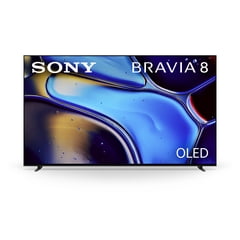
Sony 55 Inch BRAVIA 8 OLED 4K Ultra HD Smart Google TV K-55XR80
Sony
Buy — Its 54.6-inch OLED screen occupies roughly 28 degrees at eight feet and provides pixel-level black control that the frame-dimmed Bravia 3 lacks.
This is the balanced size for an eight-foot main seat and a possible later move to a room with a six-foot-or-longer viewing distance. Its OLED picture suits nighttime viewing, but large bright scenes trigger automatic brightness limiting and only two HDMI inputs support 4K120.Available at Amazon(paid link) — opens Amazon in a new tab. Price and availability shown there.Sony 65 Inch BRAVIA 8 OLED 4K Ultra HD Smart Google TV K-65XR80
Sony
Consider — Its roughly 33-degree view at eight feet is more cinematic, but the 56.88-inch chassis is significantly harder to accommodate in a future bedroom.
Choose this size for a fixed eight-foot movie setup where greater immersion matters more than later placement. The drawback is its 56.88-inch width and 49.2-pound panel weight before adding the stand.Available at Amazon(paid link) — opens Amazon in a new tab. Price and availability shown there.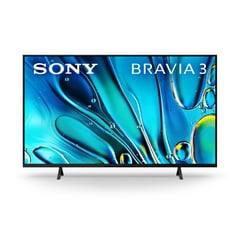
Sony 43 Inch BRAVIA 3 LED 4K HDR Google TV K-43S30
Sony
Skip — The 42.5-inch, 60Hz direct-LED panel occupies only about 22 degrees at eight feet and uses frame dimming rather than local or pixel-level light control.
An already-owned unit can serve well in a closer secondary room, particularly for ordinary SDR programs. Do not buy it for an eight-foot nighttime main seat because its small viewing angle and weak dark-scene performance recreate the problem this upgrade is meant to solve.Available at Amazon(paid link) — opens Amazon in a new tab. Price and availability shown there.

Sources
Pages consulted while researching this article. None of these are affiliate links.
- Sony K-55XR80C / Bravia 8 Specifications — sony.com
- Sony K-43S30 / Bravia 3 Specifications — sony.com
- Sony K-65XR80C / Bravia 8 Specifications — sony.com
- RTINGS Sony Bravia 8 OLED Review — rtings.com
- RTINGS Sony Bravia 3 Review — rtings.com
- RTINGS TV Size to Distance Calculator and Viewing Guidance — rtings.com
- Sony: Image Retention on OLED TVs — sony.com
- Sony K-55XR80M2 / Bravia 8 II Specifications — sony.com