Sony A95L vs A80J: Better Picture, Worth Upgrading?
The question
sony a95l vs a80j
The A95L wins for HDR brightness and color, but a healthy A80J remains worth keeping for evening viewing and 4K/120Hz gaming.
The Sony A95L is the better choice for HDR movies, with brighter highlights and stronger color performance; a healthy A80J remains worth keeping if you mainly watch ordinary television or films in a dim room. The A80J falls short for buyers seeking the most impactful HDR picture or Dolby Vision gaming at 120Hz, but replacing it does not unlock more 4K/120Hz inputs.
| Deciding feature | Sony A95L | Sony A80J |
|---|---|---|
| Model year and panel | 2023 QD-OLED | 2021 OLED |
| Maximum 4K input refresh rate | 120Hz | 120Hz |
| Inputs supporting 4K/120Hz | HDMI 3 and 4 | HDMI 3 and 4 |
| HDR formats | HDR10, HLG, Dolby Vision | HDR10, HLG, Dolby Vision |
| Standard stand width, 65-inch model | 1,442mm | 1,034mm |
Specifications come from Sony’s XR-65A95L specification sheet, XR-65A80J specification sheet, and HDMI terminal compatibility guide. The stand measurements apply specifically to those 65-inch models.
Buying either TV: the A95L wins for HDR
Choose the A95L when bright HDR highlights and rich colors are the reason you are buying an OLED. Tom’s Guide measured 1,215 nits on a 10% HDR window, alongside 99.95% UHDA-P3 coverage and 89.41% Rec.2020 coverage. Those measurements support its appeal for demanding HDR material, rather than merely repeating Sony’s panel branding. Tom’s Guide A95L review
For context, RTINGS measured the A80J at 733 nits on a 10% HDR window with Brightness Preferred enabled. That is a specific setting-dependent result, not a universal brightness ceiling. The two laboratories used different procedures, so these figures should not become a claim that the A95L is a precise percentage brighter in every scene. RTINGS A80J measurements
A 10% window also represents a small bright area, not an entirely bright screen. Treat it as evidence about highlight capability. It does not promise that a football pitch, snowy landscape, or daytime television broadcast will become proportionally brighter.
Sony’s own A95L launch comparison names the A95K as the predecessor behind its brightness claim. Applying that marketing comparison directly to the A80J would compare the wrong televisions. Sony A95L announcement
Already own an A80J? Upgrade for a visible limitation
Keep the A80J if you are happy with its brightness and mostly watch in the evening. RTINGS found excellent dark-room contrast and strong upscaling on the A80J. Its existing picture quality makes replacement harder to justify for ordinary broadcasts than for HDR showcases. RTINGS A80J review
A useful decision is to name the problem before buying: are highlights too subdued, does the screen feel too small, or do you need a particular gaming format? The A95L addresses the first problem. A same-size replacement cannot address the second, and the third needs the connection checks below.
Keep screen size separate from panel quality. Moving from a 77-inch A80J to a 65-inch A95L means a smaller image, even though the newer panel has advantages. Do not assume a stronger HDR picture will compensate for losing immersion at your existing seating distance.
Bright-room buyers need another qualification. RTINGS reports that ambient light raises the A95L’s black levels and that strong natural sunlight still challenges its SDR brightness. Its HDR advantage does not make room lighting irrelevant. RTINGS A95L review
Just want the recommendation?
Skip to the picksFor a sunlit room where brightness dominates the decision, the related LG G5 versus Sony Bravia 9 comparison explores an OLED-versus-Mini-LED choice.
Gaming gains come with the same port bottleneck
The A80J already supports 4K/120Hz, VRR and ALLM; Sony’s specification sheet lists VRR on HDMI 3 and 4. An A95L upgrade is unnecessary merely to obtain those features. Sony A80J specifications
Dolby Vision gaming is a meaningful difference. The A80J requires choosing between Dolby Vision at 4K/60Hz and 4K/120Hz without Dolby Vision. The A95L supports Dolby Vision gaming at 4K/120Hz, making it the stronger option for a compatible Xbox setup. RTINGS A80J compatibility testing, RTINGS A95L compatibility testing
However, the A95L still reserves 4K/120Hz for HDMI 3 and 4. Its eARC connection uses HDMI 3. Connect an eARC soundbar without suitable video passthrough and only HDMI 4 remains for a direct 4K/120Hz source. Two consoles plus that soundbar therefore still require connection planning. Sony HDMI compatibility guide, RTINGS A95L connection settings
On the A95L, the relevant input setting is Enhanced Format (4K120) on HDMI 3 or 4. Use an Ultra High Speed HDMI cable for the high-bandwidth signal, and check any receiver in the connection path for the exact video formats you intend to pass. Buying the television alone cannot expand an intervening receiver’s capabilities.
There is also a current software caveat. In its September 9, 2026 update, RTINGS reproduced approximately 250ms of audio delay on an A95L running Android 14 in its LPCM-over-ARC investigation after extended gameplay and signal changes. It separately reproduced intermittent eARC startup failure on firmware v114.602.080.1. Reported Dolby Vision blackouts were not reproduced. Buyers relying on external audio should confirm the status of these faults with Sony; the cited testing does not establish a fixed firmware release. RTINGS A95L firmware findings
The 65-inch upgrade may not fit your cabinet
The easily missed difference is underneath the screen. Sony specifies a standard stand width of 1,034mm for the XR-65A80J, compared with 1,442mm for the XR-65A95L. That is 408mm more width, calculated from Sony’s figures, despite both televisions being 65-inch models. The A80J also offers a 692mm narrow stand position. Sony A80J dimensions, Sony A95L dimensions
Do not transfer advice about the 77-inch A95L’s narrow stand to the smaller models. Sony’s announcement footnote specifies a three-position stand for the 77-inch version, while the 55-inch and 65-inch versions have two positions. Sony’s stand-size qualification
That gives the A80J a legitimate narrower buying case: evening viewing on existing furniture that accommodates its feet but cannot support the A95L’s wider arrangement. Measure the usable supporting surface and depth before ordering; matching screen diagonals is insufficient.
If considering a previously owned A80J, inspect the actual panel for persistent marks and unevenness, and establish return rights. Model-level reviews cannot establish the condition of an individual television. Choose the A95L for the stronger HDR picture; keep or consider the A80J when its existing strengths satisfy the job and the upgrade solves no clear limitation.
The bottom line
Both are defensible — the split is what you do with it:
Top pick
Buy this
Sony BRAVIA XR A95L 65 inch QD-OLED 4K TV XR65A95L
Tom’s Guide measured 1,215 nits on a 10% HDR window and 99.95% UHDA-P3 coverage, supporting its selection for HDR-focused viewing.
Choose it for stronger HDR highlights and color performance. Its wide feet, two 4K/120Hz inputs and documented Android 14 audio issues require attention before replacing an A80J.Available at Amazon(paid link) — opens Amazon in a new tab. Price and availability shown there.The alternative
It depends
Sony BRAVIA XR A80J 65 inch OLED 4K TV XR65A80J
The XR-65A80J offers a 692mm narrow stand position and 4K/120Hz input, but cannot combine 4K/120Hz with Dolby Vision.
Consider it for evening viewing where its narrower stand fits existing furniture, or keep a healthy one already installed. HDR highlights are less forceful, and Dolby Vision gaming stops at 60Hz.Available at Amazon(paid link) — opens Amazon in a new tab. Price and availability shown there.
Recommended products
Ordered by how well each one fits the situations above. Each link below is a paid link.
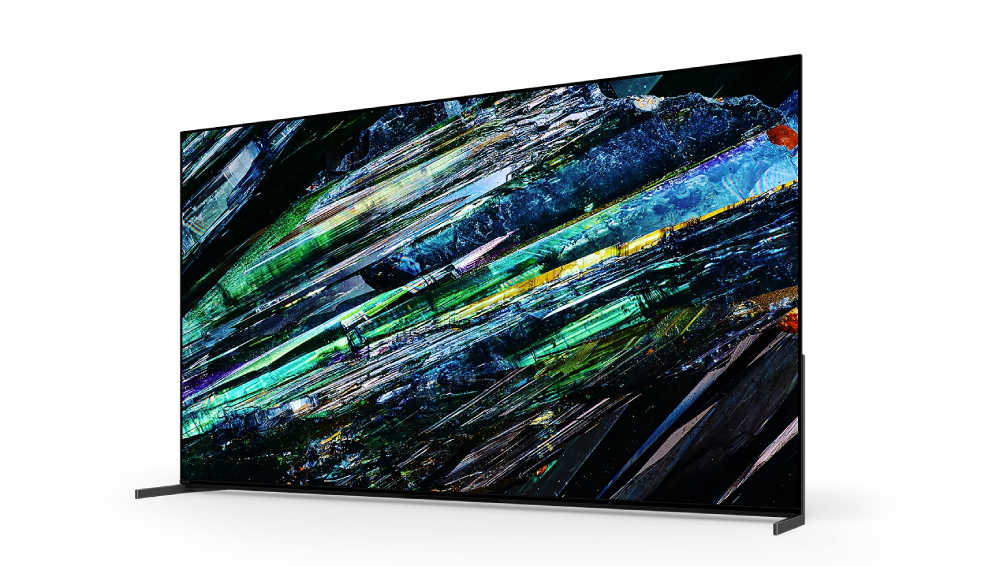
Sony BRAVIA XR A95L 65 inch QD-OLED 4K TV XR65A95L
Buy — Tom’s Guide measured 1,215 nits on a 10% HDR window and 99.95% UHDA-P3 coverage, supporting its selection for HDR-focused viewing.
Choose it for stronger HDR highlights and color performance. Its wide feet, two 4K/120Hz inputs and documented Android 14 audio issues require attention before replacing an A80J.Available at Amazon(paid link) — opens Amazon in a new tab. Price and availability shown there.Sony BRAVIA XR A80J 65 inch OLED 4K TV XR65A80J
Consider — The XR-65A80J offers a 692mm narrow stand position and 4K/120Hz input, but cannot combine 4K/120Hz with Dolby Vision.
Consider it for evening viewing where its narrower stand fits existing furniture, or keep a healthy one already installed. HDR highlights are less forceful, and Dolby Vision gaming stops at 60Hz.Available at Amazon(paid link) — opens Amazon in a new tab. Price and availability shown there.
Sources
Pages consulted while researching this article. None of these are affiliate links.
- Sony XR-65A95L specifications — sony.com
- Sony XR-65A80J specifications — sony.ca
- Sony HDMI terminal compatibility by model year — sony.com.au
- Tom’s Guide Sony Bravia XR A95L review and measurements — tomsguide.com
- RTINGS Sony A80J OLED review — rtings.com
- RTINGS Sony A95L OLED review and firmware findings — rtings.com
- RTINGS Sony A95L input and calibration settings — rtings.com
- Sony A95L announcement and stand configuration footnotes — sony.co.uk