Phi-3 Mini on a Low-End Laptop: Use Q4
The question
Phi-3 Mini — User wants a local model that is lightweight, runnable with llama_cpp on low-end laptop hardware, and more capable than past attempts.
Phi-3 Mini’s 2.2GB Q4_K_M GGUF works with llama.cpp on an 8GB laptop; cap context at 2K, expect modest CPU speed, and skip FP16.
Yes—Phi-3 Mini is a sensible step up when you want better reasoning than the tiniest local models without overwhelming a low-end laptop. Use Microsoft’s official Phi-3 Mini 4K Instruct Q4_K_M GGUF, begin with a 2,048-token context, and run it on the CPU if the laptop has no useful discrete GPU.
Skip the Phi-3 Mini FP16 GGUF on low-end hardware: Microsoft lists it at 7.2GB, versus 2.2GB for the recommended Q4_K_M file, before either version allocates its runtime cache. The larger file consumes roughly 5GB more storage and memory without changing the model’s 3.8-billion-parameter architecture. Microsoft’s official GGUF model card identifies Q4_K_M as the balanced, recommended build.
The exact model file to choose
The useful name is Phi-3-mini-4k-instruct-q4.gguf. Do not download the ordinary Transformers repository and expect llama.cpp to load its .safetensors files directly; use the GGUF repository.
The “4K” version can accept up to 4,096 tokens, but that does not mean a low-memory machine should allocate the maximum immediately. Microsoft’s underlying configuration contains a 4,096-token maximum position count and a 2,047-token sliding-attention window. That buried 2,047 figure makes a 2,048-token starting context a particularly defensible setting for modest hardware. Microsoft’s Phi-3 Mini configuration also documents 32 layers, 32 attention heads and a hidden size of 3,072.
Avoid the 128K variant for this use case. Although it has the same parameter count, long context requires a much larger key-value cache. A laptop chosen because it barely accommodates a 2.2GB quantized model is the wrong place to reserve tens of thousands of tokens.
What low-end laptop hardware actually means
For an ordinary Windows or Linux laptop, 8GB of installed RAM is the practical floor and 16GB is the comfortable target. Those are planning recommendations, not promises that the process will occupy exactly that amount: memory use changes with context length, runtime version, operating-system load and GPU offloading.
| Installed memory | Starting context | Practical expectation | Decision |
|---|---|---|---|
| 4GB | 1,024 tokens | A controlled console-only run may load, but a desktop OS can begin swapping | Test only; do not upgrade around this target |
| 8GB | 2,048 tokens | Q4_K_M is viable if browsers and heavy applications are closed | Suitable minimum |
| 16GB | 2,048–4,096 tokens | More room for the OS, documents and longer chats | Comfortable configuration |
A research team at Kennesaw State University did run Q4_K_M models through llama.cpp on a 4GB Raspberry Pi 5, so 4GB is not an absolute technical impossibility. It is still a poor general-laptop target because a graphical desktop and normal background applications need part of the same memory. The researchers measured Phi-3 Mini at 3.88 tokens per second on HellaSwag and 3.72 on WinoGrande on that Pi. Treat those figures as evidence that CPU-only execution works—not as a speed prediction for a different processor. The independent edge-device study documents the hardware, Q4_K_M preparation and measurements.
More RAM prevents swapping and failed allocations; it does not turn a slow CPU into a fast one. A machine that already has 8GB and keeps the model resident should be tested before any component is ordered.
A llama.cpp command that starts conservatively
Recent llama.cpp builds can fetch a model from Hugging Face with -hf. Its current CLI documentation says that an omitted quant defaults to Q4_K_M when that quant exists, while --device none disables accelerator offloading. It also documents the --ctx-size, --threads, --n-predict and built-in phi3 chat-template options. The official llama.cpp CLI reference is the source for these flags.
Start a typical quad-core, CPU-only laptop with:
llama-cli \
  -hf microsoft/Phi-3-mini-4k-instruct-gguf \
  --ctx-size 2048 \
  --threads 4 \
  --device none \
  --chat-template phi3 \
  --n-predict 256
Use the number of physical CPU cores as the initial thread count; four is a conservative starting value, not a universal optimum. If the laptop becomes unresponsive, try two threads. If it remains responsive and has more physical cores, benchmark higher counts rather than assuming every logical thread improves generation.
Just want the recommendation?
Skip to the picksFor llama-cpp-python, use the same policy: point model_path at the Q4 GGUF, set n_ctx=2048, choose a restrained n_threads, and set n_gpu_layers=0 for a deliberate CPU-only run. Microsoft publishes a corresponding Python example and warns that longer sequences require substantially more resources on the official GGUF model page.
The first -hf launch needs internet access to retrieve the model. Once it is cached, add --offline to prevent network access. Obtain the file from Microsoft’s repository instead of an anonymous re-upload, and do not expose llama-server on a public network without authentication and firewall rules. Local inference protects prompts from a cloud provider only while the local endpoint itself remains private.
Where Phi-3 Mini earns the extra load
Phi-3 Mini is not the fastest small model. It is the choice when the smallest models have proved too limited and you are willing to trade speed for stronger answers.
The Kennesaw State study quantized each candidate to Q4_K_M with llama.cpp and tested it on identical edge hardware. Its Raspberry Pi 5 results illustrate the trade clearly:
| Q4_K_M model | Parameter count | Measured MMLU / HellaSwag speed | Verdict for this question |
|---|---|---|---|
| Phi-3 Mini | 3.8B | 62.3% / 3.88 tokens/s | Choose for the stronger reasoning result |
| Llama 3.2 1B | 1.24B | 39.4% / 12.21 tokens/s | Consider when responsiveness matters more |
| TinyLlama | 1.1B | 19.0% / 14.99 tokens/s | Skip when inadequate capability caused the search |
Skip TinyLlama if the goal is explicitly to move beyond weak prior attempts: in this independent test it generated much faster, but its MMLU result was 43.3 percentage points below Phi-3 Mini. Llama 3.2 1B gets the compromise wrong for the same capability-first reader, although it is the better fit when heat, battery drain or waiting time matters more than benchmark accuracy.
These are multiple-choice benchmark results, not proof that Phi-3 Mini will answer every chat prompt correctly. Microsoft’s own technical report measured the original model at 69% MMLU and 8.38 on MT-Bench, but those manufacturer-reported results used a different evaluation setup and should not be substituted for the independent Q4_K_M edge measurements. The Phi-3 technical report supplies the original figures.
Phi-3 Mini is strongest as a compact English assistant for summarization, structured extraction, short coding questions and reasoning over material supplied in the prompt. It remains capable of hallucinating facts, and Microsoft says the model was trained primarily on English. Do not rely on it without verification for medical, legal, financial or safety-critical decisions.
When a 16GB RAM module is worth considering
A RAM upgrade is useful only when the laptop has replaceable DDR4 SODIMMs, supports at least 16GB and currently runs short of memory. Check the service manual, the installed memory type, the maximum supported capacity and whether any memory is soldered before opening the chassis.
The Kingston ValueRAM KVR32S22D8/16 is one concrete option for compatible DDR4 laptops. Kingston specifies it as a 16GB, DDR4-3200, CL22, dual-rank, 260-pin SODIMM operating at 1.2V in its module datasheet. It is not interchangeable with DDR3 or DDR5, and it cannot help a laptop whose memory is entirely soldered.
Do not buy RAM merely to chase a higher token rate. Capacity helps when the operating system is swapping, the model fails to allocate memory, or you need other applications open beside it. Generation speed is principally constrained by the processor, memory bandwidth and sustained thermals. Readers considering substantially larger models should also check where 18GB runs out for local LLMs before treating 16GB as a universal target.
The limits worth accepting
Phi-3 Mini Q4_K_M is lightweight relative to 7B and 8B models, not lightweight in the same sense as a one-billion-parameter model. On genuinely weak CPUs, several tokens per second may be normal. Reducing --ctx-size lowers memory pressure but does not shrink the 2.2GB model weights, while reducing --n-predict only limits response length.
If Q4_K_M swaps heavily even at a 1,024-token context with other applications closed, the honest options are more system RAM or a smaller model. If it stays resident but generates too slowly, adding capacity will not fix the processor bottleneck. In that case, Llama 3.2 1B is the narrower, speed-first alternative; Phi-3 Mini remains the better answer when the whole point is getting noticeably more capability from hardware that can tolerate the wait.
The bottom line
Confirmed to fit:
Top pick
It depends
Kingston ValueRAM 16GB DDR4 3200MT/s CL22 SODIMM KVR32S22D8/16
Kingston ValueRAM
Kingston specifies this exact part as a 16GB DDR4-3200 CL22 dual-rank 260-pin SODIMM, so it is useful only in laptops that explicitly support that memory type and capacity.
Consider this only when an upgradeable DDR4 laptop is short of memory while running Phi-3 Mini. It is incompatible with DDR3, DDR5 and soldered-memory systems, and extra capacity will not fix a slow CPU.Available at Amazon(paid link) — opens Amazon in a new tab. Price and availability shown there.
Recommended products
Ordered by how well each one fits the situations above. Each link below is a paid link.
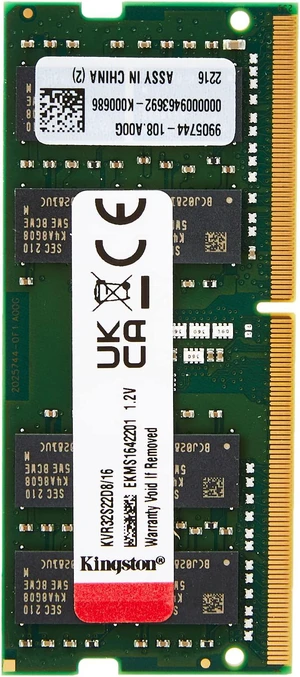
Kingston ValueRAM 16GB DDR4 3200MT/s CL22 SODIMM KVR32S22D8/16
Kingston ValueRAM
Consider — Kingston specifies this exact part as a 16GB DDR4-3200 CL22 dual-rank 260-pin SODIMM, so it is useful only in laptops that explicitly support that memory type and capacity.
Consider this only when an upgradeable DDR4 laptop is short of memory while running Phi-3 Mini. It is incompatible with DDR3, DDR5 and soldered-memory systems, and extra capacity will not fix a slow CPU.Available at Amazon(paid link) — opens Amazon in a new tab. Price and availability shown there.
Sources
Pages consulted while researching this article. None of these are affiliate links.
- Microsoft Phi-3 Mini 4K Instruct GGUF Model Card — huggingface.co
- Microsoft Phi-3 Mini 4K Instruct Configuration — huggingface.co
- llama.cpp CLI Documentation — github.com
- Characterizing and Understanding Energy Footprint and Efficiency of Small Language Models on Edges — arxiv.org
- Phi-3 Technical Report: A Highly Capable Language Model Locally on Your Phone — arxiv.org
- Kingston KVR32S22D8/16 Memory Module Specifications — kingston.com