MOZA CRP2 vs Fanatec V3: The Clearer Buy
The question this answersWhere do these come from?
Should I buy the MOZA CRP2 or the Fanatec ClubSport Pedals V3?
For a new PC rig, the CRP2 is the better pedal; choose the V3 for PlayStation, a Fanatec console setup, or an included clutch.
Choose the MOZA CRP2 for a new PC-based rig: it has the more configurable brake, adjustable pedal spacing, and a cleaner future upgrade path. Choose the Fanatec ClubSport Pedals V3 when PlayStation compatibility, an existing Fanatec console setup, built-in vibration motors, or an included clutch matters more.
This is not a case where the CRP2’s 200 kg sensor automatically makes it twice as good as the V3’s 90 kg unit. Those are load-cell capacities, not the force your foot must produce or a direct measurement of braking accuracy.
The differences that decide the comparison
| Attribute | MOZA CRP2 | Fanatec ClubSport V3 |
|---|---|---|
| Pedals in the standard set | Throttle and brake; clutch optional | Throttle, brake, and clutch |
| Brake sensing | 0–200 kg load cell plus angle sensor | 90 kg load cell |
| Published resolution | 15-bit brake angle sensor | 12-bit on all axes through direct USB |
| Pedal spacing | Pedal units move across the base plate | Pedal-unit positions are fixed |
| Console route | Xbox through a compatible MOZA base and wheel; no PlayStation support | PlayStation or Xbox through compatible Fanatec hardware |
MOZA specifies 15–20 degrees of brake travel, 15–23 degrees for the throttle, pedal-angle adjustment from 0–15 degrees, and up to 30 mm of pedal-face and heel-rest adjustment. The CRP2 support documentation also lists 115 standard brake-feel configurations, rising to 1,764 with the optional kit. MOZA’s CRP2 specifications provide unusually concrete adjustment ranges rather than simply calling the pedals “fully adjustable.”
Fanatec specifies a 90 kg load cell, contactless Hall sensors for the throttle and clutch, and 12-bit output with 4,096 values per axis over a direct PC USB connection. The V3 also has vibration motors on the throttle and brake, although Fanatec warns that dynamic vibration requires support from the game or third-party software. Fanatec’s V3 documentation confirms that the feature is not universal.
Why 200 kg does not mean twice the brake
A load-cell rating describes the sensor’s measurement range. The pressure applied at the pedal face is altered by pedal leverage, the elastomer stack, travel stops, calibration, and the angle at which your foot pushes. Consequently, the CRP2’s 200 kg and the V3’s 90 kg figures cannot be treated as equivalent maximum pedal forces.
The CRP2’s meaningful advantage is its dual-sensor brake, not the larger number alone. It can combine load-cell pressure with pedal-position data from its 15-bit angle sensor. The CRP2 manual gives specific starting points in MOZA Pit House:
- Road, rally and high-performance road cars: 60–80% angle-sensor bias.
- GT4, GT3 and other GT cars: 60–80% pressure-sensor bias.
- LMP and formula cars: 100% pressure bias.
That buried software capability is the strongest reason to choose the CRP2. A longer-travel road-car brake and a nearly solid formula brake do not have to share the same input behavior. The V3 lets you calibrate its range and alter the required brake force, but it does not provide the same pressure-versus-position blend.
Do not read 15-bit versus 12-bit as an eightfold real-world accuracy victory either. MOZA’s number describes its angle sensor, while Fanatec’s describes the reported axes over USB. Neither manufacturer publishes independent noise, linearity, or repeatability measurements that would turn those bit depths into a defensible lap-time comparison.
Where the CRP2 earns its win
The CRP2 offers more control over the physical setup. Its pedal units can be moved left or right across the base, while Fanatec confirms that the V3 pedal positions are fixed. Both let you reposition the pedal faces, but that is not the same as widening the gap between the brake and throttle.
Brake behavior is adjustable through damping-block combinations, spring preload, travel limits, calibration curves and the pressure/angle ratio. That range makes the CRP2 better suited to a rig shared between different drivers or simulations with very different cars. It also makes initial setup more involved: expect to try several stacks rather than finding one objectively correct configuration.
Independent use supports the CRP2 recommendation, with qualifications. Traxion mounted the pedals to a GT Omega Prime Lite, compared them with several other load-cell sets and judged the CRP2’s stiffer configuration better than the Fanatec ClubSport set. Its reviewer also reported that the stock combinations felt too soft, the pedal faces were slippery, and a hand-tightened brake limit screw came loose during driving. That makes the Traxion CRP2 test more useful than an unqualified build-quality claim.
A separate SimRacerGear test ran a one-hour simulated endurance race and reported no brake-input drift between the first and final laps. Its initial adjustment and calibration took roughly 15 minutes, while the pedal faces were again identified as slippery. Those are limited observations rather than laboratory accuracy measurements, but they provide at least one timed consistency test beyond MOZA’s brochure. Read the measured CRP2 test.
The CRP2 also connects directly to a PC over USB, so it can be paired with a Fanatec, Logitech, Thrustmaster or other wheelbase when the game accepts separate controllers. MOZA documents this mixed-brand arrangement in its CRP2 support guide.
The V3 case is about package and feedback
The ClubSport V3 remains the easier three-pedal package because the clutch is included. That matters for manual road cars, historic racing and truck simulators; adding an optional clutch changes the CRP2 from a direct two-pedal comparison into a larger three-pedal system.
Just want the recommendation?
Skip to the picksThe V3’s other distinctive feature is tactile feedback. Its brake and throttle carry individual vibration motors intended to signal wheel lock, ABS, wheelspin or oversteer. Their behavior depends on the game, platform and software integration, so they should be treated as useful feedback channels rather than guaranteed full-time ABS simulation.
Its stock brake allows tool-free stiffness and travel adjustment, but the optional Brake Performance Kit is the more important configuration for a short, firm racing brake. Fanatec specifies eight resistance-and-travel combinations, or 16 when the supplied polyurethane spring is included. Installing it requires partial pedal disassembly; afterward, the normal preload screw is used only to remove mechanical play rather than tune stiffness. Those limitations are stated in the official Brake Performance Kit guide.
Inside Sim Racing’s mechanical test found the V3 brake notably firmer with the Performance Kit and liked the optional damper on the brake. The same damper was undesirable on the throttle because it slowed the pedal’s return and made throttle blips harder. That independent V3 review predates current software, but its observations concern unchanged mechanical hardware.
Console compatibility can reverse the verdict
On PC, either set can operate as a separate USB controller. Consoles do not accept them that way.
For PlayStation 4 or PlayStation 5, the V3 is the choice between these two. It must connect to a PlayStation-compatible Fanatec wheelbase, such as the Gran Turismo DD Pro or ClubSport DD+. Fanatec places PlayStation authorization in the wheelbase, as its PlayStation compatibility guide explains. The CRP2 has no native PlayStation route.
For Xbox, stay within the ecosystem already on the rig:
- Use CRP2 pedals with a compatible MOZA wheelbase and Xbox-compatible steering wheel such as the ESX.
- Use V3 pedals through a Fanatec base fitted with an officially Xbox-licensed steering wheel. Fanatec places the Xbox compatibility chip in the wheel, not the pedals or base, according to its Xbox compatibility FAQ.
A direct USB connection, generic adapter or PC compatibility does not establish console compatibility. Changing the entire wheel ecosystem merely to obtain one of these pedal sets rarely makes sense.
An existing V3 changes the calculation
Moving from entry-level potentiometer pedals to either model is a substantial brake upgrade. Moving from a functioning V3 to the CRP2 is not automatically one.
Keep the V3 if its Brake Performance Kit already provides a repeatable pressure point and its fixed pedal spacing fits comfortably. The CRP2 will add sensor blending, more mechanical combinations and adjustable spacing, but those features do not guarantee faster laps once muscle memory is established.
Upgrade from the V3 when at least one CRP2-specific capability solves a real limitation: you need wider pedal spacing, want different pressure-versus-travel behavior for multiple car classes, prefer a two-pedal layout, or intend to add MOZA’s mBooster active pedal later. MOZA confirms CRP2 compatibility with the mBooster, though it recommends an extension plate for optimal mounting. MOZA documents that upgrade path here.
Before replacing an otherwise sound stock V3 solely because its brake feels soft, the V3 Brake Performance Kit is the more proportionate fix.
The rig matters more than the badge
Neither pedal set belongs loose under a desk. A pressure-sensitive brake works by giving your leg substantial resistance; an office chair rolls backward, a light stand lifts, and an unsecured pedal tray flexes before either load cell becomes the limiting factor.
Use a bolted cockpit, a braced wheel stand with a chair cradle, or another mounting system that prevents both pedal and seat movement. A rigid mount set to a moderate force will produce more repeatable braking than a nominally stronger load cell attached to a moving platform. For CRP2 owners struggling with an aggressive pedal angle, these CRP2 pedal-angle fixes for ankle pain address the ergonomic setup separately.
The final choice is straightforward: buy the CRP2 for a new PC rig and for deeper brake tuning; buy the V3 for a compatible Fanatec console rig, an included clutch, or built-in pedal vibration. If a well-configured V3 is already installed, keep it unless one of the CRP2’s specific adjustments fixes a limitation you can name.
The bottom line
The choice turns on one thing:
Top pick
Buy this
MOZA CRP2 Load Cell Pedals Throttle and Brake
MOZA
The CRP2 wins for a new PC rig because its pedal units have adjustable spacing and its brake blends pressure and position sensing.
The stronger choice for a new PC rig when adjustable spacing, dual-sensor brake mapping and extensive mechanical tuning matter. The clutch is separate, and the smooth pedal faces are better suited to shoes than socks.Available at Amazon(paid link) — opens Amazon in a new tab. Price and availability shown there.The alternative
It depends
Fanatec ClubSport Pedals V3
Fanatec
The V3 wins when compatible Fanatec console hardware, an included clutch or vibration motors matter, but its pedal-unit positions are fixed.
Choose this three-pedal set for a compatible Fanatec console system or when built-in brake and throttle vibration matters. Its pedal-unit spacing is fixed, and the best firm-brake configuration requires additional setup.Available at Amazon(paid link) — opens Amazon in a new tab. Price and availability shown there.
Recommended products
Ordered by how well each one fits the situations above. Each link below is a paid link.

MOZA CRP2 Load Cell Pedals Throttle and Brake
MOZA
Buy — The CRP2 wins for a new PC rig because its pedal units have adjustable spacing and its brake blends pressure and position sensing.
The stronger choice for a new PC rig when adjustable spacing, dual-sensor brake mapping and extensive mechanical tuning matter. The clutch is separate, and the smooth pedal faces are better suited to shoes than socks.Available at Amazon(paid link) — opens Amazon in a new tab. Price and availability shown there.
Fanatec ClubSport Pedals V3
Fanatec
It depends — The V3 wins when compatible Fanatec console hardware, an included clutch or vibration motors matter, but its pedal-unit positions are fixed.
Choose this three-pedal set for a compatible Fanatec console system or when built-in brake and throttle vibration matters. Its pedal-unit spacing is fixed, and the best firm-brake configuration requires additional setup.Available at Amazon(paid link) — opens Amazon in a new tab. Price and availability shown there.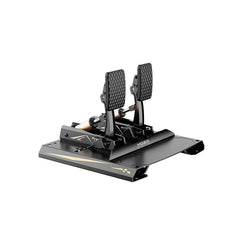
MOZA CRP2 Performance Kit
MOZA
It depends — The optional kit serves drivers wanting more brake-feel configurations, expanding the CRP2’s 115 standard options to 1,764, with setup requiring experimentation.
Useful for CRP2 drivers who want a shorter, firmer GT or formula-style brake than the stock damping blocks provide. Its many combinations require experimentation rather than offering an instant universal setting.Available at Amazon(paid link) — opens Amazon in a new tab. Price and availability shown there.
Fanatec ClubSport Pedals V3 Brake Performance Kit
Fanatec
It depends — The kit suits a short, firm V3 racing brake, but installation requires partial disassembly and afterward the preload screw only removes mechanical play.
The sensible first upgrade when an otherwise sound V3 brake feels too soft or travels too far. Installation requires partial disassembly, and the preload screw no longer adjusts stiffness afterward.Available at Amazon(paid link) — opens Amazon in a new tab. Price and availability shown there.
Sources
Pages consulted while researching this article. None of these are affiliate links.
- MOZA CRP2 Pedals Support and Specifications — support.mozaracing.com
- MOZA CRP2 Racing Pedals User Manual — image.gudsen.com
- Fanatec ClubSport Pedals V3 Specifications — fanatec.com
- Fanatec ClubSport Pedals V3 Brake Performance Kit — fanatec.com
- Traxion MOZA CRP2 Load Cell Pedals Review — traxion.gg
- SimRacerGear MOZA CRP2 Test and Review — simracergear.com
- Inside Sim Racing Fanatec ClubSport Pedals V3 Review — isrtv.com
- Fanatec PlayStation Compatibility FAQ — help.fanatec.com