Hisense U7Q vs TCL QM6K vs QM7K: What Actually Differs
The question
Hisense U7Q — The user is deciding between three similarly priced 55 inch Mini LED TVs and wants real-world ownership guidance for movies, gaming, reliability, audio, and software. They are trying to avoid buying based only on spec sheets.
The TCL QM7K measures brighter with more dimming zones than the Hisense U7Q or TCL QM6K, making it the pick unless 4K/120Hz input lag is your priority.
Among 55-inch Mini-LED sets in this price band, the TCL QM7K measures brighter and holds more local-dimming zones than both the Hisense U7Q and the TCL QM6K, which is why it’s the pick for a household splitting time between movies and gaming. The QM7K also records the fastest input lag of the three; the U7Q’s software is the thing that should give a shopper pause.
That’s the short version. The longer one matters because these three get cross-shopped constantly — Hisense’s Mini-LED lineup and TCL’s QM-series overlap almost exactly on price at 55 inches, and spec sheets alone don’t explain why owners end up happier with one than another. Here’s what independent testing and Hisense’s own documented software history actually show.
| TV | Buy / Skip | The thing that decides it | The catch |
|---|---|---|---|
| TCL QM7K | Buy | 1,000+ local-dimming zones and a measured 1,733-nit HDR peak (10% window, Filmmaker Mode) — roughly 2.5x the U7Q’s measured peak | Only 2 of 4 HDMI ports run 4K at 144Hz; the other two cap at 60Hz |
| TCL QM6K | Consider | Nearly matches the U7Q’s measured brightness for less money, with a native 144Hz panel | Slowest input lag of the three (13.1ms), and reviewers call the built-in audio weak enough to need a soundbar |
| Hisense U7Q | Skip | Lowest measured HDR brightness of the three (674 nits), and VIDAA carries documented ad-injection complaints | Its 9ms input lag at 4K/120Hz trails the QM7K’s sub-8ms result |
How the brightness and dimming-zone numbers actually compare
Spec sheets on all three claim four-figure nit counts. Measured results tell a different story. Independent testing of the Hisense U7Q recorded roughly 519–520 nits sustained in SDR and a peak of 674 nits in the brightest HDR test scene, using a 220-zone local-dimming array (a 10×22 grid) on the review unit tested — a figure that lines up closely, though not exactly, with the 240 zones RTINGS measured on the 55-inch Hisense U7N, the Google TV-badged version of effectively the same Mini-LED panel family sold in the US.
The TCL QM6K, priced closest to the U7Q, measured 695.5 nits in a 10% HDR window in Standard mode and 559.8 nits in the more accurate Filmmaker Mode, on a 500-zone dimming array (measured on the 65-inch model; TCL doesn’t publish a separate zone count for the 55-inch). That’s a small but real edge over the U7Q’s measured peak, at a similar price.
The TCL QM7K is the outlier. RTINGS measured 1,733 nits on a 10% HDR window in Filmmaker Mode (536 nits full-screen), and even higher in Standard mode — backed by over 1,000 local-dimming zones, more than four times the U7Q’s count. RTINGS also noted the QM7K hard-clips highlights in content mastered at 600–1,000 nits but rolls off gracefully near its peak with 4,000-nit content, which is the more common mastering target for recent releases. For anyone whose main use case is movies in a room with any ambient light, that brightness and zone-count gap is the deciding spec, not the one buried in the marketing copy.
Where gaming input lag and HDMI 2.1 diverge
This is a category where the U7Q performs well. Testing measured 9ms of input lag at 4K/120Hz and 17ms at 4K/60Hz — competitive with far pricier sets — on a native 144Hz panel with VRR support from 48–240Hz. The TCL QM6K trails here: Tom’s Guide measured 13.1ms of input lag, still low enough to call “great for gamers,” but clearly behind the U7Q.
The QM7K leads on responsiveness, with RTINGS recording input lag under 8ms in Game Mode — the fastest of the three — but it complicates things with its HDMI layout. Only two of its four HDMI ports run the full HDMI 2.1 spec at 4K/144Hz; the other two are capped at HDMI 2.0 and 60Hz. If a household already has a receiver or soundbar occupying one of the fast ports, a next-gen console might be left without full-bandwidth 4K/120Hz on the port that’s free. The QM7K’s 288Hz VRR ceiling also only applies at 1080p — at native 4K, all three TVs top out around 144Hz.
None of the three handle HDR calibration on consoles cleanly. The Hisense U7Q lacks HGiG support, the industry standard that lets a PS5 or Xbox tone-map HDR correctly for the specific TV rather than relying on the TV’s own auto-detection — a real gap for anyone who wants console HDR set up once and left alone rather than manually tuned. If bright-room gaming and HDR handling together are the priority rather than price, PS5 Pro in a Bright Room: Three TVs Worth Buying covers sets built specifically around that combination.
Just want the recommendation?
Skip to the picksWhat Consumer Reports actually found on reliability
Reliability is the category spec sheets never mention, and it’s also where the U7Q has the most documented history against it. Consumer Reports’ brand reliability survey rates Hisense “Fair” and predicts 20% of Hisense TVs will develop a problem within five years of ownership — a figure significant enough that Consumer Reports pulled Hisense (alongside Vizio) from its list of recommended TV brands over the pattern.
TCL sits in a comparable reliability tier in the same Consumer Reports data — grouped with Hisense, Element, and Vizio rather than with the higher-scoring brands — though Consumer Reports hasn’t published TCL’s exact five-year failure rate the way it has Hisense’s. That means neither TCL nor Hisense should be treated as a “safe” pick on reliability alone; the difference between the U7Q and the two TCL sets here isn’t reliability, it’s that Hisense’s number is the one that’s actually been published and it isn’t good.
The audio difference the spec sheet doesn’t explain
All three TVs ship with modest built-in sound by TV standards, but the gap between them is real. The Hisense U7Q runs a 2.1-channel, 20W system with a measured max output around 82dB, and it supports Dolby Atmos — but independent testing found the Dolby TrueHD version of an Atmos track didn’t pass through correctly to a connected home-theater receiver, a specific and checkable audio bug rather than a general complaint about speaker size.
The TCL QM6K uses Onkyo-tuned speakers with a built-in subwoofer, but reviewers who tested it directly described the sound as weak enough to recommend pairing it with a soundbar for anything beyond casual TV-speaker listening. The QM7K, by contrast, ships with speakers tuned by Bang & Olufsen — a genuine step up in TCL’s own lineup, and the clearer reason to prefer it if the built-in speakers are what’s actually going to get used night to night rather than a soundbar or receiver.
If the QM6K is still the pick on price, budget for a soundbar rather than relying on its built-in speakers for movies — that’s not a knock unique to TCL, but it’s a cost worth planning for that a spec sheet won’t flag.
Why VIDAA’s software history matters more than the spec sheet
Software is the category most likely to be invisible on a showroom floor and most likely to matter three months into ownership. Hisense’s smart TV platform, VIDAA (recently rebranded Home OS in some markets), has documented, ongoing complaints about non-skippable ads appearing when switching HDMI inputs, returning to the home screen, or even changing channels — reported by multiple owners well after Hisense described the behavior as a limited regional test that had ended. Testing of the U7Q’s interface separately noted it runs smoothly day to day but is missing some apps, particularly music-streaming services, compared to Google TV.
Both TCL sets run Google TV, which doesn’t carry the same documented ad-injection history and has a far larger app catalog as a result of Google’s own certification requirements. For a household that’s going to live inside the TV’s own home screen and app store rather than routing everything through an external streaming box, that’s a meaningfully different day-to-day experience than a brightness or input-lag number captures.
The pick, and when the U7Q is still worth it
For the person weighing all five factors together — movies, gaming, reliability, audio, and software — the TCL QM7K is the buy: it measures brighter, holds more dimming zones, sounds better out of the box, and runs software without a documented ad-injection history, at a price close enough to the other two that the gap is worth paying. The TCL QM6K is the fallback if the QM7K’s price is a genuine stretch; budget for a soundbar alongside it. The Hisense U7Q earns a skip in this specific three-way shootout — not because it’s a bad TV in isolation, but because its one real strength, low input lag, is bettered by the QM7K and doesn’t offset the brightness gap, the missing HGiG support, and VIDAA’s ad history. Even for a shopper for whom 4K/120Hz responsiveness is the single deciding factor and everything else is secondary, the QM7K is the fastest of the three on that measurement.
The bottom line
The choice turns on one thing:
Top pick
Buy this
TCL 55-Inch QM7K Series QD-Mini LED Google TV 55QM7K
TCL
RTINGS measured HDR peak brightness roughly 2.5x the U7Q's, backed by more than 4x the local-dimming zones.
The brightest and best-dimmed of the three, measured at over 1,000 local-dimming zones and a 1,733-nit HDR peak, with Bang & Olufsen-tuned audio.Available at Amazon(paid link) — opens Amazon in a new tab. Price and availability shown there.The alternative
It depends
TCL 55-Inch QM6K Series QD-Mini LED Google TV 55QM6K
TCL
Input lag measured at 13.1ms, the slowest of the three, and reviewers describe the built-in speakers as needing a soundbar for movies.
A cheaper entry into Mini-LED that nearly matches the U7Q’s measured brightness, but the built-in audio is weak enough that reviewers recommend a soundbar.Available at Amazon(paid link) — opens Amazon in a new tab. Price and availability shown there.
Recommended products
Ordered by how well each one fits the situations above. Each link below is a paid link.
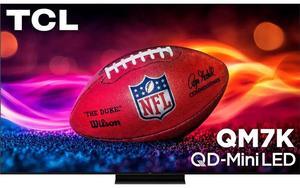
TCL 55-Inch QM7K Series QD-Mini LED Google TV 55QM7K
TCL
Buy — RTINGS measured HDR peak brightness roughly 2.5x the U7Q's, backed by more than 4x the local-dimming zones.
The brightest and best-dimmed of the three, measured at over 1,000 local-dimming zones and a 1,733-nit HDR peak, with Bang & Olufsen-tuned audio.Available at Amazon(paid link) — opens Amazon in a new tab. Price and availability shown there.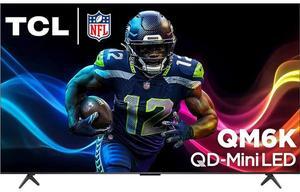
TCL 55-Inch QM6K Series QD-Mini LED Google TV 55QM6K
TCL
Consider — Input lag measured at 13.1ms, the slowest of the three, and reviewers describe the built-in speakers as needing a soundbar for movies.
A cheaper entry into Mini-LED that nearly matches the U7Q’s measured brightness, but the built-in audio is weak enough that reviewers recommend a soundbar.Available at Amazon(paid link) — opens Amazon in a new tab. Price and availability shown there.
Hisense 55-Inch U7Q Mini-LED ULED VIDAA TV
Hisense
Skip — Measured HDR peak brightness (674 nits) trails both TCL sets, and Consumer Reports predicts 20% of Hisense TVs develop a problem within five years.
Its 9ms input lag at 4K/120Hz trails the QM7K’s sub-8ms result, while it also has the lowest measured HDR brightness and a VIDAA platform with documented ad-injection complaints.Available at Amazon(paid link) — opens Amazon in a new tab. Price and availability shown there.
Sources
Pages consulted while researching this article. None of these are affiliate links.
- Hisense U7Q Review – Budget 144Hz Mini-LED TV (VIDAA) - choose.tv — choose.tv
- Hisense U7N Review (55U7N, 65U7N, 75U7N, 85U7N) - RTINGS.com — rtings.com
- TCL QM6K Review: Budget Mini-LED Brightness Tested - toptrustedproducts.com — toptrustedproducts.com
- TCL QM6K Review (55QM6K, 65QM6K, 75QM6K, 85QM6K, 98QM6K) - RTINGS.com — rtings.com
- TCL QM7K Review (55QM7K, 65QM7K, 75QM7K, 85QM7K, 98QM7K) - RTINGS.com — rtings.com
- TCL QM7K Series QD-Mini LED QLED 4K UHD Smart TV with Google TV - TCL USA — us.tcl.com
- Hisense, Vizio TVs lose CR recommendation over reliability issues - Consumer Reports — consumerreports.org
- The 5 Most Reliable TV Brands, According To Consumer Reports - SlashGear — slashgear.com