Fuji 18-55mm vs 16-80mm: The Right Travel Lens for X-E3
The question
Fujifilm 18-55mm f/2.8-4 lens — User with X-E3 body is torn between 18-55mm and 16-80mm zoom lenses for travel/hiking.
The 16-80mm's extra reach and 6-stop stabilization win for hiking, but its bulk unbalances the compact X-E3 body.
For hiking and travel, the XF 16-80mm F4 R OIS WR is the more capable lens: it reaches to a 122mm-equivalent field of view against the 18-55mm’s 84mm, and its 6.0-stop CIPA-rated stabilization roughly doubles the usable low-light shutter speeds of the 18-55mm’s 4.0-stop rating. It is also 130g heavier and physically much larger, which fights against the small, light body the X-E3 was built to be — and its weather sealing is only half the story on a body that isn’t sealed itself.
Both lenses share a mount, a similar optical formula philosophy, and a lot of overlap in the middle of their ranges. The differences that actually decide a hiking kit are reach, stabilization, weight, and how much either lens overwhelms a body as small as the X-E3.
The specs that decide it
| XF 18-55mm F2.8-4 R LM OIS | XF 16-80mm F4 R OIS WR | |
|---|---|---|
| Equivalent range | 27-84mm | 24-122mm |
| Maximum aperture | f/2.8 at 18mm, f/4 by ~35mm | Constant f/4 |
| Weight | 310g | 440g |
| Filter thread | 58mm | 72mm |
| OIS rating (CIPA) | 4.0 stops | 6.0 stops |
| Weather sealing | None | Yes, 10 sealed points, rated to -10°C |
| Max magnification | 0.08x (18mm) to 0.15x (55mm) | 0.25x across the range |
Specs from Fujifilm’s official pages for the XF 18-55mm and XF 16-80mm, cross-checked against DPReview’s listing for the 16-80mm’s CIPA rating and sealing count.
Where the 16-80mm earns the extra weight
The 122mm-equivalent long end matters more on a trail than in a city. Distant ridgelines, wildlife that won’t let you get closer, compressed shots of a trail winding below you — the 18-55mm’s 84mm-equivalent reach runs out well before those. Going from 55mm to 80mm on the barrel is a 45% increase in focal length, not a marginal bump.
The stabilization gap is the bigger real-world difference. A 6.0-stop CIPA rating against 4.0 stops means roughly two additional stops of usable handheld shutter speed — the difference between needing 1/60s and being able to shoot at 1/15s or slower at the same focal length. On a trail at dawn, in a forest canopy, or in a dim temple interior where a tripod isn’t practical, that gap decides whether a shot is sharp or not.
The 16-80mm’s 0.25x maximum magnification (against 0.08-0.15x on the 18-55mm) also makes it noticeably more useful for the close-up detail shots — trail markers, textures, small plants — that fill out a travel set.
Just want the recommendation?
Skip to the picksWhere the 18-55mm still makes sense on the X-E3
Weight and balance are not abstract concerns on this body. A Fuji X Passion field report from a photographer who carried the 16-80mm across Hong Kong and Japan states plainly that the lens “would be more difficult to handle on a small camera body like the X-E3,” even though he found it well balanced on the larger, deeper-gripped X-T2. At 78mm in diameter and 89mm long, the 16-80mm is a noticeably bigger barrel than the X-E3’s body depth was designed around, and the combination leans forward in the hand in a way the 18-55mm — 310g and a much shorter collapsed length — does not.
The 18-55mm also keeps a full stop of aperture at the wide end that the 16-80mm never offers. F/2.8 at 18mm against a constant f/4 matters for available-light interiors, restaurant tables, and dusk street scenes where the 16-80mm’s stabilization advantage doesn’t help because the subject, not the camera, is what’s moving. The Phoblographer’s review rates the 18-55mm’s output as “exceptionally sharp” and notes it holds up even in suboptimal light at f/4 — this is not a compromise lens optically, just a shorter and slower one at the long end.
The weather-sealing catch specific to the X-E3
The 16-80mm’s WR designation is real: Fujifilm specifies ten sealed points and an operating range down to -10°C. But weather sealing is a system property, not a single-part one, and the X-E3 isn’t part of that system. The X-E3’s body is mostly polycarbonate with magnesium alloy limited to the top and bottom plates — a construction comparison against the fully sealed X-T2 lays out the difference directly, noting the X-T2’s “entire body is made of tough magnesium alloy whereas the X-E3 only has top and bottom magnesium plates,” with no equivalent sealing claimed for the X-E3 at all.
That means pairing the 16-80mm with an X-E3 gets you a lens that resists moisture and dust at its own seams, but not a weatherproof system — rain or blowing dust can still reach the body through the same ports, dials, and card door that would let it in regardless of which lens is mounted. If sealing is the deciding factor for a hiking kit, it’s worth reading Fujifilm X-S20 Weather Sealing: Can It Handle Rain? to see what a body actually built for the 16-80mm’s WR rating looks like — the X-E3 is not that body, and no lens choice changes that.
If you already own the 18-55mm
Upgrading makes sense when the trip profile has changed, not because the 16-80mm is newer. It’s worth the extra 130g and bulk if the hikes involve distant subjects the 55mm end can’t reach, or low-light handheld shooting where the stabilization gap is the difference between a usable frame and a blurred one. It’s not worth it if the travel is mostly urban, mostly good light, and the appeal of the X-E3 in the first place was carrying the smallest kit that still delivers sharp files — in which case the 18-55mm already does that job.
Weight for all-day carry
A 130g difference between lenses sounds small until it’s on a strap for eight hours. The same logic that applies to choosing a smaller mirrorless body for long days on the trail — covered in Used Olympus E-M1X: Worth the Travel Weight? — applies here in miniature: the heavier, more capable option is worth carrying only when the trip actually uses the extra capability, not by default.
The honest split: pick the 16-80mm for hiking trips built around distance, low light, or single-lens versatility, and accept that it will make the X-E3 feel less balanced in hand. Pick the 18-55mm to keep the compact, well-balanced kit the X-E3 was designed around, and accept a shorter reach and no weather sealing at all.
The bottom line
The choice turns on one thing:
Top pick
Buy this
Fujifilm XF 16-80mm F4 R OIS WR lens
Fujifilm
6.0-stop CIPA-rated OIS versus the 18-55mm's 4.0 stops, plus a 45% longer telephoto reach, are decisive for trail and low-light travel shooting.
The longer reach (122mm equivalent) and 6-stop stabilization make it the stronger hiking lens, and its WR sealing protects the barrel itself even though the X-E3 body isn’t sealed.Available at Amazon(paid link) — opens Amazon in a new tab. Price and availability shown there.The alternative
It depends
Fujifilm XF 18-55mm F2.8-4 R LM OIS lens
Fujifilm
At 310g and a shorter barrel it keeps the X-E3's compact balance, and its f/2.8 wide-end aperture beats the 16-80mm's constant f/4 in dim interiors.
Right for readers who want to keep the X-E3 small and well-balanced; a hands-on field report found the 16-80mm noticeably harder to handle on this exact body.Available at Amazon(paid link) — opens Amazon in a new tab. Price and availability shown there.
Recommended products
Ordered by how well each one fits the situations above. Each link below is a paid link.

Fujifilm XF 16-80mm F4 R OIS WR lens
Fujifilm
Buy — 6.0-stop CIPA-rated OIS versus the 18-55mm's 4.0 stops, plus a 45% longer telephoto reach, are decisive for trail and low-light travel shooting.
The longer reach (122mm equivalent) and 6-stop stabilization make it the stronger hiking lens, and its WR sealing protects the barrel itself even though the X-E3 body isn’t sealed.Available at Amazon(paid link) — opens Amazon in a new tab. Price and availability shown there.
Fujifilm XF 18-55mm F2.8-4 R LM OIS lens
Fujifilm
Consider — At 310g and a shorter barrel it keeps the X-E3's compact balance, and its f/2.8 wide-end aperture beats the 16-80mm's constant f/4 in dim interiors.
Right for readers who want to keep the X-E3 small and well-balanced; a hands-on field report found the 16-80mm noticeably harder to handle on this exact body.Available at Amazon(paid link) — opens Amazon in a new tab. Price and availability shown there.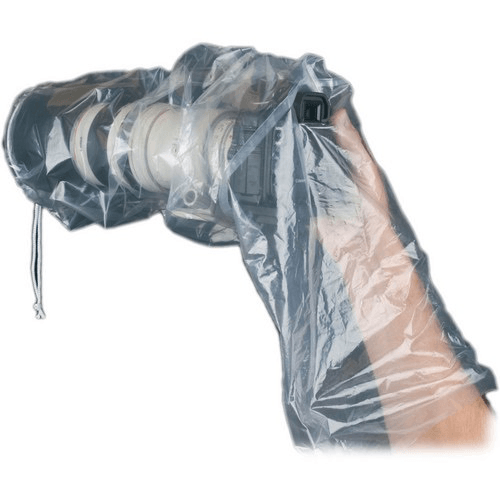
Op/Tech USA Rainsleeve for mirrorless camera
OpTech USA
Consider — The X-E3's body uses magnesium only on the top and bottom plates with no sealing elsewhere, so the 16-80mm's WR rating doesn't make the system weatherproof on its own.
Since the X-E3 body itself has no weather sealing, a simple rain cover protects the whole system in wet trail conditions regardless of which lens is mounted.Available at Amazon(paid link) — opens Amazon in a new tab. Price and availability shown there.
Sources
Pages consulted while researching this article. None of these are affiliate links.
- FUJINON XF18-55mmF2.8-4 R LM OIS Specifications | Fujifilm — fujifilm-x.com
- FUJINON XF16-80mmF4 R OIS WR Specifications | Fujifilm — fujifilm-x.com
- Fujifilm XF 16-80mm F4 R OIS WR | DPReview — dpreview.com
- Using the New Fujifilm XF 16-80mm F4 R OIS WR Zoom Lens | Fuji X Passion — fujixpassion.com
- The 10 Main Differences Between the Fujifilm X-E3 and X-T2 | Mirrorless Comparison — mirrorlesscomparison.com
- Review: Fujifilm XF 18-55mm f2.8-4 R LM OIS | The Phoblographer — thephoblographer.com