K&F Nano-X 55mm Variable ND: A First ND Filter Guide
The questionWhere do these come from?
ND Filter recommendations
I’m looking to buy an ND Filter for my xt5. I have a sigma 18-50mm on the cam right now. And I shoot mostly outdoorsy things like hiking n fishing. Does anyone have any recommendations on a filter?
The K&F Nano-X 55mm variable ND (ND8-128) is a sensible first ND filter for a 55mm-thread lens like the Sigma 18-50mm f/2.8 on a Fuji X body.
The K&F Concept Nano-X Variable ND 55mm (ND8-128, 3 to 7 stops) is a sensible first neutral density filter for anyone with a 55mm-thread lens, including the Sigma 18-50mm f/2.8 DC DN Contemporary on a Fujifilm X body such as the X-T5. One filter covers daylight water blur, wide-open portraits in sun and video shutter control. The trade-off is that variable NDs are the compromise design: they can show a dark cross at high density and they add a little colour cast. If you only want silky water, a fixed ND is the cleaner tool.
What an ND filter does, in one paragraph
An ND filter is sunglasses for your lens. It cuts light so you can use a slow shutter or a wide aperture in bright conditions. Each “stop” halves the light. A variable ND is two polarising layers that you rotate against each other to pick the amount, so one filter replaces a bag of fixed ones. The cost of that convenience is the cross-shaped dark band (“X pattern”) that appears when the two layers are turned toward maximum, especially on wide lenses.
Does 55mm fit your lens?
Pre-launch coverage consistently lists the Sigma 18-50mm f/2.8 DC DN Contemporary for Fujifilm X as taking a 55mm filter (PhotoRumors, FujiLove). Confirm the number printed inside your own lens cap or on the front ring before ordering. Many other X-mount lenses also use 55mm. Check yours, because a wrong size is the most common returned-filter mistake.
The numbers that decide whether ND8-128 is enough
K&F lists the Nano-X variable as ND8-128, which is 3 to 7 stops. A quick calculation shows how that maps to outdoor use. On a sunny day, a base exposure at f/8 and ISO 125 (the X-T5’s lowest native ISO, per the Imaging Resource spec sheet) is roughly 1/250 s. Water starts to look smooth around 1/4 s to 1/2 s, which means about 6 to 7 stops of ND. So:
Just want the recommendation?
Skip to the picks| Goal in bright daylight | Stops needed (approx.) | Does ND8-128 cover it? |
|---|---|---|
| Stay at f/2.8 without hitting the 1/8000 s mechanical shutter limit | 1 to 3 | At the low end, yes (3 stops) |
| 1/30 s to blur moving water slightly | 3 to 4 | Yes |
| 1/4 s silky stream or waterfall | 6 | Yes, near the top of the range |
| Several seconds, long exposure of clouds | 10 | No, needs a fixed ND1000 |
The first row has a workaround worth knowing: the X-T5’s mechanical shutter tops out at 1/8000 s, but its fully electronic shutter goes far beyond that (listed at 1/180,000 s in the same spec sheet), so wide-open daylight shots do not strictly need an ND if rolling-shutter distortion on moving subjects does not matter.
Where the Nano-X variable is the right buy
Choose it if you are new to NDs, want one filter on the lens through a day of hiking or fishing trips, and care more about convenience than about maximum image purity. K&F markets the Nano-X range as avoiding the X pattern, using a slim frame and coatings; Adorama’s listing of the 58mm version carries the maker’s 0.2% reflectivity and 3-7 stop figures. Buyer reviews on K&F’s retailers report little or no cross at ND128. Be aware that no independent lab we could find (no RTINGS, DPReview or similar) has published measured X-pattern or colour-cast figures for this filter, so those claims are the maker’s plus owner reports.
Where it stops being the right buy
- Wide end of the zoom at maximum density. Variable NDs are most prone to the cross and to darkened corners at the widest focal length. If you often shoot 18mm landscapes at 6 to 7 stops, expect to back the dial off a little and test it once at home before a trip.
- Fixed long exposures. For several-second exposures, a fixed 10-stop filter is cleaner and reaches further than ND128.
- Fishing on the water. The glare and surface reflections you fight there are not solved by an ND. A circular polariser removes reflections and lets you see into the water, and also loses 1 to 2 stops of light, so it doubles as a mild ND. For fishing and stream hiking it is the better first accessory, and the ND is the second.
What to skip
Skip the generic no-name variable NDs sold under a dozen brand names. Their typical failure is the pronounced cross and a strong colour cast at the edges of the range, and nothing is documented about the coatings. The extra step up to a named brand like K&F’s Nano-X is small relative to the lens it sits in front of. Skip any variable ND that does not state its stop range, since dial markings without a range are meaningless.
How to use it without a bad first day
- Fit the filter, set the camera to aperture priority and note the shutter speed it picks.
- Rotate the ring slowly and watch the exposure; stop before you see a dark band cross the frame in live view.
- Lock white balance manually, because variable NDs shift colour as you rotate.
- On a tripod or rock, use a 2-second timer to avoid shake at slow speeds.
If the filter shows a cross at moderate settings, that is a defect or a fit problem, and the seller’s returns process is the real remedy.
The bottom line
Two good answers to different versions of the question:
Top pick
Buy this
K&F CONCEPT 55mm Magnetic Variable ND8-128 Filter and Basic Adapter Ring | A1 Magnetic System 3-7 Stop Adjustable Neutral Density, 1s Quick Swap, Multi-Coated, Video Camera Lens Filter, FT709
K&F CONCEPT
ND8-128 spans the roughly 6 stops needed for a quarter-second water shot in daylight at f/8, and one filter replaces several fixed ones.
The product the question is about: a variable ND that covers 3 to 7 stops and fits 55mm lenses such as the Sigma 18-50mm f/2.8. Drawback: no independent lab has measured its X-pattern or colour cast, so those claims rest on the maker and owners.Available at Amazon(paid link) — opens Amazon in a new tab. Price and availability shown there.The alternative
It depends
K&F CONCEPT 55mm Circular Polarizer Lens Filter with 28 Multi-Layer Coated | Ultra Slim High Definition Waterproof Scratch Resistant Polarizing Lens Filter(CPL) (Nano-X Series) FC701
K&F CONCEPT
Right first accessory for fishing on water, but it only removes about 1 to 2 stops so it cannot replace an ND for long exposures.
A complement rather than a rival: a polariser cuts water glare for fishing and stream scenes and costs 1 to 2 stops, so it works as a mild ND. It cannot reach slow shutter speeds in bright light.Available at Amazon(paid link) — opens Amazon in a new tab. Price and availability shown there.
Recommended products
Ordered by how well each one fits the situations above. Each link below is a paid link.
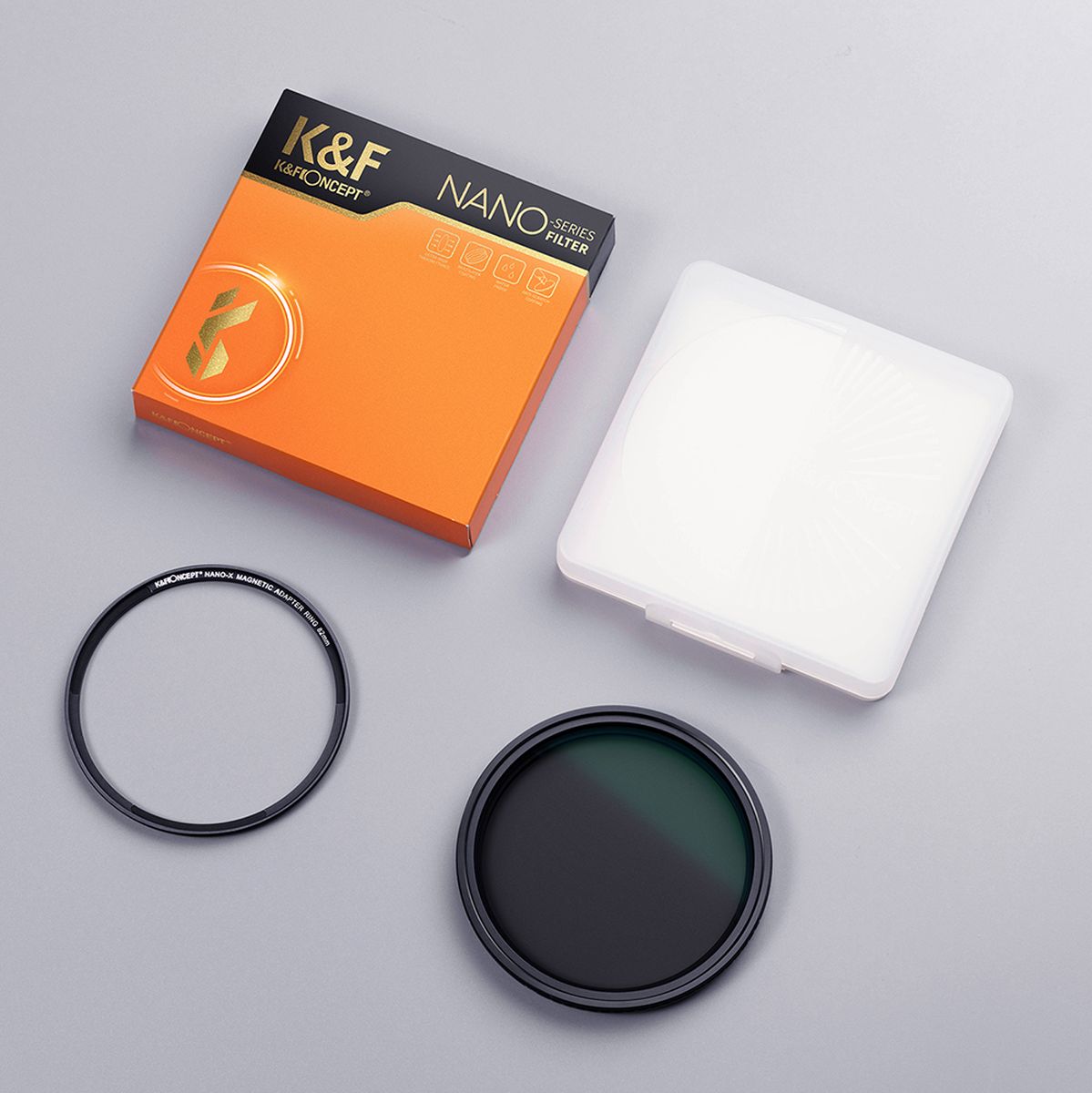
K&F CONCEPT 55mm Magnetic Variable ND8-128 Filter and Basic Adapter Ring | A1 Magnetic System 3-7 Stop Adjustable Neutral Density, 1s Quick Swap, Multi-Coated, Video Camera Lens Filter, FT709
K&F CONCEPT
Buy — ND8-128 spans the roughly 6 stops needed for a quarter-second water shot in daylight at f/8, and one filter replaces several fixed ones.
The product the question is about: a variable ND that covers 3 to 7 stops and fits 55mm lenses such as the Sigma 18-50mm f/2.8. Drawback: no independent lab has measured its X-pattern or colour cast, so those claims rest on the maker and owners.Available at Amazon(paid link) — opens Amazon in a new tab. Price and availability shown there.
K&F CONCEPT 55mm Circular Polarizer Lens Filter with 28 Multi-Layer Coated | Ultra Slim High Definition Waterproof Scratch Resistant Polarizing Lens Filter(CPL) (Nano-X Series) FC701
K&F CONCEPT
It depends — Right first accessory for fishing on water, but it only removes about 1 to 2 stops so it cannot replace an ND for long exposures.
A complement rather than a rival: a polariser cuts water glare for fishing and stream scenes and costs 1 to 2 stops, so it works as a mild ND. It cannot reach slow shutter speeds in bright light.Available at Amazon(paid link) — opens Amazon in a new tab. Price and availability shown there.
Sources
Pages consulted while researching this article. None of these are affiliate links.