Fuji XF 27mm f2.8 Original: Worth Buying Opened-Box?
The questionWhere do these come from?
Fuji 27mm f2.8 mk1 question
Hello all! I have the chance to buy a recently opened box with the 27mm mk1 for $200 and I’m wondering if I should go for it. I understand that it’s an older lens and I also understand all the specs.
Yes, the original XF 27mm f2.8 is worth buying opened-box: the 2021 R WR kept the same optics and focus system, so autofocus is not the reason to pay more.
Yes, an opened-box original Fujifilm XF 27mm f2.8 is worth buying at a sensible discount, and autofocus is not a good reason to pay extra for the newer version. Reviews of the 2021 XF 27mm F2.8 R WR describe it as the same optical design and focus system in a new body with an aperture ring and weather sealing. No source found here published a measured autofocus speed or accuracy gap between the two. Two things do matter: what an opened-box unit can hide, and whether you can live without an aperture ring.
What actually changed between the two generations
The older lens (often written “XF 27mm F2.8”, released in 2013) and the XF 27mm F2.8 R WR (2021) are the same size class: both are true pancakes. Reviewers at Photography Blog and Cameralabs describe the changes as an aperture ring with an A position, weather sealing, and a slightly narrower manual-focus ring to make room for it. Digital Camera World covers the same lens and the same story: unchanged optics, a lens that is only a few grams heavier.
| Original XF 27mm f2.8 | XF 27mm F2.8 R WR | |
|---|---|---|
| Aperture control | Camera dial or menu only | Physical ring with A position |
| Weather sealing | None | Yes (WR) |
| Optics | Original design | Same design, per reviews |
| Autofocus | Stepping-motor focus | Described as the same system; no published speed gap |
The autofocus worry, and where it comes from
The worry is real in one sense: the original is a 2013 lens, and its reputation for hunting or sounding slightly rough comes from being used on early X-series bodies with contrast-detect-heavy autofocus. The lens did not change much afterwards; the cameras did. Newer bodies with on-sensor phase detection (the X-T3 generation onward) are widely reported to focus these small lenses more confidently. If your body is that new, the original’s focus behaviour is mainly about the lens motor, and the R WR has no documented advantage there.
Just want the recommendation?
Skip to the picksLimits of this answer: the reviews cited describe the focus system as unchanged but do not publish side-by-side timings, and no independent lab measurement of either lens’s autofocus turned up. If you find a forum claim that the WR focuses much faster, treat it as anecdote until someone measures it.
What to check on an opened-box unit
- Aperture behaviour: with no ring, confirm the front or rear command dial changes f-stops on your body, and that the shutter and aperture blades move cleanly across the range.
- Focus: test autofocus at close range and at distance, and run the focus ring through its full travel by hand. Grinding or a hunting loop is a return, not a quirk.
- Front and rear elements: look for dust inside the barrel; the original has no weather sealing, so a unit that has been shot outdoors is more exposed.
- Return window: a retailer opened-box deal with a return window removes most of the risk. A private opened-box sale with no returns removes the discount’s logic.
Who should buy the original
Buy it if you shoot mainly in aperture-priority or manual with a command dial, you keep the camera dry, and you want the smallest 40mm-equivalent lens Fuji makes. The opened-box saving over the R WR is the entire argument, because image quality is stated as unchanged.
Where the R WR earns its premium
Choose the R WR instead if you shoot on bodies where a physical aperture ring is part of how you work (the X-Pro and X-T lines with dials), if you want weather sealing for rain and dust, or if you plan to resell the lens later. If the price gap is small, the WR is the safer long-term pick; the gap has to be large for the original to win.
When neither is the right lens
If f2.8 is too slow indoors, the XF 35mm f2 R WR is faster and has a similar field of view, at the cost of a bulkier lens. Skipping the pancake for it is the right move if low-light work matters more than pocketability. Nothing about the original deserves a warning beyond the lack of sealing and an aperture ring; the main lens-versus-lens call is simply price against those two features.
The bottom line
Two answers, priced differently:
Top pick
Buy this
TTArtisan 27mm F2.8 XF-Mount APS-C Pancake Autofocus Lens for Fujifilm X
TTArtisan
Reviews of the R WR describe the same optics and focus system, so the older lens gives up an aperture ring and sealing, not documented image quality or autofocus.
The original pancake the reader is weighing; buy it opened-box if you are fine setting aperture from a body dial. Drawback: no aperture ring and no weather sealing.Available at Amazon(paid link) — opens Amazon in a new tab. Price and availability shown there.The alternative
It depends
Fujifilm Fujinon XF27mmF2.8 R WR | 27mm f/2.8 R WR lens with weather resistance and aperture ring for street, portraits and travel
Fujifilm
Adds an aperture ring with A position and weather sealing, but reviewers report no autofocus or optical change.
The direct alternative: the newer generation of the same lens. Pick it if you want an aperture ring and weather sealing, and cannot find a large enough discount on the original.Available at Amazon(paid link) — opens Amazon in a new tab. Price and availability shown there.
Recommended products
Ordered by how well each one fits the situations above. Each link below is a paid link.

TTArtisan 27mm F2.8 XF-Mount APS-C Pancake Autofocus Lens for Fujifilm X
TTArtisan
Buy — Reviews of the R WR describe the same optics and focus system, so the older lens gives up an aperture ring and sealing, not documented image quality or autofocus.
The original pancake the reader is weighing; buy it opened-box if you are fine setting aperture from a body dial. Drawback: no aperture ring and no weather sealing.Available at Amazon(paid link) — opens Amazon in a new tab. Price and availability shown there.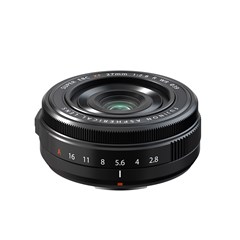
Fujifilm Fujinon XF27mmF2.8 R WR | 27mm f/2.8 R WR lens with weather resistance and aperture ring for street, portraits and travel
Fujifilm
It depends — Adds an aperture ring with A position and weather sealing, but reviewers report no autofocus or optical change.
The direct alternative: the newer generation of the same lens. Pick it if you want an aperture ring and weather sealing, and cannot find a large enough discount on the original.Available at Amazon(paid link) — opens Amazon in a new tab. Price and availability shown there.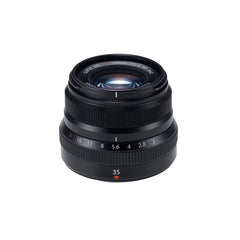
Fujifilm XF 35mm f2 R WR lens
Fujifilm
It depends — Gains a stop of light over f2.8 but gives up the pancake size that is the reason to want the 27mm.
An alternative if f2.8 is too slow indoors; faster and a similar field of view, but larger and not a true pancake.Available at Amazon(paid link) — opens Amazon in a new tab. Price and availability shown there.
Sources
Pages consulted while researching this article. None of these are affiliate links.
- Fujifilm XF 27mm F2.8 R WR Review – Photography Blog — photographyblog.com
- Fujifilm XF 27mm f2.8 R WR review – Cameralabs — cameralabs.com
- Fujinon XF27mmF2.8 R WR review – Digital Camera World — digitalcameraworld.com