Used Olympus E-M1X: Worth the Travel Weight?
The question
olympus e-m1x deciding whether a bargain used e-m1x is worth buying despite size concerns for travel, wildlife
A used E-M1X suits wildlife-first travel, but its 997 g integrated-grip body makes the smaller OM-1 Mark II better for mixed trips.
Yes—but only when wildlife is the trip’s main photographic purpose and you actively want an integrated vertical grip. For mixed travel, street photography, landscapes and occasional wildlife, the E-M1X’s permanent bulk is difficult to justify; the OM System OM-1 Mark II is the better one-body choice.
| Camera | Pack-size reality | Wildlife speed | Verdict |
|---|---|---|---|
| Olympus OM-D E-M1X | 997 g; 146.8 mm tall; integrated grip | 18 fps with continuous AF; 10 fps mechanical | Consider for wildlife-first trips |
| OM System OM-1 Mark II | 599 g listed weight; about 92 mm tall | Up to 50 fps with continuous AF on compatible lenses | Buy for mixed travel and wildlife |
Neither body deserves a universal skip: both are capable wildlife cameras, and the deciding difference is whether an integrated grip is useful equipment or dead weight. The E-M1X gets that balance wrong for travel-first photographers who will spend more time walking through towns or carrying the camera than waiting beside a wildlife subject.
The size concern is not exaggerated
Olympus specifies the E-M1X at 144.4 × 146.8 × 75.4 mm and 997 g with two BLH-1 batteries and a card. Its width and depth are not extraordinary, but the integrated portrait grip makes it unusually tall. The grip cannot be removed when you want a smaller sightseeing camera. Olympus says the body can operate with one battery, but removing a battery reduces weight without reducing the space it occupies in a bag. Olympus’s E-M1X specifications also confirm two UHS-II-compatible SD slots, USB Power Delivery and an 870-shot CIPA rating with both batteries.
Compared with the OM-1 Mark II, the E-M1X is roughly 55 mm taller and about 400 g heavier before either body receives a lens. In practical terms, it is about 60% taller. That height is often more consequential than the weight: it can determine whether the camera fits upright in a compact shoulder bag or requires a deeper compartment.
The size becomes reasonable with lenses such as the M.Zuiko 300mm F4 IS PRO or 40-150mm F2.8 PRO. The deep grip, duplicated vertical controls and second battery all help when a long lens remains mounted for hours. Put a small travel prime on it, however, and you still carry a full-height professional body. For a lighter daytime lens decision, the related Olympus 12-40 versus 12-45 comparison explains where reducing lens weight helps—but no compact lens makes the E-M1X itself compact.
Where the E-M1X still earns its bulk
Wildlife features remain substantive rather than nostalgic. The E-M1X shoots at 10 fps with continuous autofocus using its mechanical shutter and 18 fps with continuous autofocus using the electronic shutter. DPReview measured buffers of 60 Raw-plus-JPEG frames at 10 fps and 66 frames at 18 fps with a V90 card. Its Pro Capture mode can retain frames recorded before the shutter is fully pressed, which is genuinely useful for take-offs, strikes and other actions that begin faster than human reaction time. DPReview’s measured E-M1X results also found approximately 4.6 stops of stabilization benefit at a 200mm-equivalent field of view, rather than simply repeating the higher laboratory rating.
Battery endurance and redundant storage matter on remote days. The two card slots can provide backup, separation of Raw and JPEG files, or overflow. Two batteries reduce the need to open the battery compartment in dust or rain, while USB Power Delivery offers another charging route. The integrated vertical controls are particularly valuable when mammals or perched birds are repeatedly framed in portrait orientation.
Weather resistance is another legitimate strength. The E-M1X carries an IPX1 rating when paired appropriately, an unusually explicit claim for a camera of its generation. IPX1 is not permission to submerge it, and an old gasket may no longer perform like a new one, but the body was designed for outdoor professional use.
Wildlife autofocus is capable, not current-leading
The E-M1X’s autofocus should not be confused with the subject-recognition systems in current flagship bodies. In DPReview’s original moving-subject test, increasing C-AF Sensitivity from its default setting to +2 raised the single-point hit rate from about 65% to 80%; a weaving-subject tracking test produced roughly a 90% hit rate. Those tests occurred before Olympus added bird recognition, so they describe general continuous autofocus rather than the later bird mode.
Just want the recommendation?
Skip to the picksFirmware version 2.0 added detection of a bird’s eye, head and body, with eye priority. It also made bird detection compatible with Pro Capture. Any used E-M1X intended for bird photography should therefore be running version 2.0 or newer; otherwise one of its most relevant wildlife features is absent. Olympus’s firmware announcement documents exactly what the update added.
Even updated, this is still an older 20MP Four Thirds body. DPReview found its Raw output broadly similar to the E-M1 II and noted that larger-sensor rivals preserve more flexibility at high ISO and after heavy cropping. The E-M1X’s large exterior does not contain a larger sensor. That matters for dawn, dusk and forest wildlife, where shutter speeds force ISO upward.
Why mixed trips favor the OM-1 Mark II
The OM-1 Mark II removes nearly 400 g from the body comparison while retaining a substantial grip, two card slots and strong weather protection. Its stacked 20.4MP sensor enables continuous-AF electronic bursts up to 50 fps with compatible lenses, while the optional HLD-10 grip can be added only when vertical controls or extra battery capacity are actually needed. DPReview recorded a 256-frame Raw buffer at 50 fps in its initial testing. Its OM-1 Mark II assessment describes the deeper buffer, AI subject recognition and IP53-rated construction.
Independent measurements provide useful limits to the marketing claims. RTINGS measured the OM-1 Mark II at approximately 13.8 × 9.2 × 7.9 cm and 0.61 kg. It achieved a 94% perfect-focus rate and 100% usable-focus rate in RTINGS’ center-point continuous-AF test, although the more demanding tracking test produced 41% perfect and 83% usable frames. The lab also needed almost 90 seconds to clear a completely filled high-speed buffer before switching to video. RTINGS’ OM-1 Mark II measurements show why the newer camera is better, not infallible.
For a trip split between hiking, cities and wildlife reserves, buy the OM-1 Mark II if choosing between these bodies without another compact camera. Its smaller shape is present every minute of the trip, while the E-M1X’s duplicated controls earn their keep only during particular kinds of shooting.
The E-M1X remains the more coherent choice when most outings begin with a long telephoto already attached, portrait-orientation controls are used regularly, and two-battery endurance matters more than fitting the body into a small bag. In that narrower case, its size is functional rather than accidental.
Test a used E-M1X before committing
A clean exterior is not enough. Check the functions that distinguish this body and the areas that can turn an attractive used camera into a repair problem:
- Open the firmware information screen and confirm version 2.0 or newer if bird detection matters.
- Insert known-good cards into both slots. Record and play back files from each slot rather than merely checking that both cards appear in the menu.
- Shoot mechanical and silent bursts, then review every frame for recording errors, banding unrelated to the lighting, or inconsistent focus.
- Test the shutter release, command dials, joystick and autofocus controls in both horizontal and vertical orientations. The duplicated controls are part of the reason to own this model.
- Inspect the lens mount, battery carriers, card door, USB-C port and rubber seals. A damaged seal is grounds to pass when wet-weather use is important; appearance alone cannot certify water resistance.
- Photograph an evenly lit plain surface at a small aperture and inspect the file for stubborn sensor marks. Then focus repeatedly between near and distant subjects with the intended telephoto lens.
- Confirm that both BLH-1 batteries charge, hold power and are recognized. Battery deterioration is replaceable; intermittent power from the body or carrier is a more serious warning.
- Treat the mechanical shutter count as one clue, not a complete usage record, because electronic-shutter captures can leave the mechanical total low.
If weather sealing is essential, only a qualified service inspection can establish the condition of internal seals on a used body. No menu check or cosmetic inspection resolves that uncertainty.
The decision rule
Consider the Olympus E-M1X when wildlife accounts for most of the trip, a large telephoto will usually be mounted, and the camera will be carried ready to shoot rather than packed among general travel gear. Its grip, twin batteries, dual cards, stabilization, Pro Capture and updated bird detection still form a serious wildlife tool.
Pass on it when the trip is evenly divided between wildlife and ordinary travel photography, when every item must fit into a small day bag, or when the integrated vertical grip already feels excessive before departure. In those conditions, the OM-1 Mark II is the better buy because it is dramatically shorter and lighter while offering newer autofocus, a faster stacked sensor and an optional—not permanent—vertical grip.
The bottom line
Worth it either way — the difference is your budget:
Top pick
It depends
Olympus OM-D E-M1X Mirrorless Digital Camera Body
Olympus
The body weighs 997 g with two batteries and a card, but provides 18 fps continuous-AF shooting, an integrated vertical grip and an 870-shot CIPA rating.
Consider this body when wildlife dominates and you will use the integrated vertical controls, two batteries and dual card slots. Its 997 g body and fixed 146.8 mm height remain significant drawbacks for general travel.Available at Amazon(paid link) — opens Amazon in a new tab. Price and availability shown there.The alternative
Buy this
OM SYSTEM OM-1 Mark II Mirrorless Camera Body
OM System
Its listed 599 g weight is about 398 g below the E-M1X, while its stacked sensor supports up to 50 fps with continuous autofocus on compatible lenses.
This is the stronger one-body solution for trips combining wildlife, hiking and general photography. It is far smaller than the E-M1X and has newer subject detection, although adding the optional grip gives up part of that portability advantage.Available at Amazon(paid link) — opens Amazon in a new tab. Price and availability shown there.
Recommended products
Ordered by how well each one fits the situations above. Each link below is a paid link.
Olympus OM-D E-M1X Mirrorless Digital Camera Body
Olympus
Consider — The body weighs 997 g with two batteries and a card, but provides 18 fps continuous-AF shooting, an integrated vertical grip and an 870-shot CIPA rating.
Consider this body when wildlife dominates and you will use the integrated vertical controls, two batteries and dual card slots. Its 997 g body and fixed 146.8 mm height remain significant drawbacks for general travel.Available at Amazon(paid link) — opens Amazon in a new tab. Price and availability shown there.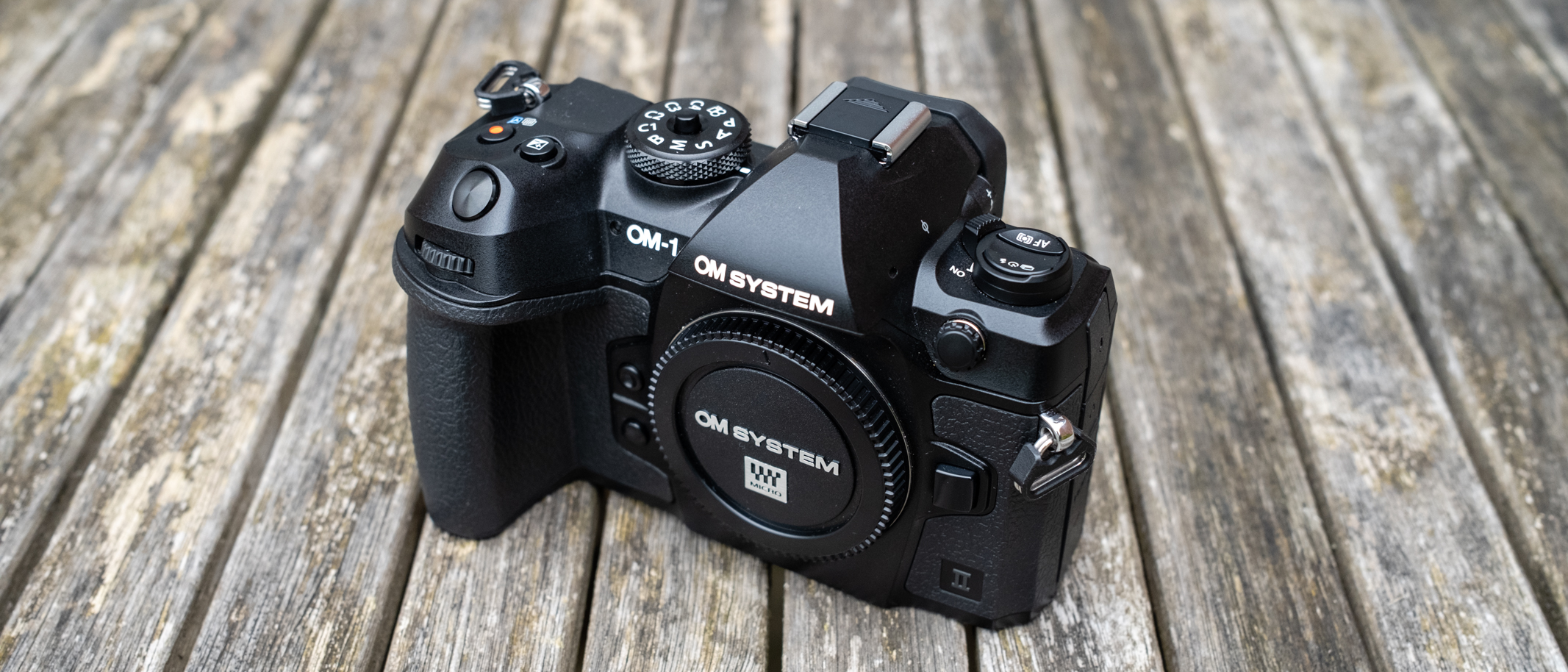
OM SYSTEM OM-1 Mark II Mirrorless Camera Body
OM System
Buy — Its listed 599 g weight is about 398 g below the E-M1X, while its stacked sensor supports up to 50 fps with continuous autofocus on compatible lenses.
This is the stronger one-body solution for trips combining wildlife, hiking and general photography. It is far smaller than the E-M1X and has newer subject detection, although adding the optional grip gives up part of that portability advantage.Available at Amazon(paid link) — opens Amazon in a new tab. Price and availability shown there.
Sources
Pages consulted while researching this article. None of these are affiliate links.
- Q&A for E-M1X — Olympus Digital Camera Support — support.jp.omsystem.com
- Olympus OM-D E-M1X Review — DPReview — dpreview.com
- E-M1X Firmware Version 2.0 Bird Detection Announcement — Olympus — olympus-global.com
- OM System OM-1 Mark II Initial Review — DPReview — dpreview.com
- OM System OM-1 Mark II Camera Review — RTINGS — rtings.com