Can Panasonic Eneloop AA Start a Motor?
The question
The device needs enough voltage under motor load, and the old alkaline cells can read 1.35 V at rest while sagging too low in use. The user also wants to know whether rechargeable AA cells make sense here.
Panasonic Eneloop AA usually beats partly used alkaline cells under motor load, but a strict 1.5 V device may still reject NiMH.
Yes—Panasonic Eneloop AA is usually a sensible replacement when old alkaline cells read 1.35 V at rest but cannot start a motor. Eneloop’s 1.2 V rating looks lower, yet its lower internal resistance can let it maintain more usable voltage under a heavy load than a partly depleted alkaline cell.
That is not a guarantee of compatibility. A device that explicitly prohibits NiMH, requires nearly 1.5 V per cell at startup, or uses a sealed waterproof battery compartment may still be unsuitable for Eneloop. Panasonic says most AA devices operate across roughly 0.9–1.5 V per cell, but it also lists those exceptions in its Eneloop compatibility guidance.
| Cell | Deciding specifications | Best use here | Verdict |
|---|---|---|---|
| Panasonic Eneloop AA BK-3MCCA | 1.2 V; minimum 1900 mAh | Default choice when the device permits NiMH | Buy |
| Panasonic Eneloop Pro AA BK-3HCCA | 1.2 V; minimum 2450/2500 mAh by region | Longer runtime after compatibility is established | Consider |
Both are sound choices; the difference is capacity and cycle life, not voltage compatibility. There is no honest product skip here. The assumption to skip is that the cell with the higher resting-voltage reading must also deliver the higher voltage while the motor is running.
Why 1.35 V at rest can be misleading
A digital multimeter places almost no meaningful load on an AA cell. Its reading is therefore open-circuit voltage: useful information, but not a test of whether the battery can supply a motor’s starting current.
A practical approximation is:
loaded voltage = open-circuit voltage − current × internal resistance
Analog Devices gives typical internal-resistance ranges of 30–100 milliohms for new high-capacity AA NiMH cells and 200–300 milliohms for alkaline cells, rising as high as 700 milliohms depending on the alkaline cell’s state of charge. Contact resistance must be added to those figures. Analog Devices documents the ranges and calculation.
Consider an illustrative 1 A load. An alkaline cell reading 1.35 V with 0.30 ohm of internal resistance would fall to approximately 1.05 V: 1.35 − (1 × 0.30). A motor can briefly demand more than its normal running current while starting, producing an even larger momentary drop. The exact result depends on the motor, cell condition, temperature and battery contacts, but the arithmetic explains why 1.35 V at rest does not prove that an old alkaline remains usable.
Eneloop reverses the apparent advantage: its open-circuit or nominal figure may be lower, but less voltage is lost inside the cell when substantial current flows. Panasonic describes Eneloop as maintaining approximately 1.2 V during discharge while alkaline voltage declines progressively.
What independent discharge measurements show
In an independent test of an early Sanyo-branded Eneloop pack, Stefan Vorkoetter discharged four AA cells at 1.2 A. After five charge/discharge cycles, he measured 1848 mAh, an average 1.17 V per cell under load and 0.096 ohm of DC resistance per cell. Those numbers apply to the tested 2006-generation cells—not automatically to every current Panasonic cell—but they demonstrate the relevant behavior under a real high-current load. The complete readings appear in the computer-controlled Eneloop discharge test.
Just want the recommendation?
Skip to the picksHKJ later tested the Panasonic BK-3MCCE 1900 mAh generation at discharge currents from 1 A through 10 A. The two samples tracked closely, with capacity declining as the load increased; recorded temperature rise was 1.3°C at 1 A and 10.6°C at 5 A. That is independent evidence that this specific Eneloop generation was tested under much heavier loads than a typical meter reading imposes, although it is not a promise that every motorized device can safely draw those currents. See the BK-3MCCE measurement page.
The loaded-voltage test that answers it
Use a matched set of fully charged Eneloop cells and test the device rather than trying to infer compatibility from resting voltage alone:
- Charge every cell in the set with a charger intended for NiMH batteries. Let unusually warm cells return to room temperature before testing.
- Inspect and clean the device’s battery contacts. Corroded or loose contacts add resistance and create another voltage drop when the motor starts.
- Install Eneloop cells of the same model and similar age. Never mix NiMH with alkaline cells, or charged cells with depleted ones.
- Start the motor. Normal starting and sustained operation are the most relevant compatibility test.
- If the battery terminals are safely accessible, measure DC voltage across the complete pack while the motor starts and while it runs. Keep the meter lead in the voltage socket—using its current socket across a battery pack creates a short circuit.
- Compare the behavior with a complete set of fresh, manufacturer-approved alkaline cells. If fresh alkaline works but fully charged Eneloop is rejected immediately, the device may have an unusually high cutoff or depend on the higher initial voltage of new alkaline chemistry.
Do not dismantle a sealed appliance merely to reach the terminals, and keep probes, clothing and fingers away from moving parts. Stop if the batteries become hot, leak or smell unusual. When both fresh alkaline and charged Eneloop sag badly, investigate dirty contacts, a jammed mechanism or a failing motor rather than continuing to replace cells.
Where Eneloop still loses
A simple unregulated DC motor may initially run faster from fresh alkaline cells because their starting voltage can be higher. Eneloop often wins once the alkaline cells have been used, but it cannot reproduce that initial voltage peak.
A strict electronic cutoff is the other exception. If the device treats roughly 1.2 V per cell as empty, even a charged Eneloop may trigger an immediate low-battery shutdown. The manual decides this case: follow any instruction requiring alkaline cells or prohibiting NiMH.
Panasonic also warns that Eneloop is unsuitable for devices explicitly marked incompatible with NiMH and for airtight waterproof battery compartments where gas from severe over-discharge could accumulate. Do not substitute rechargeable NiMH in those devices merely because the cells fit physically.
Standard Eneloop versus Eneloop Pro
Standard Eneloop is the default choice because it addresses motor-load sag while offering substantially greater rated cycle life. Panasonic’s current Eneloop lineup lists minimum AA capacity of 1900 mAh for standard Eneloop and 2450 or 2500 mAh for Pro, depending on region. Under the older IEC method, Panasonic lists up to 2100 cycles for standard and 500 for Pro; its footnotes give approximately 600 and 150 respectively under the stricter 2017 method.
Eneloop Pro gets one thing wrong for someone trying to fix a motor-start cutoff: it is still a 1.2 V cell, so its extra capacity cannot raise the device’s nominal startup voltage. Choose Pro only after standard Eneloop has proved compatible and the motor needs longer intervals between charges.
What the battery indicator may get wrong
Some devices estimate remaining charge from an alkaline discharge curve. Because Eneloop spends much of its discharge near 1.2 V, such a device may show a low-battery icon soon after freshly charged cells are installed. Panasonic specifically warns that battery indicators can report less remaining capacity than Eneloop actually holds.
A pessimistic gauge is different from an actual shutdown. If the motor starts and continues operating normally, the gauge may simply be calibrated for alkaline chemistry. If the device stops, repeatedly resets or cannot start the motor, the loaded voltage is genuinely crossing a limit. Recharge the cells before the motor slows to a stop; Panasonic cautions that continuing until complete shutdown can over-discharge the weakest cell in a multi-cell set.
The bottom line
Two options, and the revision you own picks one:
Top pick
Buy this
Panasonic eneloop AA 8-Pack BK-3MCCA8BA
Panasonic
Panasonic rates standard Eneloop AA at 1.2 V and at least 1900 mAh, with markedly more rated recharge cycles than Eneloop Pro.
This is the default cell for testing and running a motorized AA device that officially accepts NiMH. Its drawback is that the 1.2 V chemistry cannot satisfy equipment that genuinely requires close to 1.5 V per cell.Available at Amazon(paid link) — opens Amazon in a new tab. Price and availability shown there.The alternative
It depends
Panasonic eneloop pro AA 4-Pack BK-3HCCA4BA
Panasonic
Its minimum capacity rises to 2450 or 2500 mAh depending on region, but nominal voltage remains 1.2 V and Panasonic lists fewer recharge cycles.
Consider Pro only when standard Eneloop already starts the motor and additional runtime between charges matters. It has more capacity but the same 1.2 V nominal output, so it cannot cure a strict voltage cutoff.Available at Amazon(paid link) — opens Amazon in a new tab. Price and availability shown there.
Recommended products
Ordered by how well each one fits the situations above. Each link below is a paid link.
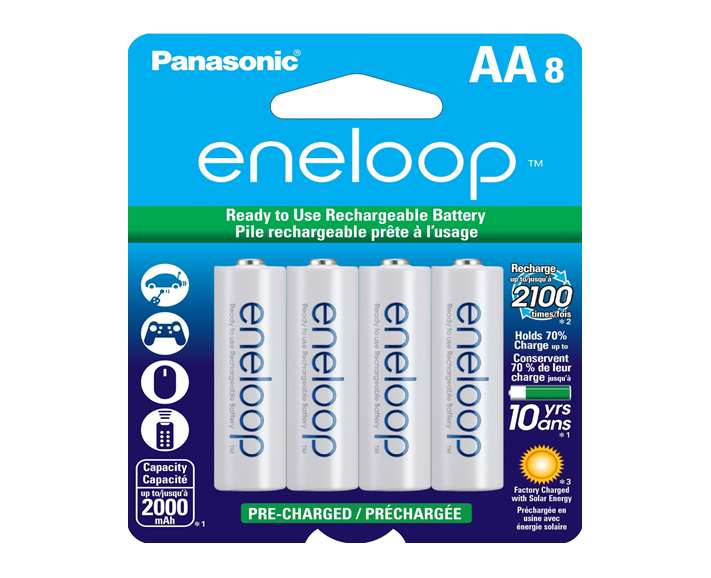
Panasonic eneloop AA 8-Pack BK-3MCCA8BA
Panasonic
Buy — Panasonic rates standard Eneloop AA at 1.2 V and at least 1900 mAh, with markedly more rated recharge cycles than Eneloop Pro.
This is the default cell for testing and running a motorized AA device that officially accepts NiMH. Its drawback is that the 1.2 V chemistry cannot satisfy equipment that genuinely requires close to 1.5 V per cell.Available at Amazon(paid link) — opens Amazon in a new tab. Price and availability shown there.
Panasonic eneloop pro AA 4-Pack BK-3HCCA4BA
Panasonic
Consider — Its minimum capacity rises to 2450 or 2500 mAh depending on region, but nominal voltage remains 1.2 V and Panasonic lists fewer recharge cycles.
Consider Pro only when standard Eneloop already starts the motor and additional runtime between charges matters. It has more capacity but the same 1.2 V nominal output, so it cannot cure a strict voltage cutoff.Available at Amazon(paid link) — opens Amazon in a new tab. Price and availability shown there.
Sources
Pages consulted while researching this article. None of these are affiliate links.
- Panasonic Eneloop FAQ and Compatibility Guidance — panasonic.com
- Analog Devices Overview of Rechargeable Batteries and Chargers — analog.com
- Testing Sanyo’s Eneloop Low Self-Discharge Battery — stefanv.com
- HKJ Test of Eneloop AA BK-3MCCE 1900mAh — lygte-info.dk
- Panasonic Eneloop Battery Lineup — panasonic.com