ASUS TUF Gaming OC RTX 5070 Ti: Is It the Right Pick?
The question
User is choosing a 5070 Ti model for a new PC build and is unsure whether the ASUS TUF Gaming OC is the right pick.
It suits a full-size ATX build with an 850W PSU, but its 329mm, 3.125-slot cooler won't clear every case or budget.
The ASUS TUF Gaming OC is a legitimate pick for most new builds, with one real caveat: at 329mm long and 62.5mm thick — ASUS lists it as a 3.125-slot card — it’s one of the larger RTX 5070 Ti models on the market. The decision usually comes down to whether your case and power supply can actually fit it, but the independent acoustic and thermal results discussed below are for a different, larger sample and do not establish this card’s performance.
Where it sits in ASUS’s RTX 5070 Ti lineup
ASUS sells the RTX 5070 Ti across at least three tiers: the Prime (entry-level, smaller cooler), the TUF Gaming OC (mid-tier, triple-fan, “military-grade” component spec), and the ROG Strix OC (flagship, largest cooler, highest factory clocks). The TUF Gaming OC sits in the middle. It carries a larger three-fan open-air cooler than the Prime, a factory overclock in both its default and software-switchable OC modes, and ASUS’s durability features: a conformal coating over the PCB to resist dust and moisture, dual ball-bearing fans rated for 80,000 hours, and the MaxContact heatsink-baseplate process that flattens the contact surface against the GPU die. If the open question is really the 5070 Ti tier itself rather than a specific model, G14 RTX 5060 vs 5070 Ti for Engineering covers when stepping up from a 5060-class card is worth it.
The card is bigger than most cases expect
At 329 x 140 x 62.5mm with a listed 3.125-slot width, the TUF Gaming OC is noticeably larger than ASUS’s own Prime RTX 5070 Ti (304 x 126 x 50mm, 2.5-slot) or a small-form-factor card like Gigabyte’s Windforce OC SFF (304 x 126 x 50mm, requiring 2.5-slot clearance). That extra width isn’t cosmetic — it’s the room ASUS uses for a bigger heatsink and three fans. But it means checking two numbers before ordering: the maximum GPU length your case supports, and how many expansion slots sit clear of drive cages, front-panel headers, or a closed side panel. A 3.125-slot card in a case with only three usable slots below the top PCIe bracket won’t seat cleanly next to a triple-slot motherboard heatsink or an adjacent PCIe card.
| Model | OC-mode boost clock | Dimensions (L x W x H) | Slot width | Best fit |
|---|---|---|---|---|
| ASUS TUF Gaming OC RTX 5070 Ti | 2610 MHz | 329 x 140 x 62.5 mm | 3.125-slot | Full-size ATX/mid-tower builds |
| ASUS Prime RTX 5070 Ti | 2482 MHz | 304 x 126 x 50 mm | 2.5-slot | Tighter cases, lower budget |
| Gigabyte Windforce OC SFF RTX 5070 Ti | 2497 MHz | 304 x 126 x 50 mm | 2.5-slot clearance | Small-form-factor cases |
What the 850W PSU recommendation is really about
ASUS lists 850W as the recommended power supply for the TUF Gaming OC — higher than NVIDIA’s 750W baseline for the RTX 5070 Ti class, and higher than the 750W ASUS recommends for its own Prime card. LanOC’s independent testing measured its different, larger 348 x 146 x 72mm, 3.5-slot sample pulling an average of 348W and peaking at 362W under gaming load, but those figures do not establish the power behavior of the smaller card discussed here. For this card, ASUS’s 850W recommendation is the applicable guidance rather than an independently verified consumption figure.
Just want the recommendation?
Skip to the picksThe card uses a single 16-pin 12V-2x6 connector and ships with an adapter that splits it into three 8-pin PCIe connectors, so it doesn’t strictly require a PSU with a native 12V-2x6 cable. Use a native cable where your PSU has one — it removes one connection point from a high-current circuit — and make sure the connector seats fully with no sharp bend near the plug, the same guidance that applies to any 12V-2x6 card this generation.
OC Mode vs Default Mode: what 2610 MHz buys you
ASUS’s spec sheet lists two clock figures for a reason: 2588 MHz is the boost clock out of the box, and 2610 MHz is what the card runs in “OC Mode,” a profile switched on in ASUS’s Armoury Crate software rather than something requiring manual overclocking. Both numbers sit above the RTX 5070 Ti’s 2452 MHz reference boost clock, so even in default mode this card is already factory-overclocked; OC Mode adds roughly another 1% on top of that, a marginal difference rather than a headline one. Don’t pick this card over a cheaper 5070 Ti expecting a large frame-rate jump from clock speed alone — pick it for the cooler and the size that cooler buys, since GPU Boost still adjusts the real-time clock based on temperature and power headroom regardless of which mode is selected.
How quiet it runs under load
LanOC’s independent testing measured its larger 348 x 146 x 72mm, 3.5-slot sample at 40.1 dB(A) under gaming load on its stock fan curve, with the GPU itself holding at 60°C and memory at 48°C. Those figures landed in the bottom third of that review’s noise comparison chart, meaning the tested sample was quieter than most cards tested alongside it; they do not establish the noise or temperatures of the smaller 329 x 140 x 62.5mm, 3.125-slot card discussed here. Pushing the tested sample’s fans to 100% dropped the GPU to 53°C while raising noise only slightly. ASUS’s semi-passive fan profile is also worth knowing before building around it: all three fans stop completely below roughly 50°C and only restart past about 55°C, so at idle or light desktop use the card runs silent rather than merely quiet.
When a smaller card is the better pick
Skip the TUF Gaming OC for a small-form-factor build or a mid-tower with tight slot clearance — its 3.125-slot width and 329mm length are the tradeoff for that larger cooler, and neither shrinks to fit a cramped case. Gigabyte’s Windforce OC SFF RTX 5070 Ti is a 304 x 126 x 50mm card built for exactly that situation, though it requires the same 2.5-slot clearance as ASUS’s Prime; the same 300W GPU squeezed into a smaller heatsink has less thermal mass to dissipate it, so treat it as the pick for cases where the TUF Gaming OC physically won’t fit rather than as a straight upgrade. For low-profile or SFF cards more broadly, RTX 3050 Low Profile in a 3070 SFF: Skip It? covers where that tradeoff stops making sense. ASUS’s own Prime RTX 5070 Ti splits the difference at 2.5 slots and 304mm, with a 750W PSU recommendation and a lower 2482 MHz OC-mode clock — a reasonable choice for the ASUS name and the RTX 5070 Ti tier without the TUF Gaming OC’s size or its 850W PSU requirement.
Warranty and registration
ASUS’s warranty terms for graphics cards are published on each card’s own support page and vary by country. In the US, ASUS VGA cards have carried a three-year limited warranty as standard policy. Register the card through ASUS’s support site within the window listed at purchase — doing so keeps the serial number and proof of purchase on file, which speeds up an RMA if a fan bearing fails or coil whine develops outside the return window a retailer offers on its own. If the warranty page for the specific SKU and region shows a different term when checked, that page overrides any general figure quoted elsewhere, since ASUS explicitly states coverage can vary by market.
The bottom line
Two good answers to different versions of the question:
Top pick
Buy this
ASUS TUF Gaming OC GeForce RTX 5070 Ti 16GB GDDR7
ASUS
Its 3.125-slot, 329mm body needs extra case room, and LanOC's 40.1 dB(A) and 60°C results came from a different, larger sample, so they do not establish this card's noise or thermal performance.
The mid-tier pick in ASUS’s RTX 5070 Ti range, with a triple-fan cooler and factory clocks above ASUS’s Prime but below its flagship ROG Strix.Available at Amazon(paid link) — opens Amazon in a new tab. Price and availability shown there.The alternative
It depends
ASUS Prime GeForce RTX 5070 Ti 16GB GDDR7
ASUS Prime
Its 750W recommended PSU and 2482 MHz OC-mode clock trail the TUF Gaming OC, so it fits tighter cases and budgets rather than matching the TUF's cooling headroom.
ASUS’s smaller, cheaper RTX 5070 Ti, built at 2.5 slots and 304mm rather than the TUF Gaming OC’s larger footprint.Available at Amazon(paid link) — opens Amazon in a new tab. Price and availability shown there.
Recommended products
Ordered by how well each one fits the situations above. Each link below is a paid link.
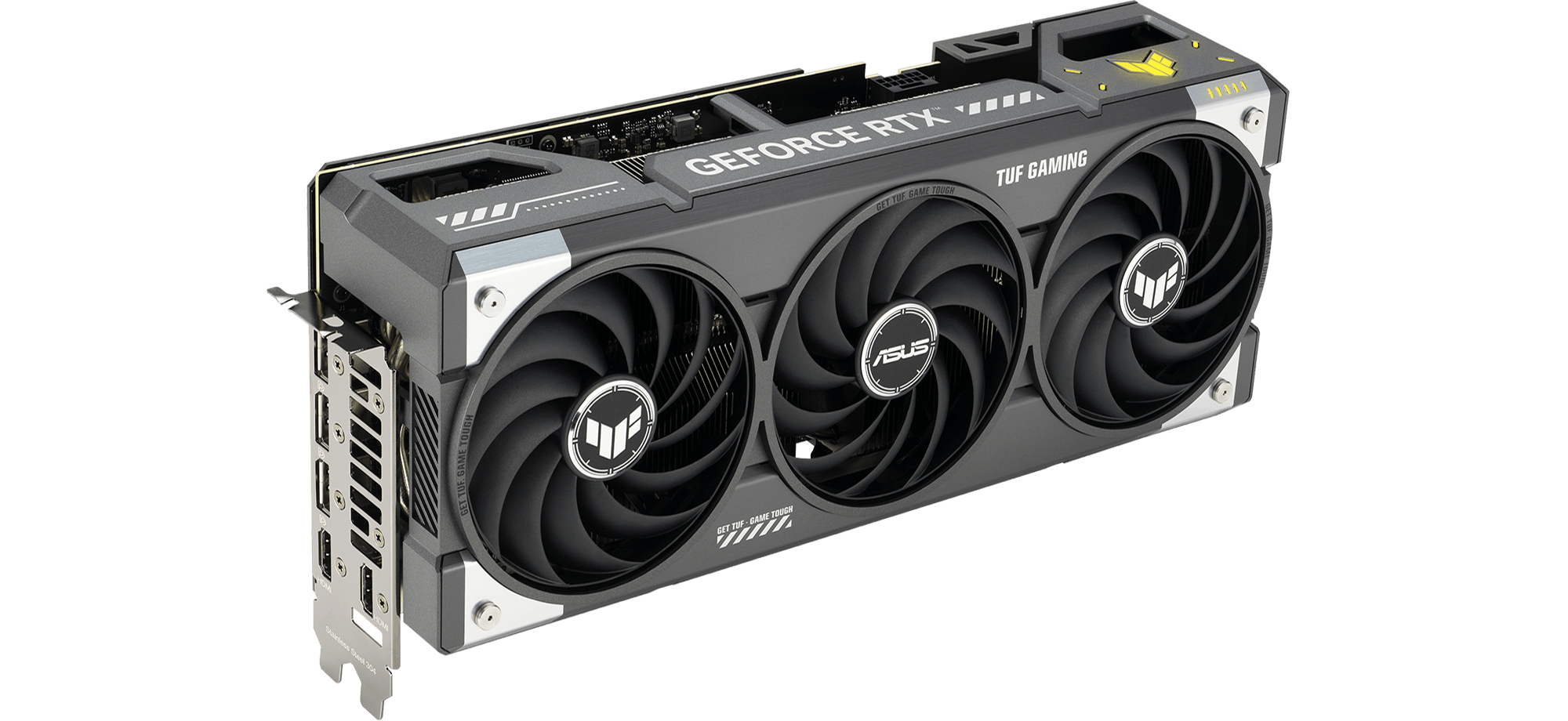
ASUS TUF Gaming OC GeForce RTX 5070 Ti 16GB GDDR7
ASUS
Buy — Its 3.125-slot, 329mm body needs extra case room, and LanOC's 40.1 dB(A) and 60°C results came from a different, larger sample, so they do not establish this card's noise or thermal performance.
The mid-tier pick in ASUS’s RTX 5070 Ti range, with a triple-fan cooler and factory clocks above ASUS’s Prime but below its flagship ROG Strix.Available at Amazon(paid link) — opens Amazon in a new tab. Price and availability shown there.ASUS Prime GeForce RTX 5070 Ti 16GB GDDR7
ASUS Prime
Consider — Its 750W recommended PSU and 2482 MHz OC-mode clock trail the TUF Gaming OC, so it fits tighter cases and budgets rather than matching the TUF's cooling headroom.
ASUS’s smaller, cheaper RTX 5070 Ti, built at 2.5 slots and 304mm rather than the TUF Gaming OC’s larger footprint.Available at Amazon(paid link) — opens Amazon in a new tab. Price and availability shown there.GIGABYTE GeForce RTX 5070 Ti Windforce OC SFF 16GB
Gigabyte
Consider — The same 300W GPU packed into a 2.5-slot, 304 x 126 x 50mm cooler has less heatsink volume than the TUF Gaming OC's, so it suits space-limited builds specifically rather than serving as a general upgrade.
A 2.5-slot RTX 5070 Ti built for small-form-factor cases where the TUF Gaming OC’s 3.125-slot width won’t physically fit.Available at Amazon(paid link) — opens Amazon in a new tab. Price and availability shown there.
Sources
Pages consulted while researching this article. None of these are affiliate links.
- ASUS TUF Gaming GeForce RTX 5070 Ti 16GB OC Edition - Tech Specs — asus.com
- ASUS TUF Gaming GeForce RTX 5070 Ti 16GB OC Edition - Product Page — asus.com
- ASUS Prime GeForce RTX 5070 Ti 16GB - Tech Specs — asus.com
- GIGABYTE GeForce RTX 5070 Ti WINDFORCE OC SFF 16G - Specifications — gigabyte.com
- Asus TUF Gaming RTX 5070 Ti OC Review - LanOC Reviews — lanoc.org
- NVIDIA GeForce RTX 5070 Ti Specs - TechPowerUp GPU Database — techpowerup.com
- GeForce RTX 5070 Family Graphics Cards - NVIDIA — nvidia.com
- Best PSU for RTX 5070 Ti - Corsair — corsair.com