Ajazz AK820 Max HE vs AULA Hero 84 HE
The questionWhere do these come from?
Weekly General Help Post
Seeking Advice: Ajazz AK820 MAX HE vs. Skyloong GK75 HE am looking for a 75% Hall Effect (HE) keyboard for competitive gaming (prioritizing Rapid Trigger/low latency) and daily use.
Choose the AULA Hero 84 HE for competitive play; its cleaner web calibration beats the Ajazz unless a physical volume knob is mandatory.
Choose the AULA Hero 84 HE for competitive play; its cleaner web calibration beats the Ajazz unless a physical volume knob is mandatory. The Ajazz AK820 Max HE is the narrower choice for its knob, gasket construction and deeper stock sound, but its variant-specific drivers and documented 0.1 mm ghost-input complaints make it harder to recommend for set-and-forget Rapid Trigger.
| Keyboard | Verdict | Rapid Trigger and software | Main catch |
|---|---|---|---|
| AULA Hero 84 HE | Buy | Dedicated Chromium web driver, visual switch travel, full-key calibration, 8,000 Hz wired polling | No rotary volume knob; configuration depends on a web service |
| Ajazz AK820 Max HE Wired 8K | Consider | 0.1–4.0 mm claimed adjustment, calibration control, DKS and Rapid Trigger | Reports of ghost inputs at 0.1 mm and drivers failing to recognize some units |
There is no honest flat skip between these two. The AULA is the better answer to the reliability question, while the Ajazz remains defensible when a hardware volume knob is non-negotiable and you accept a more troublesome setup process.
Why the AULA wins the software comparison
AULA gives the Hero 84 HE a dedicated entry in its official web-driver directory, leading to a browser configurator for that model rather than a collection of similarly named installers. Its product documentation specifies per-key actuation adjustment, key remapping, macros, Rapid Trigger, Mod Tap and Dynamic Keystroke through a Chromium-based browser.
That does not make the software perfect. The English Hero web driver was unavailable for at least some users in early 2026; a recorded workaround used AULA’s Chinese WebHID page until the English service returned. A browser configurator can fail when its server is down, and WebHID requires a compatible Chromium browser. Those are real limitations.
Even so, AULA’s current path is easier to audit: open the model-specific official page, grant access to the connected Hero 84 HE and configure it without installing an unsigned utility from an unrelated mirror. An independent Tech4Gamers review found the web interface responsive and confirmed that it exposes profiles, per-key actuation, Rapid Trigger, SOCD, DKS and remapping, although that review did not publish instrumented latency figures. Tech4Gamers’ software findings therefore support usability, not a claim that the AULA is measurably faster.
The Ajazz gets the core requirement wrong for players who want dependable, set-and-forget Rapid Trigger: its lowest sensitivity has recorded instability, while finding software that recognizes the correct hardware revision has repeatedly required troubleshooting.
The Ajazz driver problem is partly a naming problem
“AK820 Max HE” describes two materially different products. Ajazz says the wired-only version reaches 8,000 Hz and allows a 0.1–4.0 mm trigger range; the tri-mode version tops out at 1,000 Hz, uses a narrower 0.2–2.5 mm range and adds wireless connectivity plus a screen. Both have a knob. Those distinctions are stated on the Ajazz AK820 Max HE product page.
Ajazz also publishes separate downloads for “Wired Only” and “Wired & Wireless” on its official driver page. Selecting the wrong package can produce the familiar “device not connected” message even though the keyboard works normally as a USB input device.
A long-running owner thread records several additional faults: drivers not detecting the wired board, remapping that would not save, profiles resetting after shutdown and ghost presses at the 0.1 mm setting. The same thread records an online configurator and later firmware as successful workarounds for some—not all—units. These are user reports rather than a failure-rate study, but their repeated, model-specific nature is enough to reject the Ajazz as the more reliable software choice. The recorded AK820 Max HE driver faults are collected here.
Download Ajazz software only from its official driver page, match the package to the label on the underside of the keyboard and leave normal operating-system security enabled. A peripheral should be returned rather than made to work by disabling antivirus protection or installing an unidentified archive from a forum link.
Do not run either keyboard at its minimum setting first
AULA advertises adjustment down to 0.01 mm, while Ajazz specifies 0.1 mm steps on the wired model. Those figures describe configuration granularity, not guaranteed physical accuracy or total input latency. Finger tremor, keycap movement, switch tolerances and sensor noise can all exceed one hundredth of a millimetre.
Just want the recommendation?
Skip to the picksStart competitive profiles at roughly 0.3 mm actuation with 0.2–0.3 mm Rapid Trigger press and release sensitivity. That is a practical stability baseline, not a universal optimum. Lower one value at a time only after confirming that a resting finger does not create extra inputs.
A published high-speed-camera test of the Ajazz reported a 24.1 ms end-to-end average across ten runs. The measurement included the keyboard, game and display chain, so it cannot be compared directly with the 0.125 ms interval implied by 8,000 Hz USB polling. The useful finding was elsewhere in the test: 0.1 mm produced unstable activations, while 0.2–0.3 mm eliminated the phantom inputs on that sample. The tester documented both the camera method and calibration behavior.
No independent lab has published directly comparable, keyboard-only latency and actuation-error measurements for both of these models. Claims that one is faster because its product page says 0.01 rather than 0.1 mm are therefore unsupported.
A clean calibration routine for either board
Calibration matters because a Hall Effect keyboard measures magnetic position rather than waiting for two contacts to close. AULA’s Hero 84 HE manual provides a factory reset with Fn + Space, while its documentation exposes visual switch-travel calibration through the web driver.
Use this order before judging either keyboard:
- Connect it directly by USB rather than through an unpowered hub. For the Ajazz, confirm that it is the wired 8K model before installing anything.
- Open the manufacturer’s official model-specific driver. Grant WebHID access only to the expected keyboard when using AULA’s browser tool.
- Restore defaults, then run the full-key calibration exactly as the interface prompts. Do not rest fingers on the keys or hold them down unless the calibration screen explicitly asks.
- Set only the movement keys to the chosen competitive profile. Keep ordinary typing keys at a deeper actuation point to reduce accidental presses.
- Save the profile, disconnect and reconnect the keyboard, then verify that the settings survived.
- Press and release each movement key repeatedly in a key-event tester before opening a game. Watch for repeated presses, keys that remain active after release or travel readings that never return to rest.
If an Ajazz still produces ghost inputs at 0.3 mm after a factory reset, correct firmware and a second clean calibration, stop treating it as a tuning problem. That unit needs replacement or return. The same applies to an AULA key whose visual travel reading remains offset after reset and calibration.
Knob, sound and the exact version to buy
The standard AULA Hero 84 HE has an RGB light bar rather than a rotary volume control. Its manual assigns media functions to key combinations, including volume up, volume down and mute. If reaching for a physical knob during a match is mandatory, the AULA fails that requirement.
The Ajazz wired 8K model retains the multifunction knob and uses a gasket structure with Poron, EVA and silicone damping. That combination can produce the deeper, softer sound often described as creamy, although acoustics remain dependent on the desk, keycaps and individual stabilizers. Its independent sound test found a deep stock profile but also noted some switch scratchiness during slow typing.
The AULA is not inherently harsh: its official specification lists five damping layers, and Tech4Gamers described the reviewed sample as soft and muted rather than hollow. Its tray-mounted construction feels firmer than the Ajazz gasket assembly, however. Sound preference is the legitimate reason to audition both—not evidence that one has more reliable sensing.
When shopping through a regional Amazon storefront, verify the complete model description and photographs. For the Ajazz, “Wired Only,” “8K” and the absence of the tri-mode screen are the important identifiers. Do not assume that every AK820 Max HE listing is the competitive wired version.
For competitive gaming, buy the AULA Hero 84 HE and calibrate it before lowering Rapid Trigger sensitivity. Consider the Ajazz AK820 Max HE Wired 8K only when the volume knob and gasket sound matter enough to accept its less dependable driver path and the need to avoid the unstable 0.1 mm setting.
The bottom line
The choice turns on one thing:
Top pick
Buy this
AULA HERO84 HE 75% Wired Hall Effect Magnetic Gaming Keyboard
AULA
AULA provides a dedicated model-specific web driver with visual calibration, while the wired keyboard supports 8,000 Hz polling and 0.01–3.4 mm advertised adjustment.
This is the stronger choice when dependable calibration and a clean Rapid Trigger interface matter most. Its drawback is the lack of a physical volume knob and its reliance on a Chromium web configurator.Available at Amazon(paid link) — opens Amazon in a new tab. Price and availability shown there.The alternative
It depends
AJAZZ AK820 MAX HE Wired Only 8K Hall Effect Keyboard
AJAZZ
Only the wired-only model reaches 8,000 Hz, and recorded tests and owner reports identify ghost inputs at 0.1 mm plus model-specific driver-recognition faults.
Consider this version when a physical volume knob and gasket-dampened sound are requirements. The tradeoff is a fragmented driver path, with recorded detection problems and unstable inputs at the minimum 0.1 mm setting.Available at Amazon(paid link) — opens Amazon in a new tab. Price and availability shown there.
Recommended products
Ordered by how well each one fits the situations above. Each link below is a paid link.
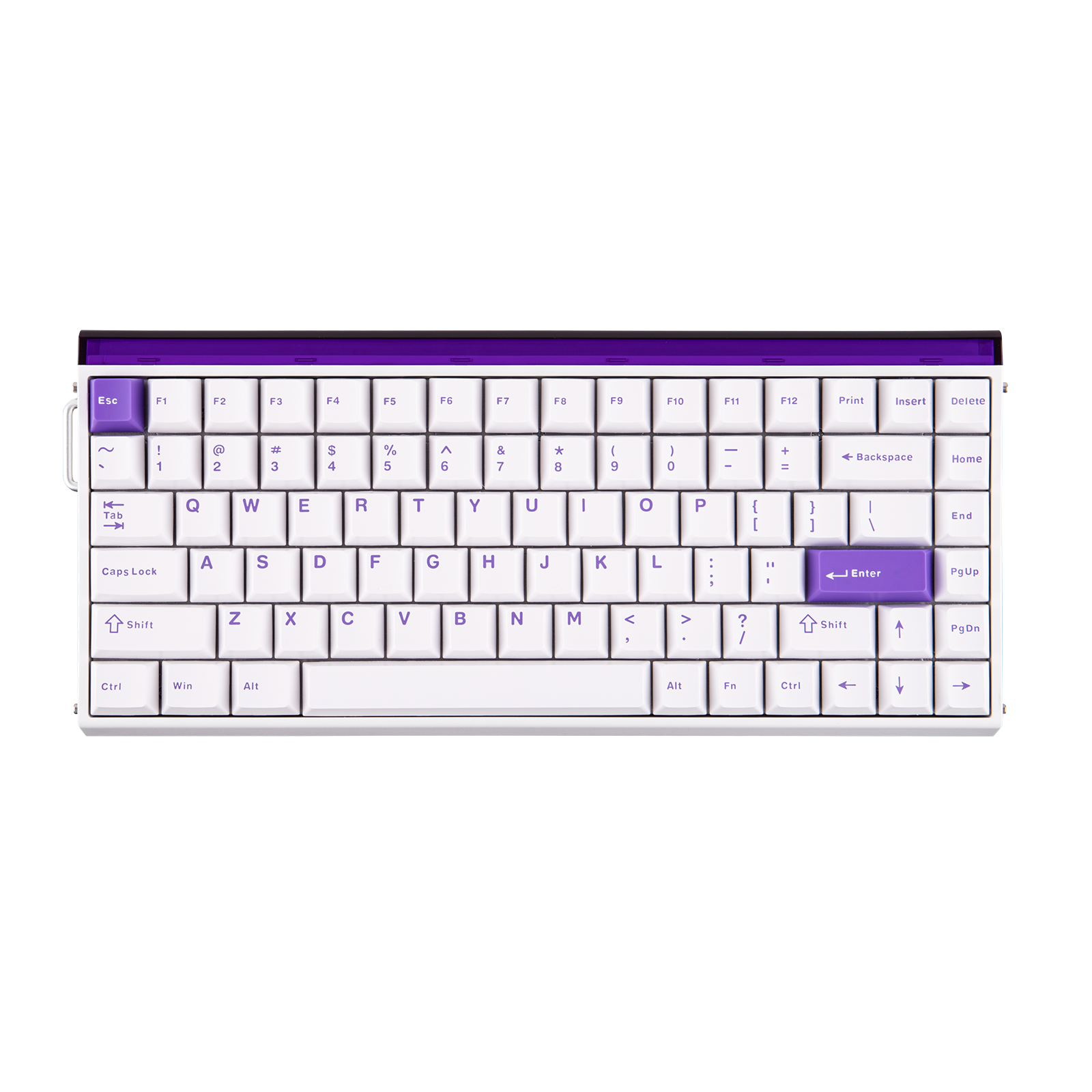
AULA HERO84 HE 75% Wired Hall Effect Magnetic Gaming Keyboard
AULA
Buy — AULA provides a dedicated model-specific web driver with visual calibration, while the wired keyboard supports 8,000 Hz polling and 0.01–3.4 mm advertised adjustment.
This is the stronger choice when dependable calibration and a clean Rapid Trigger interface matter most. Its drawback is the lack of a physical volume knob and its reliance on a Chromium web configurator.Available at Amazon(paid link) — opens Amazon in a new tab. Price and availability shown there.
AJAZZ AK820 MAX HE Wired Only 8K Hall Effect Keyboard
AJAZZ
It depends — Only the wired-only model reaches 8,000 Hz, and recorded tests and owner reports identify ghost inputs at 0.1 mm plus model-specific driver-recognition faults.
Consider this version when a physical volume knob and gasket-dampened sound are requirements. The tradeoff is a fragmented driver path, with recorded detection problems and unstable inputs at the minimum 0.1 mm setting.Available at Amazon(paid link) — opens Amazon in a new tab. Price and availability shown there.
Sources
Pages consulted while researching this article. None of these are affiliate links.
- AULA HERO84 HE official product specifications — aulagear.com
- AULA official web-driver directory — aulastar.com
- AULA Hero 84 HE official manual — aulagear.com
- Ajazz AK820 Max HE official product specifications — ajazz.net
- Ajazz official software and driver downloads — ajazz.net
- Tech4Gamers AULA Hero 84 HE review — tech4gamers.com
- Techxreviews Ajazz AK820 HE latency and calibration test — techxreviews.com
- Recorded Ajazz AK820 Max HE driver and ghost-input faults — reddit.com