Sigma 18–50mm f/2.8: How Good Is It in Low Light?
The question
sigma 18 50mm f 2.8 low light performance
The Sigma 18–50mm f/2.8 is a strong low-light kit-zoom upgrade, but moving subjects and unstabilized bodies expose its limits.
The Sigma 18–50mm F2.8 DC DN Contemporary performs well in low light for a compact APS-C zoom, especially when replacing a lens that reaches f/5.6 at the long end. Its limits are equally clear: it has no optical stabilization, and f/2.8 cannot preserve fast shutter speeds as effectively as an f/1.4 prime in very dim light.
This article concerns the 18–50mm F2.8 DC DN Contemporary mirrorless lens, not Sigma’s older DSLR lenses with similar names. Sigma lists Sony E, Fujifilm X, Canon RF and L-Mount versions; select the mount that matches your camera. Sigma specifications
Indoor people: the improvement comes from shutter speed
The useful feature is the constant maximum aperture: you can keep f/2.8 selected throughout the zoom range. Compared with f/5.6, f/2.8 provides a nominal two-stop exposure advantage—four times as much light at the same shutter speed, before differences in lens transmission.
For example, a scene requiring 1/60 second, f/5.6 and ISO 6400 would nominally allow either:
- 1/250 second, f/2.8 and ISO 6400, trading the extra light for less movement blur.
- 1/60 second, f/2.8 and ISO 1600, trading it for a lower ISO setting.
These are exposure calculations, not measured results from this lens. They also show why buying a brighter lens does not automatically produce cleaner photographs: if you spend the entire aperture advantage on a faster shutter, ISO stays unchanged.
The gain is smaller when your existing lens already opens wider. From f/4 to f/2.8, you gain approximately one stop; from f/3.5, roughly two-thirds of a stop. Check the aperture your current zoom actually uses at your preferred focal length before expecting a two-stop improvement everywhere.
For indoor family photographs, start around 1/125 second for relatively still adults, 1/250 for active children and 1/500 for faster movement. These are starting points, not guarantees. Use f/2.8 and Auto ISO, then inspect faces and hands for movement blur. A sharp photograph at higher ISO is usually more useful than a cleaner frame with a blurred face.
Static night scenes: stabilization changes the answer
The Sigma 18–50mm has no optical stabilization. Gordon Laing’s Camera Labs review demonstrated the consequence on a Sony A6400, which also lacks sensor-shift stabilization: handheld video was visibly unsteady. Camera Labs review
For a stationary building or restaurant interior, a stabilized slower lens can sometimes let you use a longer exposure and a lower ISO than this unstabilized f/2.8 zoom. That is the condition under which “a brighter lens is always better at night” fails. The result depends on how much slower you can actually handhold without blur.
If your camera has in-body image stabilization, the Sigma becomes more attractive for stationary subjects. Without it, start around 1/60 second at 18mm and 1/125 at 50mm, check a magnified image, and adjust for your steadiness and output size. These are conservative starting settings rather than measured handheld limits.
Stabilization cannot freeze someone walking through the frame. For moving people, keep the shutter speed high enough for their movement even when the camera itself is stabilized. For architecture on a tripod, longer exposures largely remove the need to shoot at maximum aperture.
Wide-open sharpness is useful; dark corners need attention
You do not need to stop down automatically just because the light is poor. Camera Labs found good detail at f/2.8 across its distant-scene tests at 18mm, 35mm and 50mm, with relatively modest improvements from stopping down. That supports using the aperture you bought the lens for when shutter speed matters. Camera Labs optical tests
Just want the recommendation?
Skip to the picksThe less obvious limitation is corner illumination. The Digital Picture measured approximately three stops of shading at 18mm f/2.8 and about 2.5 stops at 50mm f/2.8. Its review also explains that correcting vignetting increases noise in the brightened areas. The Digital Picture measurements
That matters for night photographs containing important shadow detail near the corners. A lens profile can make brightness more uniform, but it cannot recover photons that were never recorded. Consequently, corrected corners can look noisier than the center even when the overall exposure looks right.
Those shading measurements are not a prediction of how dark every finished JPEG will look. Camera corrections, RAW processing and sensor coverage affect the visible result. Inspect corrected files as well as uncorrected ones before judging a night image solely by its corners.
For handheld people photographs, retaining f/2.8 is usually the sensible tradeoff. For a static scene with support, stopping down and extending the exposure gives you another option. For stars, these general sharpness tests do not establish corner-star quality: they are insufficient to promise low coma or clean star shapes at f/2.8.
Dim video: f/2.8 helps, but shutter speed has limits
For conventional motion rendering, useful starting settings are 25 fps at 1/50 second or 30 fps at 1/60 second. At those shutter speeds, opening to f/2.8 can reduce the ISO required compared with a slower aperture. Constant f/2.8 also avoids an aperture-driven exposure change when zooming.
Recording at 60 fps with a 1/125-second shutter needs roughly twice the light of 30 fps at 1/60. If the room is already dim, switching to the lower frame rate may be more useful than expecting the lens to compensate. Lighting flicker can require different shutter choices.
A tripod, gimbal or effective camera stabilization remains relevant because the lens has no optical stabilization. Digital stabilization may steady the framing, but it does not add light or remove motion blur already recorded during each exposure.
Autofocus also needs a qualification. Camera Labs reported swift focusing on its A6400, but that does not establish a minimum usable light level across every supported camera. The cited tests do not provide a standardized low-light autofocus threshold for every mount and body. If focus hunts, try a defined focus area over a contrasty detail; a brighter aperture alone cannot guarantee reliable tracking in darkness.
When an f/1.4 prime is the better purchase
The Sigma 30mm F1.4 DC DN Contemporary is a useful alternative if you repeatedly photograph people in dim interiors and can accept one focal length. The following comparison uses the manufacturers’ aperture specifications; the light ratios are calculated, not transmission measurements. 18–50mm specifications, 30mm specifications
| Attribute | Sigma 18–50mm F2.8 DC DN | Sigma 30mm F1.4 DC DN |
|---|---|---|
| Focal length | 18–50mm | 30mm |
| Maximum aperture | f/2.8 | f/1.4 |
| Nominal light at maximum aperture | 1× | 4× |
At 30mm, switching from f/2.8 to f/1.4 nominally allows ISO 6400 to become ISO 1600 while retaining the same shutter speed. Alternatively, it can turn 1/60 second into approximately 1/250 at the same ISO. The costs are shallower depth of field and losing the ability to zoom; group photographs may still require stopping down.
For moving subjects in very dim rooms, the Sigma 18–50mm’s limitation against the 30mm prime is its two-stop smaller maximum aperture. For travel and events where framing changes constantly, the prime’s fixed 30mm view is the restriction that makes the zoom more practical.
Neither lens deserves a blanket skip: both are sound choices for different shooting conditions. Choose the 18–50mm for a flexible everyday zoom that remains useful indoors; consider the 30mm f/1.4 when insufficient shutter speed at f/2.8 is the recurring problem.
The bottom line
It splits on what you are actually asking:
Top pick
Buy this
Sigma 18-50mm F2.8 DC DN Contemporary Lens for Sony E
Its constant f/2.8 maximum aperture provides a nominal two-stop exposure advantage over f/5.6 at the same focal length.
A useful everyday zoom for indoor people and evening photography, with f/2.8 available throughout its range. It has no optical stabilization; this listing is the Sony E version, so select the correct mount for your camera.Available at Amazon(paid link) — opens Amazon in a new tab. Price and availability shown there.The alternative
It depends
Sigma 30mm F1.4 DC DN Contemporary Lens for Sony E
Its f/1.4 maximum aperture offers two stops more nominal light than f/2.8, but only at a fixed 30mm focal length.
Consider it for moving subjects in dim interiors when f/2.8 still requires too much ISO or too slow a shutter. Its fixed 30mm view sacrifices zoom flexibility, and f/1.4 reduces depth of field; select your camera’s mount.Available at Amazon(paid link) — opens Amazon in a new tab. Price and availability shown there.
Recommended products
Ordered by how well each one fits the situations above. Each link below is a paid link.

Sigma 18-50mm F2.8 DC DN Contemporary Lens for Sony E
Buy — Its constant f/2.8 maximum aperture provides a nominal two-stop exposure advantage over f/5.6 at the same focal length.
A useful everyday zoom for indoor people and evening photography, with f/2.8 available throughout its range. It has no optical stabilization; this listing is the Sony E version, so select the correct mount for your camera.Available at Amazon(paid link) — opens Amazon in a new tab. Price and availability shown there.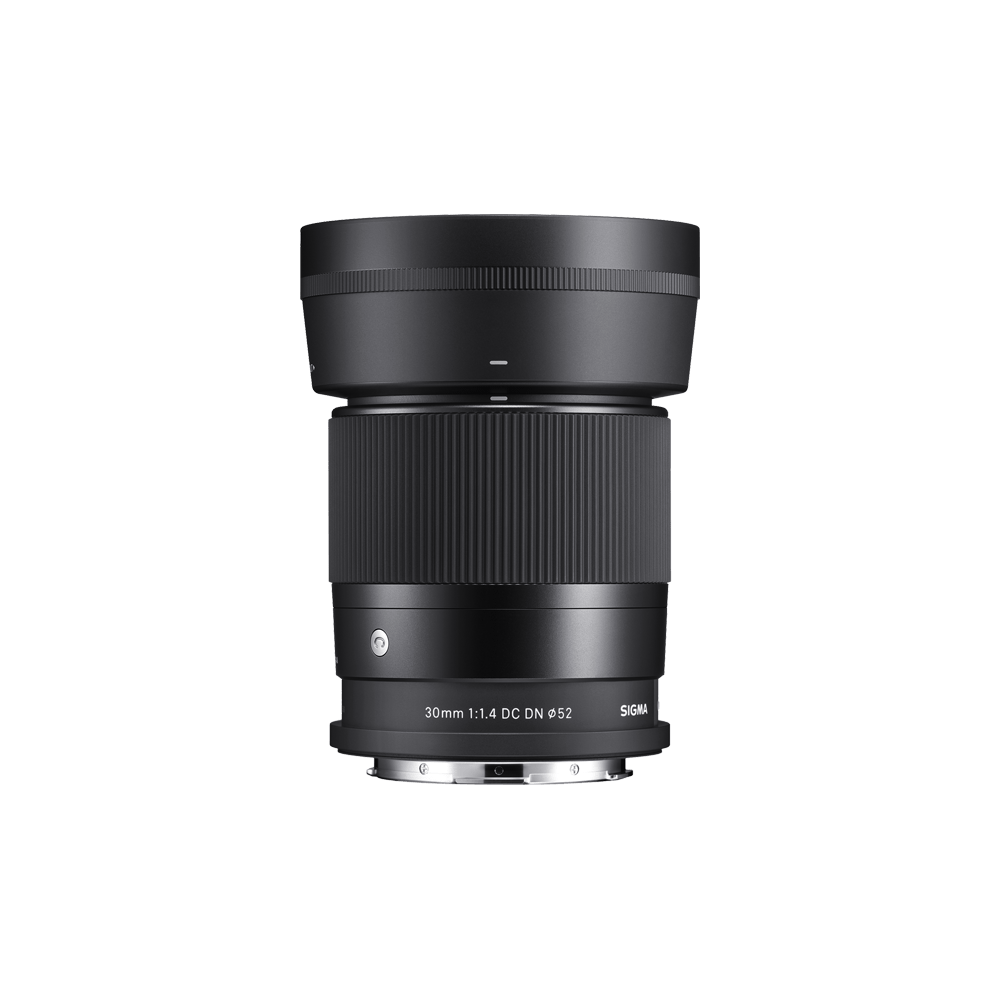
Sigma 30mm F1.4 DC DN Contemporary Lens for Sony E
Consider — Its f/1.4 maximum aperture offers two stops more nominal light than f/2.8, but only at a fixed 30mm focal length.
Consider it for moving subjects in dim interiors when f/2.8 still requires too much ISO or too slow a shutter. Its fixed 30mm view sacrifices zoom flexibility, and f/1.4 reduces depth of field; select your camera’s mount.Available at Amazon(paid link) — opens Amazon in a new tab. Price and availability shown there.
Sources
Pages consulted while researching this article. None of these are affiliate links.
- Sigma 18–50mm F2.8 DC DN Contemporary specifications — sigma-global.com
- Camera Labs: Sigma 18–50mm f2.8 DC DN review — cameralabs.com
- The Digital Picture: Sigma 18–50mm F2.8 DC DN Contemporary Lens Review — the-digital-picture.com
- Sigma 30mm F1.4 DC DN Contemporary specifications — sigma-global.com