Olympus 12-40 F2.8 vs 12-45 F4: Pick One
The question
User is deciding between the Olympus 12-40 f2.8 and 12-45 f4 for a rainy December trip with an E-M1 II. They need help balancing low-light speed, cost, weight, and weather sealing.
Choose the 12-40mm F2.8 for indoor or moving subjects; choose the 12-45mm F4 when saving 128g matters more than one stop.
Choose the Olympus M.Zuiko 12-40mm F2.8 PRO if this will be your only standard zoom: its one-stop advantage matters more for moving people, indoor scenes and dusk than the 12-45mm’s extra 5mm of reach. Choose the 12-45mm F4 PRO when reducing size and weight is what will make you carry the camera.
There is no honest skip here. Both are sharp, sealed PRO lenses; the decision is one stop of light versus a 128g weight reduction. What the 12-45mm gets wrong for low-light event, family and street photographers is its f/4 ceiling, which requires either twice the ISO or half the shutter speed compared with f/2.8 in the same light.
| Lens | Aperture and range | Weight, length and sealing | Verdict |
|---|---|---|---|
| Olympus 12-40mm F2.8 PRO | Constant f/2.8; 24–80mm equivalent | 382g; 84mm; IPX1 with a compatible sealed body | Buy for the more versatile one-lens kit |
| Olympus 12-45mm F4 PRO | Constant f/4; 24–90mm equivalent | 254g; 70mm; IPX1 with a compatible sealed body | Consider when compactness is the priority |
Those figures come from the manufacturers’ specifications for the original 12-40mm F2.8 PRO and 12-45mm F4 PRO. The 12-45mm is 128g lighter, 14mm shorter and 6.5mm narrower. Conversely, the 12-40mm is roughly 50% heavier than the 12-45mm, so this is not a difference that disappears on a kitchen scale.
Where one stop changes the photograph
Moving from f/4 to f/2.8 doubles the light reaching the sensor. In a scene where the 12-45mm needs ISO 6400 at 1/125 second, the 12-40mm can hold 1/125 at ISO 3200. Alternatively, it can retain the same ISO while moving from roughly 1/60 to 1/125 second.
That distinction matters when the subject moves. In-body stabilization can reduce blur caused by your hands, but it cannot stop a walking person, an active child or wind-blown foliage. For museums, restaurants, evening streets, indoor events and environmental portraits, f/2.8 is the more useful specification. It also permits shallower depth of field at the same focal length, distance and framing.
The advantage becomes less important for static architecture and landscapes. With a stabilized Olympus body, you can lower the shutter speed instead of raising ISO, provided the subject remains still. If most photographs are made outdoors in adequate light, both lenses will commonly be used at f/4, f/5.6 or f/8 anyway.
What the 128g saving feels like as a complete kit
The weight difference becomes clearer when calculated with a body. Olympus specifies the E-M1 Mark II at 574g with its battery and memory card. That produces a 956g body-and-lens combination with the 12-40mm, versus 828g with the 12-45mm, before adding a strap, hood or filter. The smaller lens therefore cuts about 13% from that complete combination. Olympus documents the E-M1 Mark II’s weight and Micro Four Thirds compatibility.
On a long walk, a small shoulder bag or a compact E-M5/E-M10-style body, that reduction can be more valuable than f/2.8. The 12-45mm also uses 58mm filters rather than the 12-40mm’s 62mm filters. Existing polarizers or neutral-density filters may therefore affect the practical choice.
The extra telephoto reach is real but modest: 45mm instead of 40mm, or a 90mm rather than 80mm full-frame-equivalent angle of view. It helps with tighter portraits and details, but it is not a substitute for a telephoto zoom.
Rain is not the reason to choose between them
Both compared lenses are dust-resistant and carry an IPX1 splash-resistance specification when attached to a compatible weather-sealed Olympus body. Olympus says the 12-45mm uses seals at nine locations, but its rating still does not exceed the original 12-40mm’s IPX1 level. Treat both as suitable for ordinary rain precautions, not as waterproof or submersible equipment.
Just want the recommendation?
Skip to the picksThis matters particularly with the E-M1 Mark II. The newer OM System 12-40mm F2.8 PRO II lens is rated IP53, but an official OM System body-and-lens sealing compatibility table says an IP53 lens on a weather-resistant body that is not IP53 yields IPX1-equivalent protection for the combination. Therefore, putting the PRO II on an E-M1 Mark II does not turn the entire kit into an IP53 system.
The PRO II becomes the meaningful weather upgrade when it is paired with a compatible IP53 body. It retains the 382g weight, 84mm length, f/2.8 aperture and 0.2m minimum focusing distance while adding IP53-rated sealing and a fluorine-coated front element, according to the PRO II specifications.
Sharpness does not provide a clean winner
Independent testing supports treating both as serious optics rather than assuming the slower lens is inferior. ePHOTOzine tested the 12-45mm on a Panasonic G9 with Imatest and recorded excellent central sharpness at f/4 throughout the tested focal lengths. It also measured corrected barrel distortion of -1.12% at 12mm and found diffraction increasingly harmful at f/16 and f/22. Its 12-45mm performance results are published with the test method.
ePHOTOzine’s separate Imatest review of the original 12-40mm found outstanding sharpness across the frame at 12mm and strong results between maximum aperture and f/8 at 18mm. At 40mm and f/2.8, the center was rated very good and the edges good; stopping down to f/4–f/5.6 raised performance across the frame to outstanding.
A direct controlled comparison by Amateur Photographer reached the more useful purchasing conclusion: results from the two lenses were nearly indistinguishable on a 20MP E-M5 Mark III, apart from slight 12mm corner softness from the 12-45mm at f/4 when viewed closely. The publication also confirmed that the 12-45mm lacks the 12-40mm’s pull-back manual-focus clutch and customizable L-Fn button. Amateur Photographer’s side-by-side findings make optical quality a poor reason to carry the heavier lens; aperture and handling are the defensible reasons.
Close focusing has a counterintuitive result
The 12-45mm can focus from 0.12m at 12mm and 0.23m at 45mm, while the 12-40mm specifies 0.2m throughout its range. That makes the 12-45mm sound like the automatic close-up winner, but maximum magnification says otherwise: it reaches 0.25×, while the 12-40mm reaches 0.30× at its telephoto end.
Choose the 12-45mm for flexible close focusing across the zoom range. Choose the 12-40mm when the largest possible subject reproduction is the goal. Neither replaces a true 1:1 macro lens.
The decision rule that holds up
Buy the Olympus 12-40mm F2.8 PRO when you regularly photograph moving subjects in poor light, want shallower backgrounds, use manual focus often or need a customizable lens button. Its drawback is the 382g weight and larger 62mm filter thread.
Consider the Olympus 12-45mm F4 PRO when daylight travel, hiking or a compact everyday kit dominates. It is the wrong choice for photographers expecting stabilization to compensate for moving subjects after dark, but it is the better-balanced lens when every 100g affects whether the camera leaves the house.
A strict lens budget can legitimately decide the purchase after that capability test. If f/2.8 will be used, sacrificing it to reduce the checkout total removes a photographic option that software cannot fully restore. If nearly every image will be made at f/4 or smaller, paying for and carrying a wider aperture provides little practical return.
The bottom line
Neither is wrong; the use case separates them:
Top pick
Buy this
Olympus M.Zuiko Digital ED 12-40mm F2.8 PRO Lens
Olympus MZuiko
Its constant f/2.8 aperture gathers one stop more light than f/4 while retaining a useful 24–80mm-equivalent range.
Choose it for moving subjects, indoor photography and dusk, where f/2.8 halves the required ISO or doubles the available shutter speed against f/4. The drawback is its 382g weight and larger 62mm filter thread.Available at Amazon(paid link) — opens Amazon in a new tab. Price and availability shown there.The alternative
It depends
Olympus M.Zuiko Digital ED 12-45mm F4.0 PRO Lens
Olympus MZuiko
It weighs 254g and measures 70mm long—128g lighter and 14mm shorter than the 12-40mm—but loses one stop of light.
Choose it for hiking, daylight travel or compact bodies when reducing carry weight matters more than maximum aperture. The f/4 ceiling is a real limitation with moving subjects in weak light.Available at Amazon(paid link) — opens Amazon in a new tab. Price and availability shown there.
Recommended products
Ordered by how well each one fits the situations above. Each link below is a paid link.
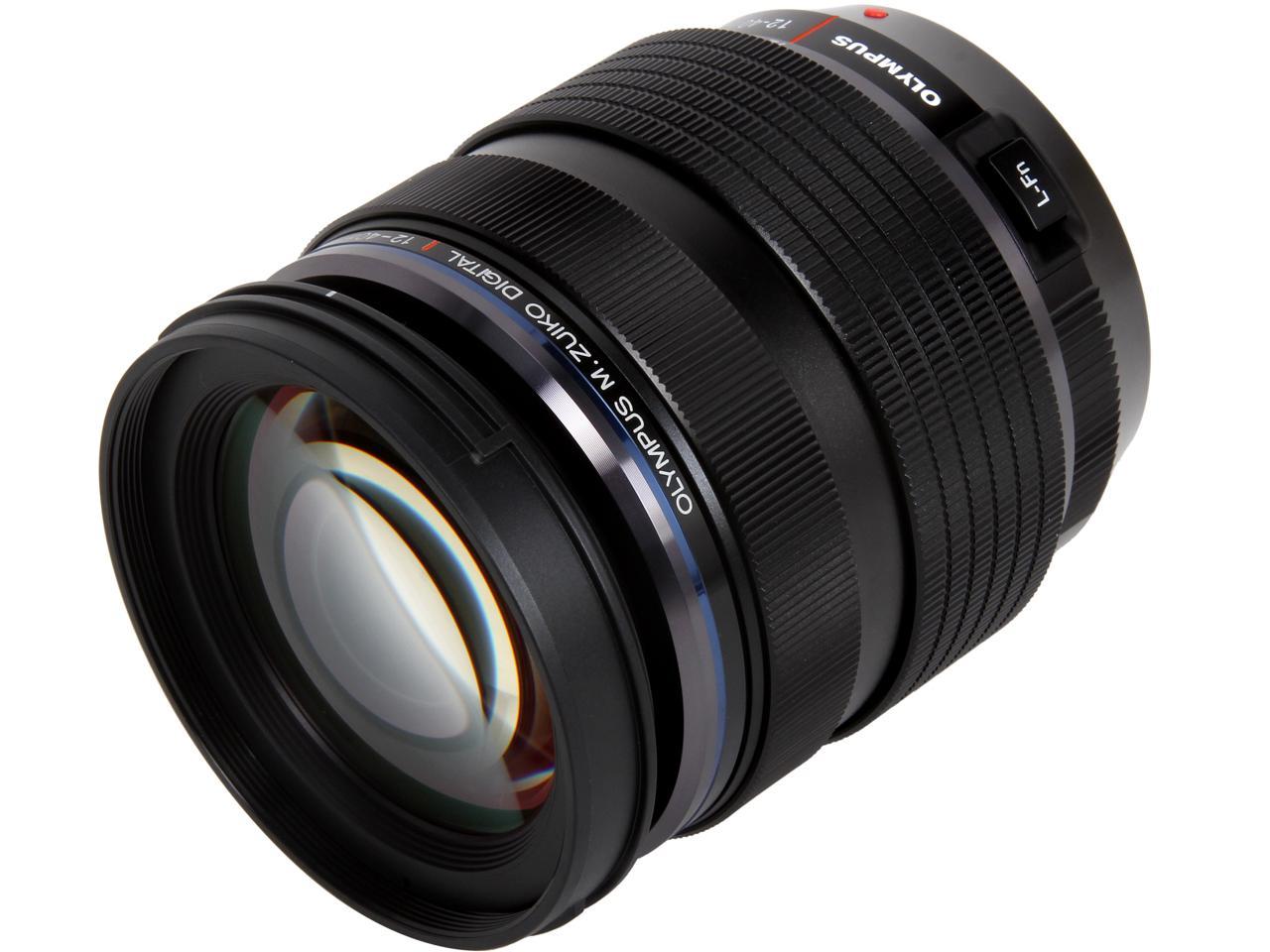
Olympus M.Zuiko Digital ED 12-40mm F2.8 PRO Lens
Olympus MZuiko
Buy — Its constant f/2.8 aperture gathers one stop more light than f/4 while retaining a useful 24–80mm-equivalent range.
Choose it for moving subjects, indoor photography and dusk, where f/2.8 halves the required ISO or doubles the available shutter speed against f/4. The drawback is its 382g weight and larger 62mm filter thread.Available at Amazon(paid link) — opens Amazon in a new tab. Price and availability shown there.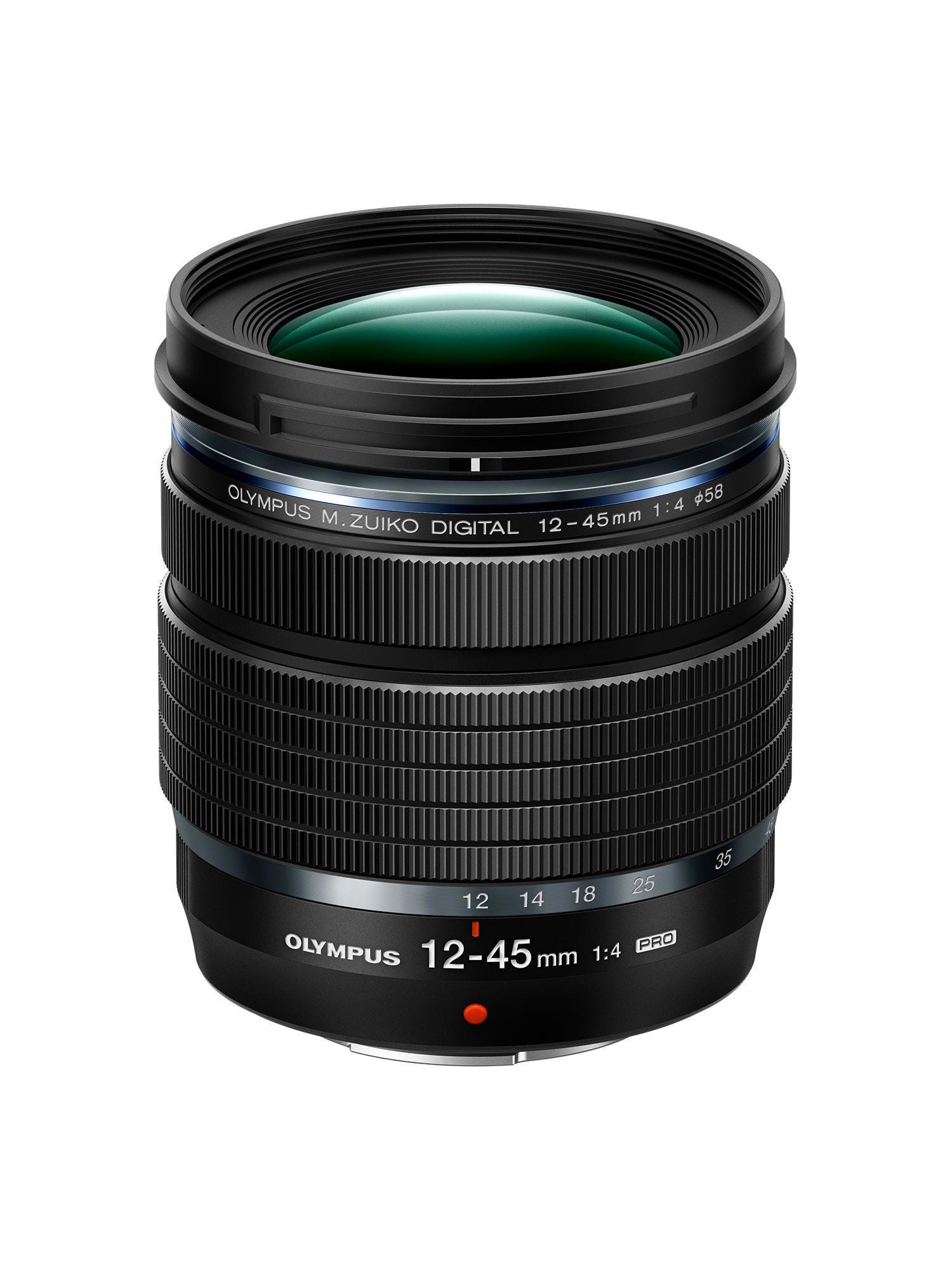
Olympus M.Zuiko Digital ED 12-45mm F4.0 PRO Lens
Olympus MZuiko
Consider — It weighs 254g and measures 70mm long—128g lighter and 14mm shorter than the 12-40mm—but loses one stop of light.
Choose it for hiking, daylight travel or compact bodies when reducing carry weight matters more than maximum aperture. The f/4 ceiling is a real limitation with moving subjects in weak light.Available at Amazon(paid link) — opens Amazon in a new tab. Price and availability shown there.
Sources
Pages consulted while researching this article. None of these are affiliate links.
- M.Zuiko Digital ED 12-40mm F2.8 PRO Specifications — OM System — jp.omsystem.com
- M.Zuiko Digital ED 12-45mm F4.0 PRO Specifications — OM System — jp.omsystem.com
- E-M1 Mark II Product Q&A and Specifications — OM Digital Solutions — support.jp.omsystem.com
- Weather-Sealed Lens and Body Compatibility — OM Digital Solutions — digital-faq.jp.omsystem.com
- M.Zuiko Digital ED 12-40mm F2.8 PRO II Specifications — OM System — jp.omsystem.com
- Olympus M.Zuiko Digital ED 12-45mm F4.0 PRO Review: Performance — ePHOTOzine — ephotozine.com
- Olympus M.Zuiko ED 12-40mm F2.8 PRO Lens Review — ePHOTOzine — ephotozine.com
- Olympus M.Zuiko Digital ED 12-45mm F4 Pro Review — Amateur Photographer — amateurphotographer.com