GH6 or S5D? The Better Body for EF Video
The questionWhere do these come from?
What is better: the Lumix S5 or the Lumix GH6 with a 0.71x speed booster?
I am currently looking to invest in a budget camera for videography and possibly build a rig around it later.
Choose the GH6 for video formats and speed-boosted EF glass; choose the S5D for full-frame framing, low light, and shallow focus.
Choose the Lumix GH6 if high-frame-rate video, internal ProRes, long 10-bit recording, or an EF speed booster matters most. Choose the Lumix S5D if you primarily want full-frame image characteristics, stronger low-light flexibility, and the original field of view from full-frame EF lenses.
| Specification | Lumix GH6 | Lumix S5D |
|---|---|---|
| Sensor and mount | 25.21MP, 17.3 × 13.0mm, Micro Four Thirds | 24.20MP, 35.6 × 23.8mm, L-Mount |
| Main internal 10-bit modes | 5.7K 60p 4:2:0; C4K/4K 60p 4:2:2 | C4K/4K 30p 4:2:2; 4K 60p 4:2:0 in APS-C or Pixel/Pixel mode |
| High frame rate | C4K/4K 120p 4:2:0 10-bit | 4K up to 60fps; FHD up to 180fps in Slow & Quick mode |
| 10-bit recording duration | Unlimited C4K/4K 60p under Panasonic’s specified operating conditions | Up to 30 minutes for the principal 4K 10-bit modes |
| Manufacturer V-Log latitude claim | 13+ stops with Dynamic Range Boost | 14+ stops |
These figures come from Panasonic’s official GH6 specifications and S5D specifications. The latitude figures are manufacturer claims, not a controlled comparison proving that the S5D delivers exactly one additional usable stop in every scene.
Choose the GH6 for a video-first EF rig
The GH6 is the more capable video body. It records 5.7K at 60p, C4K/4K at 120p, 5.8K 4:3 anamorphic footage, and several 10-bit All-Intra modes. It can also record Apple ProRes 422 or ProRes 422 HQ internally to CFexpress Type B media. The S5D reserves its 5.9K output for 12-bit RAW over HDMI to a compatible external recorder; it does not record 5.9K internally.
That distinction affects the whole rig. The GH6 can provide an edit-friendly internal master without adding an HDMI recorder, recorder mount, HDMI cable, or another battery. It also has a fan and supports unlimited C4K/4K 60p 4:2:2 10-bit recording under Panasonic’s stated environmental and power conditions. The S5D limits its primary 4K 10-bit modes to 30-minute clips, although its 4K 8-bit modes can continue without that time limit.
For slow motion, the choice is straightforward: the GH6 reaches C4K/4K 120p in 10-bit, while the S5D’s Slow & Quick mode tops out at 60fps in 4K and 180fps in FHD. Dynamic Range Boost must be disabled for the GH6’s 120p modes. When Dynamic Range Boost is enabled for V-Log, its base sensitivity rises to ISO 2000, so daylight work will usually require adequate ND filtration.
Choose the S5D when the full-frame image matters more
The S5D’s full-frame sensor uses the image circle of a full-frame EF lens without a focal reducer. A 24mm full-frame EF lens therefore retains approximately the field of view expected from a 24mm lens on full frame when used with a non-reducing EF-to-L adapter. At 4K 60p, however, the S5D switches to an APS-C or Pixel/Pixel image area, narrowing that field of view.
The larger sensor makes the S5D the stronger fit for available-light shooting and shallow depth of field at the same framing. Its V-Log Dual Native ISO settings are ISO 640 and ISO 4000, whereas the GH6 uses a much smaller Micro Four Thirds sensor and relies partly on its Dynamic Range Boost processing. No fixed low-light advantage in stops can be promised without testing the exact recording modes, exposure, lens, and noise-reduction workflow.
The S5D is also smaller and lighter before adapters: Panasonic lists 714g with battery and one SD card, against 823g for the GH6 under the corresponding configuration. Its two card slots accept one UHS-II SD card and one UHS-I SD card. The GH6 instead provides one CFexpress Type B slot and one UHS-II SD slot, which supports higher internal bit rates but gives unlike-for-like media rather than two interchangeable SD slots.
If you plan to use a 0.71x EF speed booster
A 0.71x EF-to-Micro Four Thirds focal reducer is a meaningful reason to select the GH6. Metabones states that its EF-MFT Speed Booster ULTRA makes the lens 0.71x wider and increases the maximum aperture by one stop. It reduces the effective Micro Four Thirds crop from approximately 2.0x to 1.4x.
Just want the recommendation?
Skip to the picksFor example, a 24mm f/2.8 EF lens becomes approximately a 17mm f/2 optical combination before the sensor crop, producing a field of view close to a 34mm lens on full frame. That is considerably wider and brighter than using the same lens on the GH6 with a plain adapter, but it does not turn the GH6 into a full-frame camera or guarantee S5D-level noise and depth-of-field performance.
The current Canon EF Lens to MFT T Speed Booster ULTRA 0.71x Mark II explicitly lists the GH6 as compatible. Its limitations matter for video: electronic iris changes occur in 1/8-stop increments and may be visible, in-camera lens corrections are unavailable, and older third-party EF lenses can behave unpredictably. Check the manufacturer’s lens list rather than assuming every EF lens will work.
A focal reducer is normally the wrong adapter for the S5D. Its full-frame sensor already needs the full image circle from full-frame EF glass; reducing that image circle would cause heavy vignetting. Use a plain mechanical or electronic EF-to-L adapter instead.
If the EF lens is manual focus but has electronic aperture
“Manual focus” does not necessarily mean the lens is fully mechanical. Most Canon EF stills lenses lack a manual aperture ring. They need a powered smart adapter to change aperture even when focus is pulled entirely by hand. A cinema EF lens with a mechanical iris can use a simpler passive adapter.
Both cameras provide Focus Peaking, MF Assist, and an MF Guide. The GH6 additionally lists Enlarged Live Display for video, and both bodies allow Focus Peaking and its sensitivity control to be assigned to a function button. For a non-communicating lens, enter the lens’s effective focal length in the stabilization settings before depending on IBIS. With a 0.71x reducer, that means the reduced value—for example, approximately 35.5mm for a 50mm lens—unless the smart adapter reports the corrected focal length automatically.
Support for aperture, optical stabilization, EXIF data, and focus-by-wire varies by exact lens and adapter firmware. If the lens is not present on the adapter manufacturer’s compatibility list, confirmation from that manufacturer is the only reliable answer before purchase.
If “S5D” was meant to mean the original S5
The S5D is a refreshed S5-generation camera, not an S5 II with a different letter. Its published specification still lists contrast autofocus with DFD rather than phase-detection autofocus. The headline addition is readiness for the DJI LiDAR Range Finder Module used with the DJI RS 3 Pro: Panasonic says distance data travels to the camera over USB so the camera can drive focus without a separate focus motor. Panasonic’s S5D announcement describes the required DJI hardware and connection.
That LiDAR feature should not influence a manual EF-lens decision unless Panasonic, DJI, or the adapter manufacturer explicitly confirms the complete lens-and-adapter combination. A fully mechanical manual-focus EF lens cannot be driven by the camera merely because the S5D is LiDAR-ready.
For the workflow described, the practical verdict remains: build around the GH6 when the speed booster, 4K 120p, internal ProRes, anamorphic capture, and long 10-bit takes are central. Build around the S5D when full-frame field of view, shallow focus, high-ISO work, and a lighter body outweigh the recording-format limitations.
The bottom line
The pick, plainly:
Top pick
It depends
Metabones Speed Booster Ultra 0.71x Adapter for Canon EF Lens to Sony E Mount T Speed Booster
Metabones
The article recommends the GH6-compatible EF-to-MFT 0.71x model only with lens-compatibility checks, while warning that a focal reducer would cause heavy vignetting on the S5D.
This is the current 0.71x EF-MFT model that Metabones explicitly lists as GH6-compatible, providing electronic aperture control and a one-stop optical gain. Its drawbacks are visible 1/8-stop iris steps, no in-camera lens corrections, and lens-specific compatibility limits.Available at Amazon(paid link) — opens Amazon in a new tab. Price and availability shown there.
Recommended products
Ordered by how well each one fits the situations above. Each link below is a paid link.
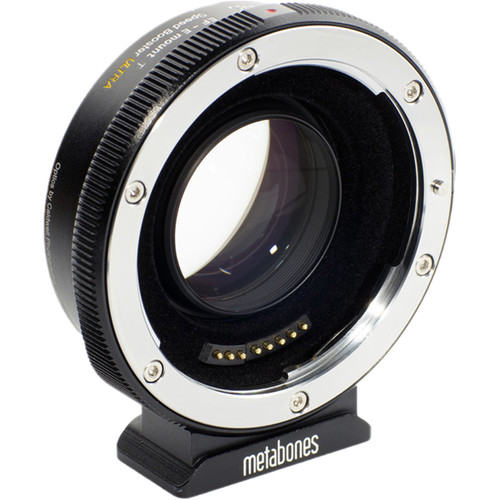
Metabones Speed Booster Ultra 0.71x Adapter for Canon EF Lens to Sony E Mount T Speed Booster
Metabones
It depends — The article recommends the GH6-compatible EF-to-MFT 0.71x model only with lens-compatibility checks, while warning that a focal reducer would cause heavy vignetting on the S5D.
This is the current 0.71x EF-MFT model that Metabones explicitly lists as GH6-compatible, providing electronic aperture control and a one-stop optical gain. Its drawbacks are visible 1/8-stop iris steps, no in-camera lens corrections, and lens-specific compatibility limits.Available at Amazon(paid link) — opens Amazon in a new tab. Price and availability shown there.
Sources
Pages consulted while researching this article. None of these are affiliate links.
- Panasonic Lumix S5D review — COMPUTER BILD — computerbild.de
- Panasonic LUMIX GH6 Lab Test — CineD — cined.com
- Canon EF Lens Catalogue: EF Lens Primary Technologies — asia.canon
- Micro Four Thirds System FAQ — four-thirds.org
- Panasonic Lumix GH6 Features and Specifications — panasonic.com
- Panasonic Lumix S5D Specifications — panasonic.com
- Panasonic Introduces Lumix S5D Full-Frame Mirrorless Camera Refresh — panasonic.com
- Metabones Canon EF Lens to MFT T Speed Booster ULTRA 0.71x Mark II — metabones.com