Fuji X-E5 vs Sony A7C II: The Casual-Shooter Verdict
The questionWhere do these come from?
Selling the A7CII for a Fuji ie X-E5. Anyone else made a similar jump?
Long post, sorry. Trying to think this through out loud. I bought the A7CII about two years ago when I was creating content for Instagram; travel, video, colour grading, the whole thing.
The X-E5 with the 23mm f/2.8 wins for casual, film-simulation shooting; keep the A7C II for tracking, battery life or serious video.
If casual, walk-around shooting and in-camera film looks are genuinely the whole use case, the Fujifilm X-E5 with the XF 23mm f/2.8 R WR is a reasonable switch from the Sony A7C II — you’re trading autofocus polish and battery life for a dedicated Film Simulation dial and a body that disappears in a jacket pocket. Keep the A7C II instead if any of your shooting involves moving subjects, video work, or low light past what a well-lit street or living room provides.
What the X-E5 and 23mm f/2.8 actually change
The X-E5 pairs a 40.2-megapixel X-Trans CMOS 5 HR sensor with a new top-plate Film Simulation dial — the same control Fujifilm put on the X-T50 and X-M5, with six physical positions (Provia, Velvia, Astia, Classic Chrome, Reala Ace and Acros) plus three customizable slots for saved recipes, drawing from 20 simulations in total (Fujifilm X-E5 product page). That dial is the actual feature being asked about when someone frames this as “casual shooting and film simulations” — it turns a JPEG look into a physical setting you can change without opening a menu, and DPReview’s own coverage credits the X-E5 specifically with getting more photographers to take film recipes seriously because the hardware now supports them directly (DPReview: why the X-E5 turned me into a film recipes fan). Fuji X Weekly’s Ritchie Roesch, who has spent years building these recipes, calls the pairing “ideal for everyday walk-around photography” and notes the 23mm f/2.8 is “sharp with minimal flaws” (Fuji X Weekly: X-E5 review).
Size is the other half of the appeal. The X-E5 body weighs 445g with battery and card; the 23mm f/2.8 R WR lens adds only 90g and is 23mm long — Fujifilm’s own listing describes it as “compact and lightweight,” and it was designed specifically as the X-E5’s launch kit lens (Fujifilm XF23mmF2.8 R WR page). A camera-plus-lens combo under 540g total is meaningfully smaller than an A7C II with almost any full-frame prime attached, and it’s the reason reviewers keep comparing the X-E5 to a interchangeable-lens version of the X100VI rather than to a scaled-down full-frame body (DPReview: X-E5 in-depth review).
What you give up leaving the A7C II
The A7C II’s autofocus is the biggest thing on the table. It runs 759 phase-detection points across 94% of the frame with real-time subject recognition for humans, animals and vehicles, and DPReview rates it 87% overall with a Silver Award, calling the autofocus “one of the best on the market” (DPReview: A7C II review). The X-E5, by contrast, gets a more measured verdict from the same reviewer: “generally quick and reliable” but “off the pace set by Canon, Nikon and Sony,” with occasional distance misjudgment on moving subjects. For static street shots, portraits and travel snapshots that gap rarely matters. For a kid running across a yard or a pet that won’t sit still, it will.
Battery life splits the same way. The X-E5 is CIPA-rated for 310 shots per charge; the A7C II is rated for roughly 530 shots through the viewfinder and 560 on the rear screen (Alpha Shooters: A7C II battery guide). That’s not a rounding difference — it’s close to double, and it means a full day of casual shooting on the X-E5 more often needs a spare battery than the same day on the A7C II. Weather sealing is also asymmetric: the A7C II’s magnesium-alloy shell is rated dust- and moisture-resistant, while the X-E5 body carries no equivalent sealing rating, even though the 23mm f/2.8 lens itself is weather-resistant on its own (Fujifilm XF23mmF2.8 R WR page).
Just want the recommendation?
Skip to the picksBoth cameras land close on stabilization — Fujifilm rates the X-E5’s IBIS at up to 7.0 stops center-frame and 6.0 stops at the periphery, its first in-body stabilization in the X-E line, while the A7C II’s 5-axis IBIS is rated to roughly 7 stops as well, up from 5 stops on the original A7C (DPReview: X-E5 in-depth review). Sensor size still decides low-light headroom on its own terms: the A7C II’s 33-megapixel full-frame sensor gathers roughly 1.6x more light per pixel area than the X-E5’s APS-C sensor at the same aperture and ISO, which shows up specifically once the room gets dim rather than in daylight comparisons.
Video and viewfinder, if either matters to you
If any part of “casual shooting” secretly includes video, the gap widens further. The A7C II records 4K at up to 60p in 10-bit 4:2:2 with full-pixel readout and no crop. The X-E5 records 6.2K at 30p with a 1.23x crop and 4K at 60p with a 1.14x crop, dropping to full-width only at 4K 30p (DPReview: X-E5 in-depth review). Neither camera has a strong viewfinder by modern standards — both use a 2.36-million-dot EVF panel — but the A7C II’s is larger at 0.70x magnification against the X-E5’s 0.62x, which DPReview describes as “relatively small” with a “fairly short eye-point,” better suited to bright-light framing than extended eye-level shooting.
Is the 23mm f/2.8 the right lens, or should it be the 27mm
The 23mm f/2.8 gives a 35mm-equivalent field of view, which is the standard street and travel focal length and the reason Fujifilm chose it as the X-E5’s launch lens. If you find 35mm slightly too wide for the kind of casual, closer-in shooting you did on the A7C II with something like a 40mm or 50mm equivalent, the Fujinon XF 27mm f/2.8 R WR II is the closest Fuji alternative: it’s smaller still at 84g, gives a 41mm-equivalent view closer to a normal-vision perspective, and also carries a weather-resistant rating (Fujinon XF27mmF2.8 R WR product page). It’s a real trade rather than a straight upgrade — the narrower field of view is less forgiving in tight interiors and on crowded streets, which is exactly where a 35mm-equivalent lens like the 23mm earns its keep.
The comparison, side by side
| Verdict | The thing that decides it | The catch | |
|---|---|---|---|
| Fuji X-E5 + XF 23mm f/2.8 R WR | Buy | Physical Film Simulation dial with 3 recipe slots, plus a 535g total kit weight | Autofocus trails Sony’s tracking and CIPA battery life is roughly 40% lower per charge |
| Sony A7C II | Consider | 759-point AF with real-time tracking, 10fps burst, and full weather sealing | No built-in recipe system — every JPEG look has to be built and applied manually, and there’s no equivalent to the dial |
| Fujifilm X100VI | Consider | Same 40.2MP sensor and a similar 35mm-equivalent lens sealed into one fixed body | No interchangeable lenses, and full weather resistance needs the separate AR-X100 adapter ring and a 49mm filter (Fuji Rumors: X100VI weather sealing) |
| Fujinon XF 27mm f/2.8 R WR II | Consider | Smaller and lighter than the 23mm, with a 41mm-equivalent view closer to normal vision | Narrower framing is less versatile than 35mm-equivalent for interiors and street work |
If you shoot moving subjects or serious video, keep the A7C II
The condition that flips this decision is simple: does any meaningful share of your shooting involve autofocus tracking moving subjects, low light beyond a lit room, or video past casual clips? If yes, the A7C II’s 759-point tracking system, near-double battery life, and uncropped 4K60 are not conveniences you’ll want to give up for a film dial, however good that dial feels. The X-E5 is built around JPEG character and physical handling, not around chasing focus on something that won’t hold still.
The alternative nobody in this comparison mentions: the X100VI
Because the X-E5 shares its 40.2-megapixel X-Trans CMOS 5 HR sensor with the Fujifilm X100VI, and the 23mm f/2.8 gives nearly the same field of view as the X100VI’s fixed 23mm f/2, the X-E5-plus-lens combination is functionally a interchangeable-lens version of that camera — which is exactly how DPReview frames it, positioning the X-E5 as an option “for those unable to obtain the popular X100VI” (DPReview: X-E5 in-depth review). If the appeal is purely the sensor and the film simulations rather than lens flexibility, and the fixed-lens body is available, it’s worth comparing against directly rather than assuming interchangeable lenses are automatically the better fit for “casual” use — a fixed lens forces no decisions once you own it, while an X-mount body means the 23mm f/2.8 is only the first of many lenses you’ll eventually be tempted to add.
The bottom line
For casual, walk-around shooting built around Fujifilm’s film simulations, the X-E5 with the 23mm f/2.8 is the right switch, and the trade-offs — slower autofocus tracking, shorter battery life, no body weather sealing — are ones that matter far more in sports, wildlife or professional video work than in the kind of shooting the question describes. Keep the A7C II if any part of the actual use case leans toward moving subjects, low light, or serious video, because that’s precisely where the full-frame sensor and Sony’s autofocus system earn the extra size and weight.
The bottom line
Both are defensible — the split is what you do with it:
Top pick
Buy this
Fujifilm X-E5 with XF 23mm f/2.8 R WR kit
Fujifilm
CIPA-rated 310 shots and DPReview's 'off the pace' autofocus verdict are real costs, but neither matters much for static, casual shooting, and no rival offers a physical film-recipe dial.
The subject of the comparison: a dedicated Film Simulation dial with three custom recipe slots and a sub-540g total kit weight make it a genuine fit for casual, walk-around shooting, though autofocus tracking and battery life both trail the A7C II.Available at Amazon(paid link) — opens Amazon in a new tab. Price and availability shown there.The alternative
It depends
Sony A7C II mirrorless camera body
Sony
Right for shooters whose work includes tracking moving subjects, low light, or serious video — but it has no equivalent to Fujifilm's in-camera film simulation dial.
The camera being switched away from: its 759-point autofocus, 10fps burst and full weather sealing outclass the X-E5 for anything that moves, and its CIPA battery rating is nearly double.Available at Amazon(paid link) — opens Amazon in a new tab. Price and availability shown there.
Recommended products
Ordered by how well each one fits the situations above. Each link below is a paid link.
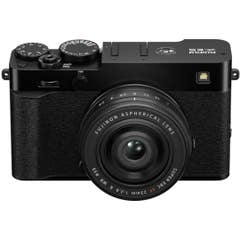
Fujifilm X-E5 with XF 23mm f/2.8 R WR kit
Fujifilm
Buy — CIPA-rated 310 shots and DPReview's 'off the pace' autofocus verdict are real costs, but neither matters much for static, casual shooting, and no rival offers a physical film-recipe dial.
The subject of the comparison: a dedicated Film Simulation dial with three custom recipe slots and a sub-540g total kit weight make it a genuine fit for casual, walk-around shooting, though autofocus tracking and battery life both trail the A7C II.Available at Amazon(paid link) — opens Amazon in a new tab. Price and availability shown there.
Sony A7C II mirrorless camera body
Sony
It depends — Right for shooters whose work includes tracking moving subjects, low light, or serious video — but it has no equivalent to Fujifilm's in-camera film simulation dial.
The camera being switched away from: its 759-point autofocus, 10fps burst and full weather sealing outclass the X-E5 for anything that moves, and its CIPA battery rating is nearly double.Available at Amazon(paid link) — opens Amazon in a new tab. Price and availability shown there.
Fujifilm X100VI camera
Fujifilm
It depends — No interchangeable lenses, and full weather resistance requires the separate AR-X100 adapter ring and a 49mm filter rather than being built in.
An alternative worth checking before buying an X-mount body: it shares the X-E5’s 40.2MP sensor and a similar 35mm-equivalent lens sealed into one fixed-lens body.Available at Amazon(paid link) — opens Amazon in a new tab. Price and availability shown there.
Sources
Pages consulted while researching this article. None of these are affiliate links.
- FUJIFILM X-E5 Mirrorless Digital Camera - The Refined Classic — fujifilm-x.com
- Fujifilm X-E5 in-depth review | DPReview — dpreview.com
- Sony a7C II review: small camera, little compromise | DPReview — dpreview.com
- Why the Fujifilm X-E5 turned me into a film recipes fan | DPReview — dpreview.com
- Review: Fujifilm X-E5 — Pancakes & Recipes | Fuji X Weekly — fujixweekly.com
- XF23mmF2.8 R WR Lens | Fujifilm — shopusa.fujifilm-x.com
- Fujifilm 23mm f/2.8 R WR review | Digital Camera World — digitalcameraworld.com
- Sony A7C II Battery & Charger Guide | Alpha Shooters — alphashooters.com