Canon SX710 HS Video: Better Than a Phone?
The questionWhere do these come from?
Suggest a $200-ish camera
I have a Canon 550D and assortment of lenses but they aren't convenient to carry around for spur of the moment shots and my phone camera sucks.
The SX710 HS delivers smooth daylight 1080/60p and excellent optical reach, but low-light noise, basic autofocus, and fixed audio limit it.
The Canon PowerShot SX710 HS produces decent 1080p video in good light, with smooth 59.94 fps motion and far more optical reach than a phone. Its 30x zoom is the reason to buy it; low-light quality, autofocus, audio, and manual control are the reasons not to.
The SX710 HS wins decisively on zoom reach
The SX710 HS wins decisively when the subject is too distant for a phone. Its stabilized 30x optical zoom covers a 25–750mm-equivalent range without relying on digital cropping. That is useful for wildlife, aircraft, outdoor sports, concerts viewed from a distance, and travel details.
At the wide end in ordinary daylight, the answer is less clear. A recent phone may produce cleaner-looking footage through computational processing, HDR, and stronger subject tracking. The Canon gives you a more natural optical perspective and a physical zoom control, but not automatically superior detail or dynamic range.
Canon built the camera around a 20.3-megapixel, 1/2.3-inch sensor and an f/3.2–6.9 lens. The aperture becomes f/6.9 at maximum telephoto, so the lens gathers considerably less light when fully zoomed. Those specifications explain why the camera is most convincing outdoors and least convincing in dim rooms. Canon’s SX710 HS specifications confirm the sensor, lens, zoom range, recording formats, and frame rates.
Full HD 60p is the best mode for motion
| Recording mode | Resolution | Actual frame rate | Best use |
|---|---|---|---|
| Full HD 60p | 1920 × 1080 | 59.94 fps | Sports, moving subjects, smoother pans |
| Full HD 30p | 1920 × 1080 | 29.97 fps | General travel and family clips |
| HD 30p | 1280 × 720 | 29.97 fps | Smaller files when Full HD is unnecessary |
Use Full HD 60p unless storage or editing compatibility requires 30p. It gives moving subjects and handheld pans a smoother appearance. It also allows footage to be slowed to half speed on a 29.97 fps editing timeline, although this is not a dedicated high-frame-rate slow-motion mode.
The files are MP4 with H.264 video and AAC-LC stereo audio. There is no 4K mode. Canon’s interface list also contains no microphone input, so an external microphone cannot be connected directly. Dialogue-heavy work requires a separate audio recorder or another camera.
Each clip stops when it reaches 4 GB or approximately 29 minutes and 59 seconds, whichever comes first. Canon recommends an SD Speed Class 10 or faster card; a slower card may stop recording unexpectedly. These limits are documented in the Canon SX710 HS Camera User Guide.
If 60p is missing, switch to Movie mode
Turn the mode dial to the dedicated Movie position—the movie-camera icon—then press FUNC./SET, select the movie-quality tile, and choose Full HD 60p. Pressing the red record button while the dial is in an ordinary still-photo mode can start a movie, but Full HD 60p remains unavailable.
For handheld footage, open MENU → shooting tab → IS Settings → Dynamic IS. Stronger Dynamic IS correction crops the frame slightly. Keep that correction for walking shots; reduce it when retaining the widest possible field of view matters more than maximum stabilization.
Just want the recommendation?
Skip to the picksExposure during recording is largely automatic. Exposure lock and compensation provide limited intervention, but the SX710 HS is not a manual-video camera with direct control over shutter speed, aperture, and ISO while filming.
Optical zoom works during recording—with limits
Optical zoom remains available during video, and stabilization is effective enough to make moderate handheld zoom useful. At 750mm equivalent, however, tiny hand movements become large movements in the frame. Brace the camera against a railing, use a monopod or tripod, and avoid abrupt zoom-lever movements.
Published sample clips found effective stabilization at wide focal lengths but increasing difficulty at maximum telephoto. They also showed colored fringing while the lens was actively zooming and some autofocus hesitation when switching from a distant subject to a closer, lower-contrast subject. Those are camera limitations, not faults that a faster memory card will repair. The CameraLabs SX710 HS review and video samples show these behaviors in outdoor, low-light, autofocus, and zoom tests.
The safest technique is to frame the shot, let focus settle, and then record. If the subject stays at roughly one distance, avoid repeatedly asking the autofocus system to jump between foreground and background.
Low light is the SX710 HS’s weak point
Expect visible noise, reduced fine detail, and less reliable focusing. The small sensor and slow f/6.9 telephoto aperture impose a physical limit; changing resolution or installing different firmware cannot turn the SX710 HS into a strong low-light camera.
Improve the result by staying near the wide end of the lens, adding light, keeping the subject in a brighter part of the frame, and avoiding digital zoom. Full HD 30p may be preferable when smooth action is not required, but it does not transform the underlying sensor performance.
For indoor family video, night streets, interviews, or self-recording, a good phone can be the more dependable choice. For a distant subject in daylight, the Canon’s real optical reach remains the advantage a phone cannot reproduce through digital zoom alone.
The SX720 HS adds reach, not better video
| Specification | PowerShot SX710 HS | PowerShot SX720 HS |
|---|---|---|
| Maximum video mode | 1920 × 1080 at 59.94 fps | 1920 × 1080 at 59.94 fps |
| Sensor | 20.3 MP, 1/2.3-inch CMOS | 20.3 MP, 1/2.3-inch CMOS |
| Optical zoom | 30x | 40x |
| 35mm-equivalent lens | 25–750mm | 24–960mm |
| Battery model | NB-6LH | NB-13L |
The SX720 HS does not provide a higher video resolution or frame rate. Its meaningful advantage is the longer 40x lens, reaching 960mm equivalent instead of 750mm. If 750mm is already enough, choosing the SX710 HS does not sacrifice the headline 1080/60p video specification. Canon’s SX720 HS specification chart confirms the comparison.
What to check before buying one used
Record a long Full HD 60p test rather than accepting a still photo as proof that the camera works. During that test:
- Zoom from 25mm to 750mm equivalent and confirm that the lens moves smoothly without an error message.
- Record a distant subject handheld and verify that stabilization visibly engages.
- Shift between a near, high-contrast subject and the background to expose excessive autofocus hunting.
- Play the original file on a computer and confirm that it is 1920 × 1080 at 59.94 fps with audio on both stereo channels.
- Inspect footage for permanent spots, severe corner blur, abnormal shaking, or repeated recording stops on a known-good Class 10 card.
- Check the NB-6LH battery for swelling and verify that the charger completes a full charge. Genuine replacements are discontinued, so battery condition matters.
Buy the SX710 HS for daylight travel video and distant subjects when pocket size and long optical zoom matter most. Skip it when the priority is low-light quality, dependable subject tracking, external-microphone support, 4K, self-filming, or uninterrupted long recordings.
The bottom line
Plainly:
Top pick
It depends
Canon PowerShot SX710 HS Digital Camera
Canon
Its 30x optical zoom and 1080p at 59.94 fps suit distant subjects in daylight, but weak low-light performance, autofocus hesitation, no microphone input and no 4K limit its appeal for other video uses.
The 30x optical zoom is the reason to buy this and the only thing a phone cannot answer. Good 1080p in good light at a smooth 59.94 fps; low light, autofocus, audio and manual control are where a modern phone wins.Available at Amazon(paid link) — opens Amazon in a new tab. Price and availability shown there.
Recommended products
Ordered by how well each one fits the situations above. Each link below is a paid link.
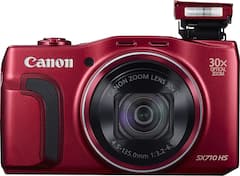
Canon PowerShot SX710 HS Digital Camera
Canon
It depends — Its 30x optical zoom and 1080p at 59.94 fps suit distant subjects in daylight, but weak low-light performance, autofocus hesitation, no microphone input and no 4K limit its appeal for other video uses.
The 30x optical zoom is the reason to buy this and the only thing a phone cannot answer. Good 1080p in good light at a smooth 59.94 fps; low light, autofocus, audio and manual control are where a modern phone wins.Available at Amazon(paid link) — opens Amazon in a new tab. Price and availability shown there.
Sources
Pages consulted while researching this article. None of these are affiliate links.
- Canon Support for PowerShot SX710 HS — usa.canon.com
- PowerShot SX710 HS Camera User Guide — gdlp01.c-wss.com
- Canon PowerShot SX710 HS Review and Video Samples — cameralabs.com
- Canon PowerShot SX720 HS Specification Chart — downloads.canon.com