Schiit Mani 2 vs Built-In Phono: Worth It?
The questionWhere do these come from?
Marantz Model 50 Phono Preamp?
Start with the amp's built-in phono stage; add a Schiit Mani 2 only for cartridge mismatch, audible noise, or needed gain and loading.
Start with the amp’s built-in phono stage; add a Schiit Mani 2 only for cartridge mismatch, audible noise, or needed gain and loading. With a conventional moving-magnet cartridge and a clean, correctly matched phono input, an external preamp is not an automatic sound-quality upgrade.
The important question is not whether a separate box is theoretically better. It is whether the built-in stage creates a specific limitation that the Mani 2 can remove. If records already play loudly enough without hiss, hum, bass distortion or excessive woofer movement, keep the built-in stage while you upgrade the turntable, cartridge, amplifier or speakers.
The three reasons the Mani 2 earns its place
The strongest reason is cartridge compatibility. Many integrated amplifiers provide a fixed moving-magnet input, normally intended for a cartridge that wants a 47k-ohm load and roughly 35–45 dB of gain. That is suitable for a large part of the cartridge market, but it may not accommodate a low-output moving-coil cartridge or an unusual moving-iron design.
The Mani 2 provides four gain settings: 33, 42, 48 and 60 dB. It also offers resistance settings of 47k, 200, 47 and 38 ohms, plus capacitance choices of 47, 100, 150 and 200 pF. Those figures come from Schiit’s current Mani specifications, which also specify RIAA accuracy of plus or minus 0.2 dB from 20 Hz to 20 kHz.
That flexibility matters when the cartridge manufacturer gives a recommended load that the amplifier cannot supply. It also matters if the next cartridge will be moving-coil while the new amplifier accepts moving-magnet cartridges only. Do not guess from cartridge type alone: check its output voltage and recommended load before selecting gain or resistance.
The second reason is an audible shortcoming. A steady hiss at the listening position, insufficient volume, or distortion on loud passages can justify bypassing the built-in stage. Test at normal listening volume, however. Noise that appears only with the amplifier turned far beyond any usable setting is not a meaningful reason to add another component.
The third reason is record-warp control. The Mani 2 includes switchable 6 dB-per-octave and 12 dB-per-octave low-frequency filtering centered at 15 Hz. This can reduce large, slow woofer movements caused by warped records or tonearm resonance. It does not repair the warp, but it can stop inaudible subsonic energy from consuming amplifier and woofer travel.
Why the built-in phono input may be enough
A competent built-in stage already performs the two essential jobs: it raises the cartridge’s tiny signal to line level and applies RIAA equalization. Putting those circuits in a separate chassis does not guarantee a more accurate frequency response or a lower noise floor.
Keep the built-in stage when all of these conditions are true:
- The amplifier explicitly supports the cartridge type.
- Its fixed loading falls within the cartridge manufacturer’s recommendation.
- Listening volume is adequate without approaching the end of the volume control.
- Hiss and hum are inaudible from the listening position.
- Loud grooves play without harshness or bass breakup.
- Warped records do not make the woofers pump visibly.
Under those conditions, the likely improvement from changing speakers, improving speaker placement, aligning the cartridge or replacing a worn stylus is greater than the improvement from exchanging one competent phono circuit for another. An amplifier upgrade should therefore be chosen for the power, speaker compatibility, inputs and features the whole system needs—not merely because one model advertises a phono socket.
Independent measurements add an important caution
Audio Science Review placed a Mani 2 sample on an analyzer rather than simply repeating the manufacturer’s claims. Its published Mani 2 measurements showed a prominent 60 Hz component, and the accompanying discussion records requests for a retest with a replacement transformer.
That result does not establish that every Mani 2 will hum. It does establish that “external” and “quieter” are not synonyms. Placement, grounding, cabling and the particular unit still matter, so an actual level-matched comparison is more useful than assuming the separate preamp must win.
Just want the recommendation?
Skip to the picksIndependent listening evidence is more favorable. AnalogPlanet evaluated the Mani 2 with both moving-magnet and very-low-output moving-coil cartridges and even published a recording from the moving-coil setup. That supports the flexibility case, but it cannot predict whether the Mani 2 will outperform the particular phono circuit inside your amplifier.
No named product deserves a blanket skip here: the built-in input may be fully adequate, and the Mani 2 is a capable conditional upgrade. What should be skipped is buying an external stage before identifying what the built-in one gets wrong.
Connect the Mani 2 without using two phono stages
A phono preamp must feed a line-level input. Connect the turntable to the Mani 2, then connect the Mani 2’s outputs to an input labeled AUX, CD, TUNER or LINE. Never connect its output to the amplifier’s PHONO input; doing so applies gain and RIAA equalization twice, producing excessive level and badly distorted frequency balance.
If the turntable has its own switchable preamp, set it to PHONO or OFF so its internal stage is bypassed. Connect the turntable’s ground wire to the Mani 2 if the system hums.
Schiit’s Mani 2 manual recommends placing the unit near the turntable, away from motors, power amplifiers and AC cables. It specifies a short, fully shielded turntable cable—about 0.25 to 0.5 metre—and ships the preamp at 42 dB, 47k ohms and 47 pF for typical moving-magnet cartridges.
Use those factory settings as the starting point for a normal MM cartridge. More gain is not automatically better: excessive gain can overload a stage and cause distortion, especially in the bass. The manual also says to power down the system before changing gain and to turn the Mani 2 on before the power amplifier to avoid loud pops.
Run a comparison that can reveal a real upgrade
Play the same record passage through both stages and match their output levels as closely as possible. Even a small level advantage can make one path seem clearer, fuller and more detailed when the difference is primarily loudness.
Listen for identifiable changes rather than broad impressions:
- Use an unmodulated lead-in or the gap between tracks to compare hiss and hum at the listening seat.
- Use a loud, bass-heavy passage to check for overload or muddiness.
- Watch the woofers while playing a mildly warped record; then engage the Mani 2’s first filter setting if necessary.
- Check vocals and cymbals for tonal changes that could indicate a capacitance mismatch with an MM cartridge.
- Repeat the comparison after returning to normal listening volume.
A quieter background, corrected cartridge loading, cleaner peaks or controlled subsonic movement is a defensible upgrade. A difference that survives only when one path is louder is not.
The upgrade order that avoids redundant purchases
When the amplifier and turntable are both changing, install the new amplifier first and try its built-in phono input with the existing cartridge. That creates a baseline and prevents buying two solutions to the same problem.
Add the Schiit Mani 2 when the new amplifier lacks a compatible phono stage, when a planned moving-coil cartridge needs its 48 or 60 dB settings, when the cartridge requires loading the amplifier cannot provide, or when a controlled comparison exposes audible noise or overload. Also consider it when warped records regularly produce visible woofer pumping and the amplifier provides no low-frequency filter.
Otherwise, keep the built-in stage. The Mani 2 is a well-specified tool for solving gain, loading and subsonic problems, not a mandatory toll on the way to better vinyl playback.
The bottom line
The one to buy:
Top pick
It depends
Schiit Mani 2 MM/MC Phono Preamp
Schiit Mani
Its 33/42/48/60 dB gain settings, four resistance loads and switchable 15 Hz filtering solve compatibility and warp problems that a fixed built-in MM stage cannot, but are redundant when that stage is already quiet and correctly matched.
This is the external phono-stage comparison for an amplifier’s built-in input. It is useful when you need selectable gain, cartridge loading or subsonic filtering, but it adds another power supply, cable pair and potential grounding point.Available at Amazon(paid link) — opens Amazon in a new tab. Price and availability shown there.
Recommended products
Ordered by how well each one fits the situations above. Each link below is a paid link.
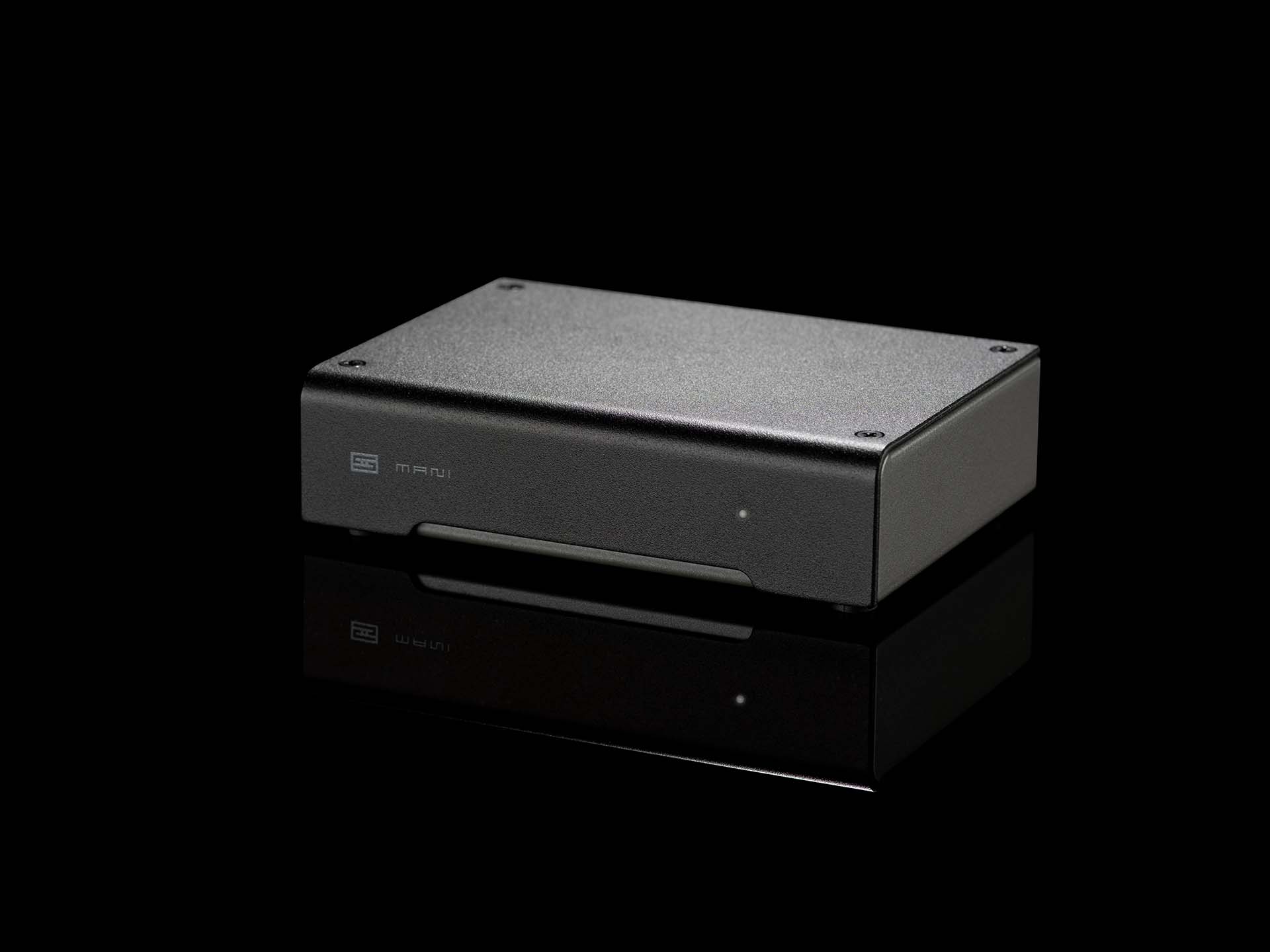
Schiit Mani 2 MM/MC Phono Preamp
Schiit Mani
It depends — Its 33/42/48/60 dB gain settings, four resistance loads and switchable 15 Hz filtering solve compatibility and warp problems that a fixed built-in MM stage cannot, but are redundant when that stage is already quiet and correctly matched.
This is the external phono-stage comparison for an amplifier’s built-in input. It is useful when you need selectable gain, cartridge loading or subsonic filtering, but it adds another power supply, cable pair and potential grounding point.Available at Amazon(paid link) — opens Amazon in a new tab. Price and availability shown there.
Sources
Pages consulted while researching this article. None of these are affiliate links.
- Schiit Mani MM/MC Phono Preamp Specifications — schiit.com
- Schiit Mani 2 Owner's Manual — schiit.com
- Schiit Mani 2 Review and Measurements — Audio Science Review — audiosciencereview.com
- Schiit's Mani 2 MM/MC Phono Preamp Review — AnalogPlanet — analogplanet.com