ART DJPREII With Passive 8 Ohm Speakers: What Else You Need
The questionWhere do these come from?
vintage passive speakers
hey all, i have this pair of speakers i would like to use with a turntable, however there is no power source and when researching tuner amps they all look like i should have bare wires to plug into the amp but mine have these plugs.
The ART DJPREII only boosts a turntable signal. Passive 8 ohm speakers also need a power amplifier, or an amp with a phono input, before a Technics will play.
The ART DJPREII is half of what passive 8 ohm speakers need to work with a Technics SL-1200M3D. It boosts the turntable’s tiny signal to line level and does nothing else. Passive speakers have no amplifier inside, so a power amplifier (or a stereo receiver) has to sit between the preamp and the speakers. If the amplifier you choose already has a phono input, the ART is not needed at all.
The signal chain, in order
- Technics SL-1200M3D, with a moving-magnet cartridge, outputs phono-level signal over its RCA leads. As far as the published specs go, the deck has no built-in phono stage, so it needs one downstream. Check your unit’s manual if it is a second-hand or modified deck.
- Phono preamp (ART DJPREII) applies RIAA equalisation and raises the signal to line level.
- Power amplifier takes the line-level signal at an input labelled Line, Aux, CD or similar, and drives the speakers.
- Passive speakers connect to the amp’s speaker terminals only.
Why the order matters: Wikipedia’s article on phono inputs notes that cartridges give an output of only a few millivolts, and that records are cut with treble emphasised and bass reduced, so playback needs RIAA equalisation. A line input is built for a much higher level (around one volt) and applies no equalisation, so a turntable plugged straight into Aux sounds faint and thin.
The second most common mistake is to plug a phono preamp’s output into the amp’s Phono input, which applies the boost and equalisation twice and distorts. Two phono stages in a row is always wrong.
What the ART DJPREII actually specifies
ART’s published specification lists RCA inputs and RCA outputs, maximum gain of 45 dB at 1 kHz with a variable control of plus or minus 10 dB, selectable input capacitance of 100 pF or 200 pF with 47k ohm input impedance, and a maximum output of +6 dBu (1.4 Vrms). It runs from a 7 to 12 V DC or 9 to 12 V AC adapter. There are no speaker outputs anywhere in that list, which is the whole point: it feeds an amplifier, never a speaker. No independent lab measurement of this unit was consulted; these are the maker’s own figures. The product page does not mention a ground terminal, so check the manual if the deck hums.
Which amp setup fits which situation
| Setup | Boxes | Needs the ART DJPREII? | The deciding fact |
|---|---|---|---|
| Receiver or amp with a Phono input | 1 | No | The phono stage is already inside |
| Power amp with only Line/Aux inputs | 2 | Yes | Preamp output goes to a Line or Aux input |
| Amp with Phono input, ART added anyway | 2 | Not needed | Only worth it if the built-in phono stage is poor or broken |
If the amplifier is vintage, look for the word Phono (or Disc) beside an input pair. A small number of older amps have a Phono input intended for a ceramic cartridge, which is the wrong input for the Technics’ moving-magnet cartridge. That is a case where the ART in front of a Line input is the safer route.
Just want the recommendation?
Skip to the picksUnfamiliar speaker plugs: what they usually are
Passive speaker connectors that look strange are normally one of a handful of types:
- Banana plugs or bare wire in binding posts. Standard, and fits most modern amps.
- Spring clips. Take bare wire; no plug needed.
- Quarter-inch (6.35 mm) mono plugs. Common on older and PA-style speakers. These carry speaker-level power, so they must go to a speaker output only.
- Speakon (twist-lock). Wikipedia describes it as a locking connector, originally from Neutrik, used mostly in professional audio, rated for at least 30 A RMS continuous current. It needs a Speakon-to-bare-wire or Speakon-to-banana lead.
- Five-pin DIN. Found on some old European gear, where the same plug type was sometimes used for line signals. Do not assume it is a speaker plug.
The safe adapter is a speaker cable with the correct plug on the speaker end and bare wire or banana plugs at the amp. Do not use a quarter-inch-to-RCA adapter to bridge a speaker plug into an RCA socket. RCA inputs are not built for speaker-level voltage, and the amp output can be damaged.
Matching the speakers to the amp
The 8 ohm rating is the friendly one. Almost every stereo amp and receiver is rated for 8 ohm loads, so the connection is electrically safe. Check the amp’s speaker-impedance rating anyway, since some old receivers specify a minimum different from 4 ohm. Also check the speakers’ power handling against the amp’s output. A very powerful amp is fine if kept at moderate volume, but a lightly rated speaker can be damaged by clipping from a small amp pushed hard.
Which route to take
Buy the ART DJPREII if the amp you have or plan to buy has no phono input. It is a common, inexpensive way to add one, and it pairs with a small power amp that has standard binding posts, such as the Fosi Audio BT30D Pro. A receiver with a phono input, such as the Yamaha R-N303, is the one-box alternative that makes the ART redundant. It is the better choice for someone starting from nothing who wants fewer cables.
Skip nothing here: neither option is wrong for this question. The ART alone, though, is the wrong purchase if there is no amplifier yet. It cannot make sound come out of passive speakers.
What this answer rests on
The wiring order above is standard hi-fi practice, supported by the Wikipedia phono input article, ART’s own specification page and the Speakon article. No independent lab has been consulted for the ART DJPREII, and the model specifics should be confirmed in the Technics, ART and amplifier manuals before connecting anything. If a connector type is still unidentifiable, a speaker retailer or the speaker maker’s support team can name it from a photograph.
The bottom line
Two options, and the revision you own picks one:
Top pick
Buy this
ART DJPREII Phono Preamplifier 14.1 x 7.3 x 2.3 inches
ART
It solves the turntable-level signal problem for a Technics SL-1200 series deck, but it has RCA outputs only and no speaker outputs, so it never drives passive speakers alone.
The subject of the question: a standalone phono stage. It is a complement to a power amplifier, not a replacement for one, and it only makes sense if the amp you pick has no phono input of its own.Available at Amazon(paid link) — opens Amazon in a new tab. Price and availability shown there.The alternative
It depends
YAMAHA R-S202BL Stereo Receiver | Phono input, Subwoofer output, Bluetooth, AM FM Tuner
Yamaha
Right when you want one box and no extra cables; wrong when you already own an amplifier, because then the phono stage is the only missing piece.
An alternative that replaces the preamp and the power amp in one box: it has a phono input and speaker terminals, so a Technics and passive speakers connect without a separate preamp. Drawback: it is large, and it costs more than a preamp plus a small amp.Available at Amazon(paid link) — opens Amazon in a new tab. Price and availability shown there.
Recommended products
Ordered by how well each one fits the situations above. Each link below is a paid link.
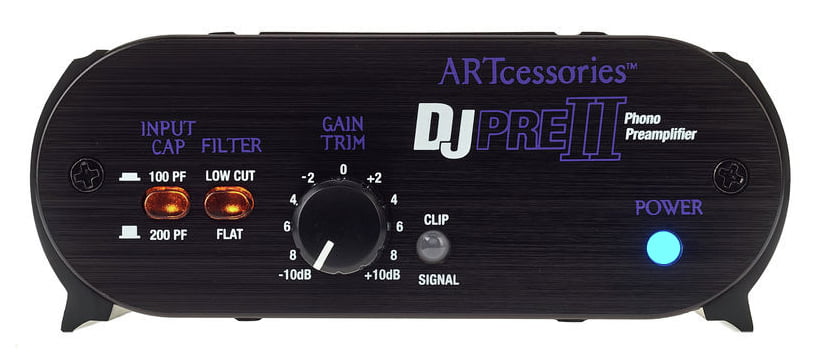
ART DJPREII Phono Preamplifier 14.1 x 7.3 x 2.3 inches
ART
Buy — It solves the turntable-level signal problem for a Technics SL-1200 series deck, but it has RCA outputs only and no speaker outputs, so it never drives passive speakers alone.
The subject of the question: a standalone phono stage. It is a complement to a power amplifier, not a replacement for one, and it only makes sense if the amp you pick has no phono input of its own.Available at Amazon(paid link) — opens Amazon in a new tab. Price and availability shown there.YAMAHA R-S202BL Stereo Receiver | Phono input, Subwoofer output, Bluetooth, AM FM Tuner
Yamaha
It depends — Right when you want one box and no extra cables; wrong when you already own an amplifier, because then the phono stage is the only missing piece.
An alternative that replaces the preamp and the power amp in one box: it has a phono input and speaker terminals, so a Technics and passive speakers connect without a separate preamp. Drawback: it is large, and it costs more than a preamp plus a small amp.Available at Amazon(paid link) — opens Amazon in a new tab. Price and availability shown there.
Fosi Audio Bluetooth Subwoofer Amplifier 2.1, BT30D Pro Subwoofer Amp with TPA3255 Chips 165W x2+350W & Bass Treble Control, 2.1 Channel Sub Amplifier for Desktop/Outdoor/Bookshelf Speakers
Fosi Audio
It depends — It works only as the second half of a preamp-plus-amp chain, and its speaker terminals are standard binding posts, so unfamiliar speaker plugs still need adapting.
A complement to the ART DJPREII: a compact power amp with speaker binding posts that takes the preamp’s line-level output. It has no phono stage, so it needs the preamp in front of it.Available at Amazon(paid link) — opens Amazon in a new tab. Price and availability shown there.
Sources
Pages consulted while researching this article. None of these are affiliate links.
- ART Pro Audio DJ Pre II product page and specifications — artproaudio.com
- Phono input (Wikipedia): signal level and RIAA equalisation — en.wikipedia.org
- Speakon connector (Wikipedia): locking speaker connector, 30 A rating — en.wikipedia.org