Luxman L-505Z With Sensitive Speakers: The Catch
The questionWhere do these come from?
Moon vs Luxman vs Allnic vs Audio Research — Which Earns Its Price Tag?
Tested four integrated amps on Wilson Sasha Vs and the solid state vs valve result wasn't what I expected. Allnic T-2000, ARC i/50, Moon 700i V2, Luxman L-505Z — anyone have experience with these on high-sensitivity speakers?
The Luxman L-505Z suits most sensitive speakers, but 100 dB-plus horns need an in-room noise and low-volume check before you buy.
Buy the Luxman L-505Z for high-sensitivity speakers in the high-90 dB range; with 100 dB-plus horns, verify hiss and low-volume range in your own system before committing. Its 88-step attenuator handles quiet adjustments better than the headline power rating suggests, but it cannot remove noise already present in the amplifier, source or grounding.
| Integrated amplifier | Verdict | Gain and noise evidence | Practical catch |
|---|---|---|---|
| Luxman L-505Z | Buy | Approximately 43.9 dB maximum gain inferred from its rated figures; 85 dB A-weighted S/N referenced to 1 W in an independent test | No input-gain selector, so extreme horns still require an audition |
| Yamaha A-S3200 | Consider | 43.4 dB measured RCA gain; 37.5 dB through XLR with its −6 dB pad | The pad works only on balanced inputs |
| Pass Labs INT-25 | Consider | 25.4 dB measured gain; 86.9 dB A-weighted S/N referenced to 2.83 V | Minimal features, substantial heat and a documented caveat with low treble impedance |
These measurements came from different laboratories and should not be treated as a one-decimal-place ranking. They are useful screening evidence: gain determines how much volume-control range you can use, while output noise helps predict whether a sensitive compression driver will reveal hiss.
Why 100 watts is not the actual problem
A sensitive speaker does not become unsafe merely because the amplifier can deliver 100 watts. The volume control determines how much of that capacity is used. What matters during quiet listening is whether the amplifier provides sufficiently small, accurately matched attenuation steps and whether its residual noise remains inaudible.
Luxman specifies 100 watts per channel into 8 ohms, 150 watts into 4 ohms and line-input sensitivity of 180 mV for rated output. Those figures imply approximately 43.9 dB of maximum line-to-speaker voltage gain. A source capable of 2 V RMS therefore has roughly 21 dB more output than the amplifier needs to reach its rated power with the volume at 0 dB. That is why normal listening will happen well down the dial. Luxman’s specifications also list a 104 dB IHF-A line-input S/N ratio.
The reassuring part is the volume system. LECUA provides 88 positions, and the owner’s manual defines them as mute followed by −87 dB through 0 dB in 1 dB increments. It is an electronically controlled attenuator rather than a conventional potentiometer operating in its least accurate region. Consequently, using only a small physical portion of the knob does not mean you have only two or three useful settings.
A real owner report illustrates the distinction. With 98 dB-sensitive, 4-ohm speakers, the owner reported room-filling output within a small portion of the knob’s rotation and more than 70 dB on a phone app with the display around −45 dB. The phone reading is not laboratory data, but the exact speaker sensitivity and volume position make it more useful than a generic claim that the amplifier is “good with horns.” The same discussion records the owner’s settings and speaker specification.
What the measured noise means through horns
The most relevant independent Luxman test comes from AUDIO’s laboratory. It measured 119 watts per channel into 8 ohms, 207 watts into 4 ohms and an A-weighted signal-to-noise ratio of 85 dB referenced to 1 watt. The measured power exceeded Luxman’s rating, while the noise figure gives a usable way to screen sensitive-speaker combinations. AUDIO publishes the measurement conditions and results in its laboratory table.
For a speaker whose sensitivity is genuinely specified in dB at 1 W/1 m, subtracting that 85 dB result provides a rough single-speaker noise estimate at one metre:
- A 98 dB/1 W/1 m speaker produces an estimated 13 dBA.
- A 105 dB/1 W/1 m horn produces an estimated 20 dBA.
That is only a screening calculation. Listening distance reduces the level, two speakers alter the total, room reflections matter, and hiss is easier to notice than a single A-weighted number suggests. Also check whether the speaker’s specification is stated at 1 watt or 2.83 volts; those are equivalent only for an 8-ohm load.
The resulting decision is practical. Speakers around 94–98 dB are unlikely to make the L-505Z inherently unsuitable. At roughly 100 dB and above, especially in a quiet room or near-field arrangement, an audition with no music playing becomes part of the purchase rather than an optional nicety.
A professional review also used the L-505Z with the high-sensitivity DeVore Fidelity O/96 alongside less sensitive Dynaudio and Gauder models. That does not prove silence with every horn, but it confirms that pairing this Luxman with an efficient loudspeaker is a real reviewed use case rather than a theoretical mismatch. Twittering Machines identifies all three speakers used during its review.
Just want the recommendation?
Skip to the picksWhere the Yamaha A-S3200 fits instead
The Yamaha A-S3200 is the closest direct alternative. Its official ratings match the Luxman at 100 watts into 8 ohms and 150 watts into 4 ohms, and it also provides balanced inputs plus an MM/MC phono stage. Yamaha publishes the complete input-sensitivity and power specifications.
Stereophile measured 43.4 dB maximum gain through the Yamaha’s RCA inputs and 43.5 dB through XLR. Its rear-panel balanced-input attenuators reduce XLR gain by 6 dB, to approximately 37.5 dB. That can provide useful extra range with a high-output balanced DAC. The same test found a stable 0.1 dB channel imbalance and reported that noise fell at lower volume settings. Stereophile’s Yamaha bench test documents those results.
The Yamaha gets the gain structure wrong for RCA-fed extreme horns: its measured 43.4 dB maximum gain is high, and the helpful −6 dB pad applies only to XLR. Consider it when the intended source has balanced outputs and you can use that pad; it is not a more convincing blind purchase than the Luxman for a 100 dB-plus speaker connected by RCA.
The lower-gain Pass Labs option
The Pass Labs INT-25 is the specialist rival. Stereophile measured 25.4 dB maximum gain—about 18 dB below the Luxman’s inferred maximum—and 86.9 dB A-weighted S/N referenced to 2.83 V. Its 1 dB volume steps and lower gain make it attractive when an efficient speaker needs very little voltage. The independent measurements also found 60 watts into 8 ohms at 1% THD+N despite the 25-watt rating.
That narrower suitability explains the consider verdict. The INT-25 manual specifies only three RCA inputs, less than 150 µV unweighted residual noise and substantial continuous power consumption. It needs generous ventilation and omits the Luxman’s phono stage, tone controls, balanced input, pre-out and headphone facilities.
The Pass gets speaker matching wrong for an efficient design whose impedance falls below 4 ohms at high frequencies. Stereophile recorded sharply increased treble distortion into 4- and 2-ohm loads at its test level and recommended speakers that stay at or above 8 ohms in the treble. It is therefore a lower-gain alternative for electrically benign speakers, not a universal horn amplifier.
None of these three deserves a blanket skip: the real differences are gain, noise, load behavior and facilities. Manufacturing a loser from three credible amplifiers would be less useful than defining the conditions under which each works.
Serviceability starts with the correct regional unit
The L-505Z’s analogue architecture and detachable preamp/power-amplifier sections provide flexibility, but they do not make every internal component locally repairable. LECUA is a proprietary electronically controlled assembly, so future work may depend on the distributor’s access to Luxman parts.
Buy the voltage-correct regional model through an authorized channel. Luxman lists 115 V and 230 V export configurations, while the domestic Japanese specification is 100 V. A transformer does not convert a grey-market purchase into a locally warrantied product. In North America, Luxman’s limited warranty provides three years of coverage but excludes purchases outside authorized dealers. The amplifier also weighs 22.5 kg, making depot shipping a meaningful part of the service plan.
Before purchase, ask the regional distributor who performs both warranty and post-warranty repairs, whether LECUA assemblies are stocked, and who pays each shipping leg. Published construction claims cannot answer those local questions.
A ten-minute audition that settles the match
Use the intended source, connection type and speakers. A demonstration through conventional showroom speakers cannot reveal what a 100 dB horn will do with the same electrical noise.
- Select the normal input with the source connected but playback stopped. Listen first from the seat and then one metre from each tweeter.
- Distinguish broadband hiss from hum or buzz. Hum that changes when a source cable is disconnected points toward grounding rather than the amplifier’s intrinsic noise floor.
- Play a centered mono vocal at the quietest nighttime level. Move through five adjacent 1 dB settings and confirm that the image remains centered.
- Play a recording with wide dynamic range. The normal position should not sit immediately above mute, and a single step should not make the level jump from too quiet to too loud.
- Repeat the test with the source at its fixed reference output. Using a temporary reduced digital level can disguise a gain mismatch and sacrifice digital headroom.
The Luxman L-505Z is therefore the best all-round choice here when the speakers are in the high-90 dB range and you want phono, tone controls, headphones and system-expansion connections in one chassis. Its precise 1 dB attenuation makes high power manageable. For 100 dB-plus horns, however, buy only after the actual source-and-speaker combination passes the silent-input and low-volume tests; no brochure S/N figure can replace that final check.
The bottom line
Both work; your situation picks one:
Top pick
Buy this
Luxman L-505Z Integrated Amplifier
Luxman
LECUA provides 88 one-decibel positions, while independent testing measured 85 dB A-weighted S/N referenced to 1 watt and 119 W per channel into 8 ohms.
The subject and top pick for high-90 dB speakers, combining an 88-step LECUA attenuator with phono, tone, headphone and preamp/power-amp facilities. Its drawback is the absence of selectable input gain for extreme-sensitivity horns.Available at Amazon(paid link) — opens Amazon in a new tab. Price and availability shown there.The alternative
It depends
Yamaha A-S3200 Integrated Amplifier
Yamaha
Stereophile measured 43.4 dB RCA gain and 43.5 dB XLR gain, with the balanced-input attenuator reducing the latter by 6 dB.
A direct alternative to the Luxman when the source has balanced outputs, because its XLR inputs include a −6 dB pad. RCA users retain its high measured gain, so it offers less advantage with extreme horns.Available at Amazon(paid link) — opens Amazon in a new tab. Price and availability shown there.
Recommended products
Ordered by how well each one fits the situations above. Each link below is a paid link.
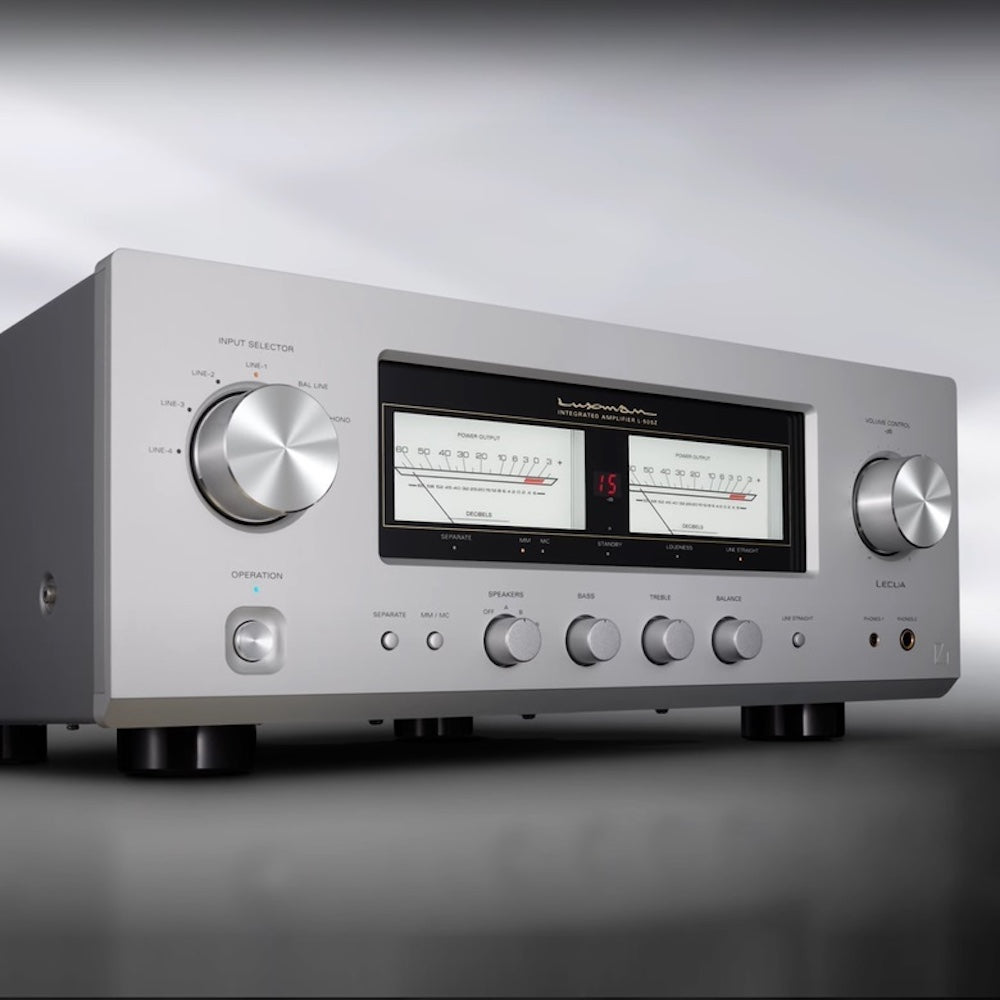
Luxman L-505Z Integrated Amplifier
Luxman
Buy — LECUA provides 88 one-decibel positions, while independent testing measured 85 dB A-weighted S/N referenced to 1 watt and 119 W per channel into 8 ohms.
The subject and top pick for high-90 dB speakers, combining an 88-step LECUA attenuator with phono, tone, headphone and preamp/power-amp facilities. Its drawback is the absence of selectable input gain for extreme-sensitivity horns.Available at Amazon(paid link) — opens Amazon in a new tab. Price and availability shown there.
Yamaha A-S3200 Integrated Amplifier
Yamaha
It depends — Stereophile measured 43.4 dB RCA gain and 43.5 dB XLR gain, with the balanced-input attenuator reducing the latter by 6 dB.
A direct alternative to the Luxman when the source has balanced outputs, because its XLR inputs include a −6 dB pad. RCA users retain its high measured gain, so it offers less advantage with extreme horns.Available at Amazon(paid link) — opens Amazon in a new tab. Price and availability shown there.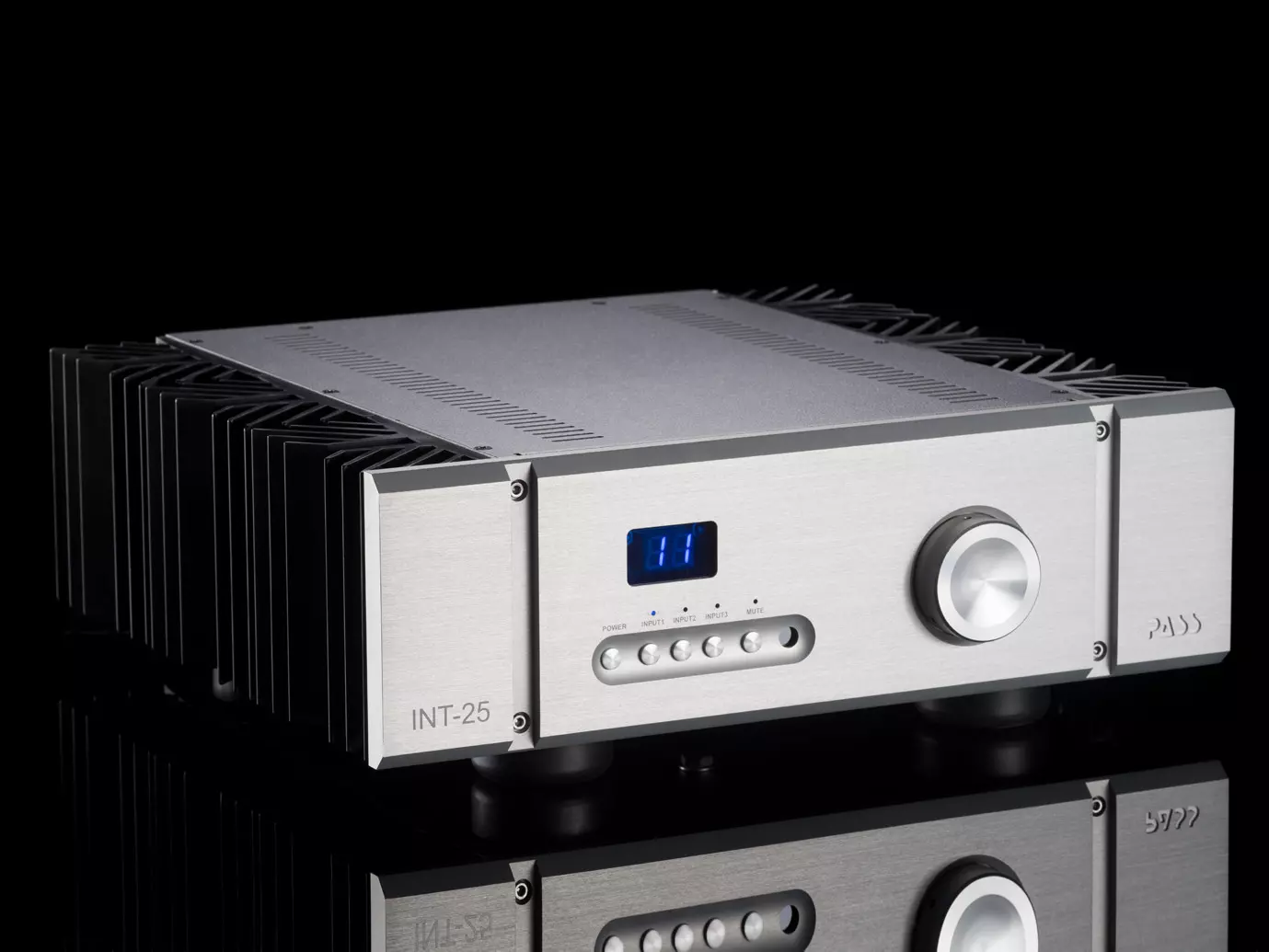
Pass Labs INT-25 Integrated Amplifier
Pass Labs
It depends — Its measured 25.4 dB gain suits efficient speakers, but Stereophile found sharply increased treble distortion into 4- and 2-ohm loads at its test level.
A lower-gain rival for high-sensitivity speakers with benign impedance, using 1 dB volume steps and a measured 25.4 dB maximum gain. It runs hot, has only three RCA inputs and lacks the Luxman’s phono and tone facilities.Available at Amazon(paid link) — opens Amazon in a new tab. Price and availability shown there.
Sources
Pages consulted while researching this article. None of these are affiliate links.
- Luxman L-505Z Product Specifications — luxman.com
- Luxman L-505Z Owner’s Manual — luxmanamerica.com
- AUDIO Laboratory Test: Luxman L-505Z — audio.com.pl
- Twittering Machines Luxman L-505Z Review — twitteringmachines.com
- Luxman L-505Z Owner Discussion With 98 dB Speakers — reddit.com
- Luxman North America Limited Warranty — luxmanamerica.com
- Yamaha A-S3200 Specifications — usa.yamaha.com
- Stereophile Yamaha A-S3200 Measurements — stereophile.com