RS3 or RS4 Mini for a Sony FX3 Kit?
The questionWhere do these come from?
DJI RS3 vs RS4 Mini for FX3 + Sigma 24-70 II (Same price used)?
Hey everyone, looking for a quick sanity check before pulling the trigger. I can buy a used RS3 Standard or a used RS4 Mini for the exact same price. My Setup: Sony FX3 + SmallRig Cage Sigma 24-70mm f2.
For an FX3 with a 24-70mm and possible 70-200mm rentals, the DJI RS 3 Standard is the safer gimbal than the RS 4 Mini.
The DJI RS 3 Standard is the safer answer for an FX3, Sigma 24-70mm, and occasional 70-200mm rentals. The DJI RS 4 Mini can work for a stripped-down FX3 and lighter 24-70mm setup, but its 2 kg tested payload leaves much less room for a long telephoto, plate, filter, cage, mic, or balance offset.
| Choice | Tested payload | Gimbal weight | Better fit |
|---|---|---|---|
| DJI RS 3 Standard | 3 kg / 6.6 lb | Approx. 990 g | FX3 with heavier zooms, accessories, rentals |
| DJI RS 4 Mini | 0.4-2 kg / 0.88-4.4 lb | Approx. 890 g | Bare mirrorless setups and light travel rigs |
DJI lists the RS 3 tested payload at 3 kg and the RS 4 Mini tested payload at 0.4-2 kg. That does not mean the RS 4 Mini fails the moment a camera package reaches 2,001 g, and it does not mean the RS 3 will balance every physically awkward lens. It means the RS 3 has the more useful margin for the exact kind of setup described: Sony FX3, standard zoom, and occasional rented 70-200mm lenses.
RS 3 Standard wins unless the kit stays small
Choose the DJI RS 3 Standard unless the kit is intentionally kept small. Sony lists the FX3 at approximately 715 g with battery and memory card. Sigma lists the 24-70mm F2.8 DG DN II for Sony E-mount at 735 g, while the earlier Sigma 24-70mm F2.8 DG DN is 830 g. That puts the camera and lens alone around 1,450 g with the newer Sigma or about 1,545 g with the older one, before the gimbal plate, lens support, filter, HDMI cable, top handle, cage, side handle, monitor, audio receiver, or follow-focus motor.
That package is within the RS 4 Mini’s official 2 kg tested payload if it is stripped down. It is also comfortably within the RS 3’s 3 kg tested payload. The practical difference is not just the raw weight. A 24-70mm zoom changes length and balance as it zooms, and an FX3 often gets built up with video accessories. The more the rig moves away from a bare camera-and-lens shape, the more the RS 3 Standard makes sense.
The RS 4 Mini still has a real advantage: it is smaller and lighter. DJI lists the RS 4 Mini gimbal at approximately 890 g including its quick-release plate and excluding the tripod, while the RS 3 gimbal is approximately 990 g before grip, tripod, and plates. If the work is mostly travel, social vertical clips, or short handheld moves with a bare FX3 and 24-70mm, the RS 4 Mini is easier to carry. If the work includes client days, rentals, heavier glass, or accessories, the RS 3 Standard is the better fit.
The 70-200mm makes RS 3 Standard the safer pick
This is where the RS 3 Standard pulls ahead. Sony lists the FE 70-200mm F2.8 GM OSS II at about 1,045 g without hood and tripod foot. With the FX3 body at about 715 g, the camera and lens alone are roughly 1,760 g. That is under the RS 4 Mini’s 2 kg tested payload, but the remaining margin is thin once a plate, filter, cable, cage, or support hardware is added.
The original Sony FE 70-200mm F2.8 GM OSS is a different story. Sony lists that lens at 1,480 g without the tripod mount. Add the FX3 body and the camera-plus-lens total is already about 2,195 g before any gimbal plate or accessory. That is over the RS 4 Mini’s tested payload and still below the RS 3 Standard’s 3 kg tested payload.
So the rule is simple: if the rented 70-200mm might be the original Sony GM, a third-party 70-200mm, or anything mounted with support hardware, do not buy the RS 4 Mini as the main gimbal for that job. Use the RS 3 Standard. If the rental is specifically the Sony FE 70-200mm F2.8 GM OSS II and the camera stays bare, the RS 4 Mini may be workable on paper, but it is not the conservative choice.
Where the RS 4 Mini’s newer features win
The RS 4 Mini is newer and has a compact, modern setup. DJI lists automatic axis locks and native vertical shooting support on the RS 4 Mini. DJI also lists the RS Intelligent Tracking Module as an RS 4 Mini accessory, with a 19 g module, 0.5-10 m tracking distance, magnetic attachment, and gesture functions for tracking and recording.
Just want the recommendation?
Skip to the picksThe RS 3 Standard has its own advantages for a heavier FX3 workflow. DJI lists more accessory ports on the RS 3 support page, including NATO ports, a cold shoe, a video transmission/focus motor USB-C port, an RSS camera control USB-C port, and a focus motor USB-C port. DJI also lists the Ronin Image Transmitter under RS 3 support, and the RS 3 FAQ says Bluetooth shutter control can handle half-press autofocus, single-press start/stop recording, and press-and-hold photo capture when supported.
For an FX3 owner, those differences matter less than payload unless the rig is always light. The RS 4 Mini is attractive when the whole point is a compact setup. The RS 3 Standard is the better match when the setup may grow into the way FX3 rigs usually grow: cage, monitor, audio, longer glass, and rented lenses with unknown balance behavior.
Camera control depends on DJI compatibility
Check DJI’s compatibility page for the exact gimbal and camera combination before buying cables. DJI’s RS 4 Mini compatibility entry for the FX3 lists camera firmware V1.00 and says the camera control cable is USB-C to USB-C; it also notes that the Sony Multi camera control cable is no longer compatible because of the gimbal shutter port protocol change.
For the RS 3, DJI points camera-control questions to the Ronin Series Compatibility Search. The RS 3 support page also says Bluetooth shutter setup starts by swiping down on the gimbal touchscreen, tapping the Bluetooth icon, selecting the camera’s Bluetooth name, and waiting until the Bluetooth icon turns blue. That is useful for record start/stop, but it is not the same as assuming every lens and every control function works through every cable.
If the camera does not trigger reliably, the fix is not to keep rebuying random cables. Confirm the FX3 firmware, check DJI’s compatibility search for the selected gimbal, use the cable type DJI lists, and then update the gimbal firmware through the Ronin app. DJI’s RS 3 firmware instructions say to power on the gimbal, connect in the Ronin app, tap the update prompt when available, and not power off the gimbal or exit the app during the update.
The mechanical checks for a used RS 3 Standard
A used RS 3 Standard is a good choice only if the mechanical parts are clean. Power it on and confirm the three axes unlock and lock automatically. DJI says the RS 3 axes should unlock and expand when powered on, and lock again when powered off or put to sleep. If an axis sticks, grinds, or does not lock, treat that as a hardware problem, not a settings issue.
Check the included plates and grip. DJI lists the RS 3 upper and lower quick-release plates at approximately 107 g together, and the battery grip as a separate part. Missing plates can turn a good-looking used listing into an incomplete gimbal. Also check the battery grip: DJI lists up to 12 hours of runtime under stationary balanced conditions, and about 2.5 hours charging with 18 W quick charging. A used grip that drains unusually fast should be treated as a support or replacement issue.
Finally, check the ports. The RS 3 ports are not waterproof or dustproof, according to DJI’s FAQ. If the used unit has corrosion around USB-C, RSS, or focus motor ports, skip it. That kind of damage is not something a firmware update fixes.
RS 3 Standard is the better fit for this kit
For a Sony FX3 with a Sigma 24-70mm and occasional 70-200mm rentals, buy the DJI RS 3 Standard over the DJI RS 4 Mini. The RS 4 Mini is the better compact gimbal for a bare, lightweight kit, but the RS 3 Standard has the payload margin that matters once a 70-200mm or normal FX3 accessories enter the setup.
The bottom line
Two good answers to different versions of the question:
Top pick
Buy this
DJI RS 3 Mini, Camera Gimbal Stabilizer, Canon/Sony/Nikon/Fujifilm
DJI
The article recommends the RS 3 Standard for its 3 kg tested payload, but does not evaluate the listed RS 3 Mini, so that recommendation does not establish this product’s suitability.
This is the safer gimbal for an FX3 with a 24-70mm and possible 70-200mm rentals because its 3 kg tested payload leaves more room for real video accessories. The drawback is that it is larger and heavier than the RS 4 Mini.Available at Amazon(paid link) — opens Amazon in a new tab. Price and availability shown there.The alternative
Buy this
DJI Electronic Briefcase Handle, Compatibility: DJI RS 5
DJI
The article makes no case against this handle, but its discussion of RS 3 accessory ports does not establish this handle’s compatibility or suitability.
Useful if the RS 3 will be used for low-angle tracking moves or longer handheld work; DJI’s compatibility list marks it compatible with RS 3. The drawback is extra bulk on an already larger gimbal.Available at Amazon(paid link) — opens Amazon in a new tab. Price and availability shown there.
Recommended products
Ordered by how well each one fits the situations above. Each link below is a paid link.
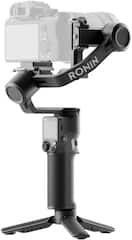
DJI RS 3 Mini, Camera Gimbal Stabilizer, Canon/Sony/Nikon/Fujifilm
DJI
Buy — The article recommends the RS 3 Standard for its 3 kg tested payload, but does not evaluate the listed RS 3 Mini, so that recommendation does not establish this product’s suitability.
This is the safer gimbal for an FX3 with a 24-70mm and possible 70-200mm rentals because its 3 kg tested payload leaves more room for real video accessories. The drawback is that it is larger and heavier than the RS 4 Mini.Available at Amazon(paid link) — opens Amazon in a new tab. Price and availability shown there.
DJI Electronic Briefcase Handle, Compatibility: DJI RS 5
DJI
Buy — The article makes no case against this handle, but its discussion of RS 3 accessory ports does not establish this handle’s compatibility or suitability.
Useful if the RS 3 will be used for low-angle tracking moves or longer handheld work; DJI’s compatibility list marks it compatible with RS 3. The drawback is extra bulk on an already larger gimbal.Available at Amazon(paid link) — opens Amazon in a new tab. Price and availability shown there.
Sources
Pages consulted while researching this article. None of these are affiliate links.
- Support for DJI RS 3 - DJI United States — dji.com
- DJI RS 4 Mini - Specs - DJI — dji.com
- FX3 + DJI RS 4 Mini Compatibility - DJI — dji.com
- ILME-FX3 Specifications - Sony USA — sony.com
- Sigma 24-70mm F2.8 DG DN II Specifications — sigma-global.com
- Sigma 24-70mm F2.8 DG DN Specifications — sigmaphoto.com
- Sony FE 70-200mm F2.8 GM OSS II — electronics.sony.com
- Sony FE 70-200mm F2.8 GM OSS Specifications — sony.com