Pioneer HPM-500 vs JBL L36 Sight Unseen
The question
pioneer hpm-500 choosing between two specific vintage speaker pairs without being able to audition them and wa
Choose the JBL L36 when condition evidence is equal; choose the HPM-500 only with documented refoaming and a clean driver-by-driver video.
Choose the JBL L36 Decade when both pairs come with equally convincing proof of condition. The Pioneer HPM-500 is the better sight-unseen choice only when its delicate polymer-graphite woofers have been correctly refoamed and you specifically want a loud, forward speaker for rock or party use.
There is no honest model-wide skip here because condition can reverse the decision. However, skip either pair if the seller will not provide grille-off photographs, separate playback of every cabinet and a clear account of any surround or driver work.
| Pair | Electrical facts | What must be proved remotely | Verdict |
|---|---|---|---|
| JBL L36 Decade | 8 ohms; 50W continuous-program rating; 1,500Hz and 6,000Hz crossovers | Healthy 125A surrounds, working midrange and tweeter, and smooth Presence and Brilliance controls | Buy when the evidence is complete |
| Pioneer HPM-500 | 8 ohms; 40W rated and 80W maximum input; 2,500Hz and 8,000Hz crossovers | Intact PG cones, correctly centered surrounds, no voice-coil rub and a functioning rear treble control | Consider for loud, on-axis listening |
Your receiver does not decide this comparison
A Pioneer SX-3700 is electrically suitable for either speaker. Its original specification is 45 watts per channel into 8 ohms from 20Hz to 20kHz, while both speaker systems have a nominal 8-ohm impedance. The SX-3700 operating instructions therefore remove amplifier matching as the tie-breaker.
The HPM-500 operating guide specifies 40W rated input and 80W maximum input. JBL rates the L36 at 50W continuous program, while its official L36 manual says comfortable listening is possible with 10W per channel and describes amplifiers up to 100W per channel for high-level, full-dynamic-range reproduction.
Those figures do not mean the volume control is safe at any position. A smaller amplifier driven into clipping can damage high-frequency drivers, and JBL specifically warns against audible distortion. Do not run both nominally 8-ohm pairs from A+B outputs simultaneously unless the receiver explicitly supports the resulting combined load.
The period HPM-500 test changes the answer
The strongest independent evidence in this comparison is a period laboratory evaluation rather than a modern recollection. In the 1981 Hi-Fi Choice loudspeaker survey, Martin Colloms measured the HPM-500 at 89dB/W sensitivity, a 45Hz low-frequency roll-off at -6dB and approximately 111dBA from a stereo pair at two metres.
That makes the HPM-500 easy to drive and capable of unusually high output for its size. The same test, however, found a bass rise around 75Hz, a dip near 1.5kHz and poor off-axis integration. Even after the rear treble control was reduced below its flat position, the listening balance remained forward and bright, with boomy bass and weak stereo depth reported by the panel.
The HPM-500 therefore gets the central question wrong for buyers seeking a broad, forgiving all-rounder: its measured response changes substantially with listening position, while the balance favored loud rock and party playback over varied programme material. That is why it receives a conditional verdict rather than the default recommendation.
The survey’s 400W peak test result should not be mistaken for a continuous amplifier rating. Pioneer’s own 80W maximum-input specification remains the relevant owner-facing limit.
The JBL is the safer choice, not a neutral one
No comparable independent laboratory measurement set for the L36 was located for this article, so its numerical specifications come from JBL rather than an outside test. That limitation matters: choosing the L36 here is primarily a condition and repair-risk decision, not proof that its frequency response is flatter.
JBL’s manual identifies a three-way, bass-reflex system with a 10-inch woofer, 5-inch midrange and 1.4-inch high-frequency radiator. Its 1982 Hi-Fi Systems Reference Chart supplies the exact original complement: 125A woofer, LE5-6 midrange, LE25-2 tweeter and N36 network. The later L36-A retained the 125A and LE5-6 but changed to an LE25-4 tweeter. That distinction lets you reject a mismatched or inaccurately described pair when service photographs are available.
The L36 is not neutral simply because it wins. JBL’s own engineering comparison between the L36 and its successor says the L50 reduced bass peaking, removed response peaks around the midrange and used a more sophisticated crossover for smoother transitions and wider dispersion. That L50 comparison document is an unusually candid indication of the L36’s limitations.
What the JBL offers is a clearly documented driver set, two independently adjustable level controls and conventional paper-cone construction. Its 125A woofer still has an aging surround, so an all-original example is not automatically healthy.
Just want the recommendation?
Skip to the picksThe remote inspection that substitutes for an audition
A phone recording cannot tell you whether you will enjoy a speaker’s tonal balance. Microphone processing, room reflections and video compression destroy that comparison. It can still expose dead drivers, rubbing voice coils, rattles and severe left-right mismatches.
Ask the seller or your pickup helper to complete these checks:
-
Remove both grilles in good light. Request straight-on and angled photographs of every cone, dust cap and surround. On the HPM-500, look for cracks, deformation, uneven glue lines or foam separating from the polymer-graphite cone. Pioneer warns that prolonged heat and direct sunlight can deform its cones.
-
Play each cabinet separately. Use the same receiver channel, cable, volume setting, source and phone position. Speech followed by pink noise or a slow, moderate-level sweep is more revealing than loud music. Compare the two recordings for missing frequency bands and unequal output.
-
Exercise every level control. The HPM-500’s rear high-range control should change treble output; Pioneer says its far-left position silences the tweeter. On the L36, both the Presence and Brilliance controls should alter their respective midrange and high-frequency levels without cutting out. A documented L36 attenuator repair shows that a mechanically displaced control can masquerade as a failed crossover or tweeter.
-
Listen for low-frequency scraping or buzzing. Do this with a low-level bass sweep, not by pressing the cone. JBL’s manual explicitly warns against manually moving a cone because it can force the voice coil out of alignment.
-
Demand specific service history. A useful record says which woofers were refoamed, when, by whom and whether the voice coils were centered. “Professionally serviced” without an invoice, photographs or measurements is not evidence. In one documented HPM-500 repair, a refoam initially left the voice coil rubbing; removing the dust cap and centering the coil with shims corrected it.
-
Use a multimeter only as a screening test. With the amplifier disconnected, compare resistance at the terminals of the two cabinets. A nominal 8-ohm speaker will not necessarily read exactly 8 ohms. An open circuit, near-short or large difference between the pair is a rejection signal, but matching readings do not prove that the midrange and tweeter work.
Walk away when the evidence stops
Skip an HPM-500 pair with deteriorated or undocumented original foam unless the purchase already assumes specialist repair. Also skip a freshly refoamed pair that buzzes, scrapes or has visibly off-center surrounds: the refoam itself may have created the fault.
Skip an L36 pair when the seller cannot demonstrate both midranges, both tweeters and the full travel of all four level controls. A dirty control may be repairable, but a silent driver cannot be diagnosed from a listing description.
For either model, reject mismatched cabinets, improvised replacement drivers or a claim that one speaker merely sounds “a little quieter.” A non-original driver changes crossover behavior and resale identity; without before-and-after measurements, it is an undocumented redesign.
When the HPM-500 is still the right pair
Choose the HPM-500 when the woofers have verifiable, correctly centered surrounds; both PG cones are undamaged; listening will be mostly on-axis; and high output for rock or parties matters more than neutral imaging across several seats. Its measured 89dB/W sensitivity also makes it the more reassuring choice for a modest receiver when loudness is the priority.
Choose the JBL L36 for mixed music, a shared listening area and the lower-risk unseen purchase when both pairs have equivalent documentation. Its faults are not imaginary—woofer surrounds and level controls still require proof—but the original component identities are unusually easy to verify.
Condition outranks badge value. If the JBL has weak drivers while the HPM has a documented refoam and clean video, buy the Pioneer; if both remain unverified, buy neither.
The bottom line
Neither is wrong; the use case separates them:
Top pick
Buy this
JBL L36 Decade Loudspeaker System
JBL
JBL specifies an 8-ohm, 50W continuous-program system, and its service chart identifies the original 125A, LE5-6 and LE25-2 drivers for remote verification.
This is the safer default when you cannot audition either pair, provided the seller proves all six drivers, both woofer surrounds and all four level controls work. Its drawback is a deliberately lively balance with documented bass and response irregularities.Available at Amazon(paid link) — opens Amazon in a new tab. Price and availability shown there.The alternative
It depends
Pioneer HPM-500 Speaker System
Pioneer
Hi-Fi Choice measured 89dB/W sensitivity and 111dBA maximum output but rated forward-response uniformity poor and found erratic off-axis integration.
Consider this pair for efficient, high-output rock and party listening when its polymer-graphite woofers have documented, properly centered refoams. The drawback is fragile cone construction and measured off-axis inconsistency.Available at Amazon(paid link) — opens Amazon in a new tab. Price and availability shown there.
Recommended products
Ordered by how well each one fits the situations above. Each link below is a paid link.
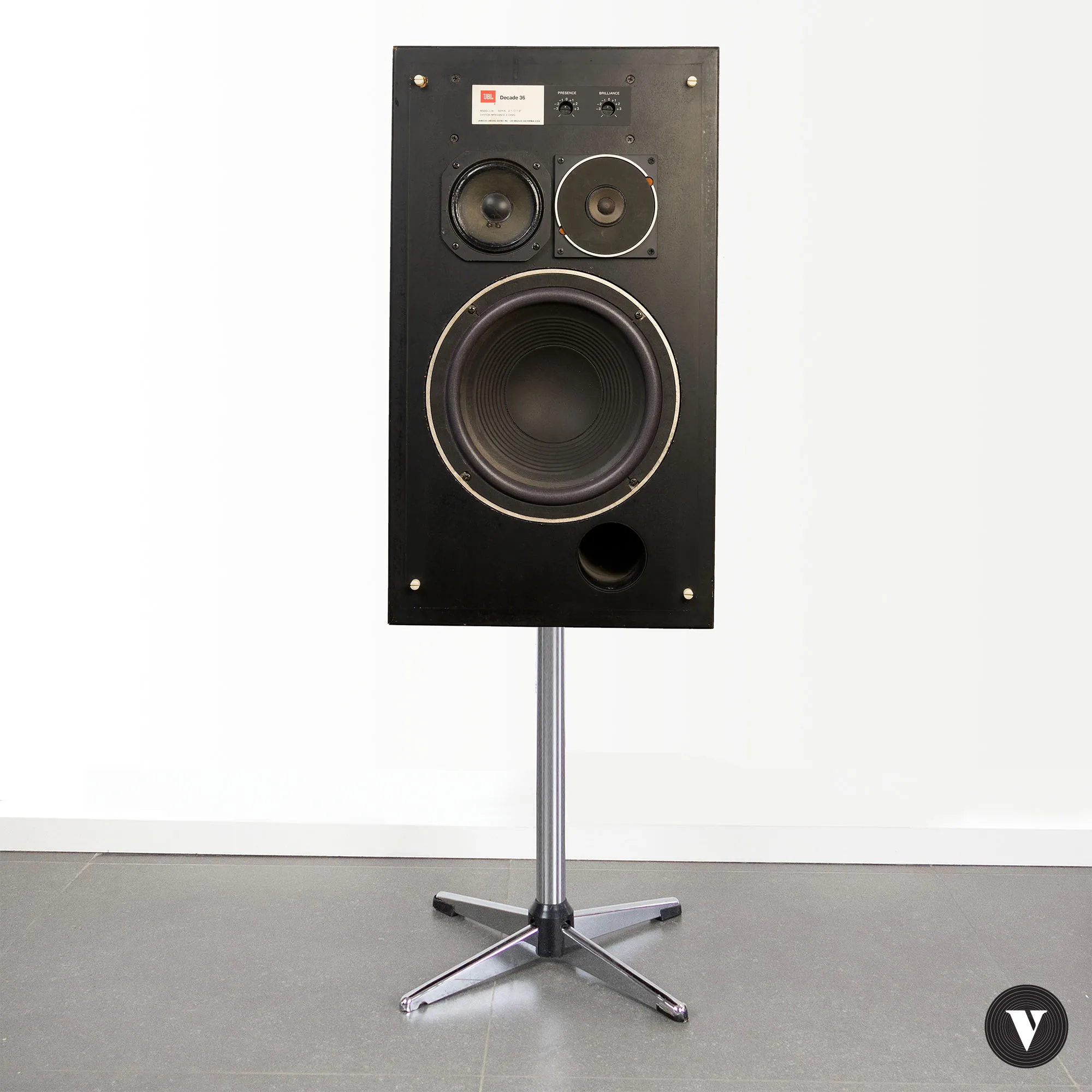
JBL L36 Decade Loudspeaker System
JBL
Buy — JBL specifies an 8-ohm, 50W continuous-program system, and its service chart identifies the original 125A, LE5-6 and LE25-2 drivers for remote verification.
This is the safer default when you cannot audition either pair, provided the seller proves all six drivers, both woofer surrounds and all four level controls work. Its drawback is a deliberately lively balance with documented bass and response irregularities.Available at Amazon(paid link) — opens Amazon in a new tab. Price and availability shown there.Pioneer HPM-500 Speaker System
Pioneer
Consider — Hi-Fi Choice measured 89dB/W sensitivity and 111dBA maximum output but rated forward-response uniformity poor and found erratic off-axis integration.
Consider this pair for efficient, high-output rock and party listening when its polymer-graphite woofers have documented, properly centered refoams. The drawback is fragile cone construction and measured off-axis inconsistency.Available at Amazon(paid link) — opens Amazon in a new tab. Price and availability shown there.
Sources
Pages consulted while researching this article. None of these are affiliate links.
- Hi-Fi Choice No. 26: Loudspeakers, 1981 — worldradiohistory.com
- Pioneer HPM-500 Operating Guide — nesovski.com
- JBL L36 Decade Instruction Manual — support.jbl.com
- JBL Hi-Fi Systems Reference Chart, 1982 — cieri.net
- Improvements in L50 System as Compared to L36 Decade System — cieri.net
- Pioneer SX-3700 Operating Instructions — manualslib.com
- Pioneer HPM-500 Woofer Replacement Repair Discussion — diyaudio.com
- JBL L-Pad and Attenuator Restoration — audiokarma.org