PartyBox 320 or a Second 120 for 60 Guests?
The questionWhere do these come from?
JBL party box 120 for wedding.
Hi. We are looking at playing our own music for our wedding. We already own one party box 120. Wedding will be indoors in a function room. About 50-60 people.
Choose the JBL PartyBox Stage 320 for a simple 50–60-guest indoor wedding; add a second Club 120 when wide-room coverage matters more.
Choose the JBL PartyBox Stage 320 for a 50-to-60-guest indoor wedding when the priority is dependable volume, stronger bass and the simplest possible setup. Add a second PartyBox Club 120 instead when the room is wide or long enough that two separated speaker positions matter more than the Stage 320’s extra output per cabinet.
This recommendation rests on JBL’s documentation and independent testing; this site did not test either speaker.
| Option | Output and drivers | The deciding advantage | Verdict |
|---|---|---|---|
| JBL PartyBox Stage 320 | 240W RMS; two 6.5-inch woofers | More output and low-frequency headroom from one cabinet | Buy |
| Two JBL PartyBox Club 120 speakers | 160W RMS and two 5.25-inch woofers per cabinet | Two physical sound sources and same-model stereo pairing | Consider for wide rooms |
Neither model deserves a blanket skip. The PartyBox Club 120 is a good speaker, and a pair can outperform one centrally placed cabinet for even coverage; the difference is whether the wedding needs maximum simplicity or two-speaker distribution.
Why the Stage 320 gets the wedding nod
JBL rates the PartyBox Stage 320 at 240W RMS, versus 160W RMS for one Club 120. It also uses two 6.5-inch woofers rather than the Club 120’s two 5.25-inch units. Both have a stated 40Hz–20kHz response at the -6dB points, so the important distinction is not an advertised extension to a lower frequency; it is the larger Stage 320 drivers and greater available output. Those figures come directly from the Stage 320 specification sheet and Club 120 specification sheet.
Do not read 240W versus 160W as “50% louder.” Amplifier power, driver sensitivity, cabinet design and signal processing all affect acoustic output. Even the theoretical difference from 1.5 times the power is only about 1.8dB when every other variable is assumed equal. The useful evidence is that RTINGS tested both models under the same methodology and found that the Stage 320 gets louder than the Club 120, while the smaller speaker delivers more consistent sound from different listening angles.
That higher ceiling matters at a wedding because music competes with conversation, applause and a crowded dance floor. It lets you run below maximum rather than forcing a smaller cabinet to its limit. In a hands-on review, HIFI.DE reported that the Stage 320 began to exhibit slight distortion at roughly 80% volume, while still judging it capable of handling smaller weddings. That is a reason to preserve headroom rather than planning to run either model at full volume all evening.
A guest count is not an acoustic specification, however. Fifty seated guests in a compact function room are much easier to cover than the same number talking and dancing in a long hall with a high ceiling. The Stage 320 is the safer single-box choice, not a guarantee that one speaker covers every room holding 60 people.
What a second Club 120 gets right
Two Club 120s give you something one Stage 320 cannot: two separately placed sound sources. Put one on each side of a dance floor or along the front of a wide room and people no longer need to hear one cabinet through several rows of bodies. JBL explicitly supports stereo pairing of two speakers for a wider soundstage, while Auracast can distribute the same program to multiple compatible PartyBoxes.
That makes the second Club 120 the better conditional choice when:
- the room is much wider than it is deep;
- the dance floor sits between two safe speaker positions;
- true left/right stereo is important;
- the existing Club 120 is already loud enough nearby but fades at the far side of the room;
- having a second usable cabinet provides valuable backup if one speaker develops a problem.
The second Club 120 gets the one-box brief wrong for anyone who wants the fewest possible failure points: it adds another cabinet, power connection, placement decision and pairing step. Each Club 120 weighs 11.05kg, so a pair is 22.1kg in total; the Stage 320 weighs 16.5kg and includes wheels and a telescopic handle. Those weights and the 35mm pole sockets are documented in the respective Club 120 owner’s manual and Stage 320 owner’s manual.
Just want the recommendation?
Skip to the picksTwo 160W amplifiers also total 320W on paper, but that number cannot be compared directly with the Stage 320’s 240W as though it were a single acoustic measurement. Placement can make the pair sound more even throughout the room without making either individual cabinet as forceful as the Stage 320 at one listening position.
Keep the existing 120 if possible
Upgrading does not have to mean disposing of the Club 120. A particularly capable arrangement is a Stage 320 facing the dance floor, with the existing Club 120 used as a lower-level fill speaker for a distant seating area.
The models can share the same program over Auracast, but a mixed Stage 320 and Club 120 arrangement is not a conventional matched left/right stereo pair. SoundGuys’ comparison explains that Auracast works with other supported JBL speakers, while stereo pairing uses an identical speaker. Treat a mixed pair as main-and-fill speakers carrying the same music.
For a wedding, the more predictable connection is the wired option where cable routing is safe. Both manuals document 3.5mm IN/OUT sockets for daisy-chaining PartyBox speakers. That avoids depending entirely on a wireless speaker-to-speaker link. Run the Stage 320 as the main cabinet, feed its output to the Club 120 and set the fill speaker only loud enough to cover the area the main speaker misses. A soundcheck from several guest positions is essential because excessive overlap can make the sound less clear rather than more powerful.
Set up the Stage 320 for intelligible speeches
The Stage 320 has two quarter-inch microphone/instrument inputs and can mix a microphone with music, but it does not have an XLR input. Confirm the officiant’s or wireless microphone receiver’s output before the event; “it has microphone inputs” does not mean every professional receiver plugs in directly.
For a compact rectangular room, place the Stage 320 near the centre of a short wall and aim it down the room. Raising it safely on a correctly rated 35mm stand helps high frequencies and speech clear a standing crowd. JBL’s manual says pole mounting must use appropriate hardware and safe rigging practices, so the speaker’s 16.5kg weight needs to be within the stand’s documented capacity.
Use AC power when it is safely available and keep the charged battery as backup. JBL advertises up to 18 hours for the Stage 320 and 12 hours for the Club 120, but both companies’ documentation warns that playback time changes with volume and content. Those maximum figures should not be treated as full-volume wedding runtimes.
During vows and speeches, turn Bass Boost off, keep the speaker in front of the microphone rather than behind it and leave volume headroom for applause. The light show can also be disabled when it would distract from the ceremony. Test the actual music source, microphone, cables and power arrangement together before guests enter—not as separate components in another room.
The final choice
Buy the JBL PartyBox Stage 320 when one purchase must cover a typical indoor wedding of 50 to 60 guests with the least setup complexity. Its 240W rating, larger woofers, higher independently observed maximum output, longer stated battery life and wheeled cabinet make it the stronger single-speaker tool.
Consider a second JBL PartyBox Club 120 when the venue is wide, the speakers can be positioned safely on opposite sides and the existing 120 already produces enough volume close up. Two 120s win on physical coverage and matched stereo; the Stage 320 wins on per-cabinet headroom and simplicity.
If the room is L-shaped, split across separate spaces or expected to host sustained DJ-level dancing, neither one Stage 320 nor an untested wireless pair should be assumed sufficient from guest count alone. That layout needs an on-site soundcheck and may require a distributed PA rather than another guess based on amplifier wattage.
The bottom line
Both are defensible — the split is what you do with it:
Top pick
Buy this
JBL PartyBox Stage 320 Portable Party Speaker
JBL PartyBox
JBL rates it at 240W RMS with two 6.5-inch woofers, and RTINGS found it gets louder than the Club 120 in matched testing.
This is the subject upgrade and the top pick for a 50-to-60-guest indoor wedding because it supplies more single-cabinet output and avoids managing a matched wireless pair. Its drawback is less even coverage than two separated speakers, plus a 16.5kg cabinet.Available at Amazon(paid link) — opens Amazon in a new tab. Price and availability shown there.The alternative
It depends
JBL PartyBox Club 120 Portable Party Speaker
JBL PartyBox
Two identical Club 120s support stereo pairing and provide two physical coverage points, but each is rated at 160W RMS with smaller 5.25-inch woofers.
This named rival is the narrower alternative to buy as a second unit when a wide room needs two speaker positions or true stereo. The drawback is managing two 11.05kg cabinets, two power arrangements and a speaker-to-speaker connection.Available at Amazon(paid link) — opens Amazon in a new tab. Price and availability shown there.
Recommended products
Ordered by how well each one fits the situations above. Each link below is a paid link.
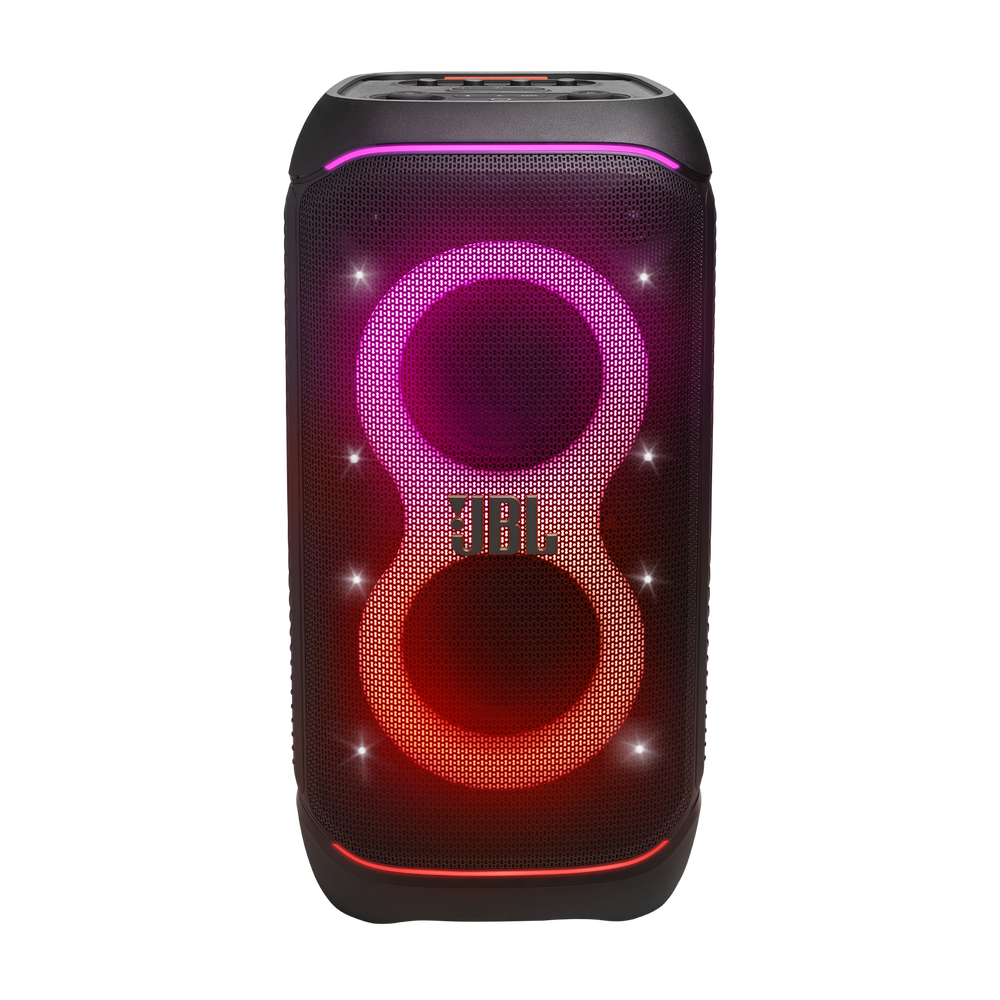
JBL PartyBox Stage 320 Portable Party Speaker
JBL PartyBox
Buy — JBL rates it at 240W RMS with two 6.5-inch woofers, and RTINGS found it gets louder than the Club 120 in matched testing.
This is the subject upgrade and the top pick for a 50-to-60-guest indoor wedding because it supplies more single-cabinet output and avoids managing a matched wireless pair. Its drawback is less even coverage than two separated speakers, plus a 16.5kg cabinet.Available at Amazon(paid link) — opens Amazon in a new tab. Price and availability shown there.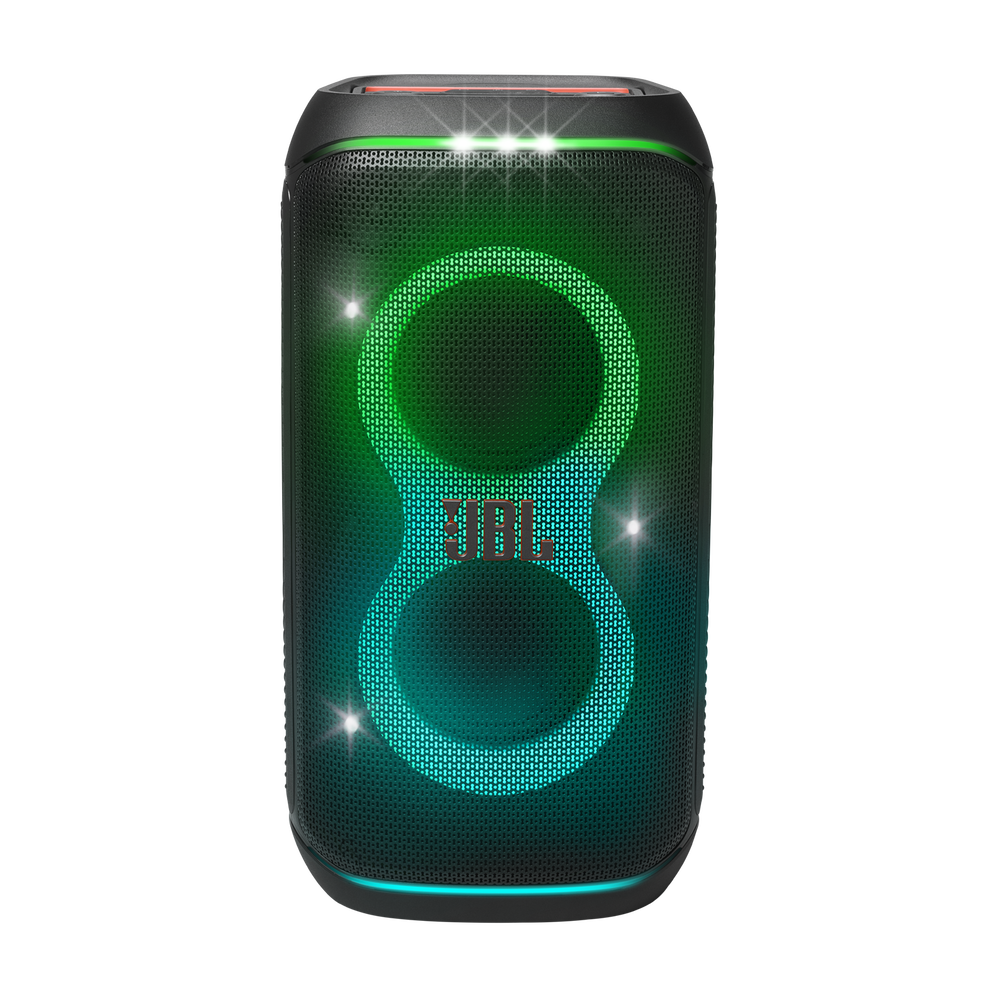
JBL PartyBox Club 120 Portable Party Speaker
JBL PartyBox
It depends — Two identical Club 120s support stereo pairing and provide two physical coverage points, but each is rated at 160W RMS with smaller 5.25-inch woofers.
This named rival is the narrower alternative to buy as a second unit when a wide room needs two speaker positions or true stereo. The drawback is managing two 11.05kg cabinets, two power arrangements and a speaker-to-speaker connection.Available at Amazon(paid link) — opens Amazon in a new tab. Price and availability shown there.
Sources
Pages consulted while researching this article. None of these are affiliate links.
- JBL PartyBox Stage 320 Specification Sheet — jbl.com
- JBL PartyBox Club 120 Specification Sheet — jbl.com
- JBL PartyBox Stage 320 vs PartyBox Club 120 — RTINGS — rtings.com
- JBL PartyBox Stage 320 Test — HIFI.DE — hifi.de
- JBL PartyBox Stage 320 Owner’s Manual — support.jbl.com
- JBL PartyBox Club 120 Owner’s Manual — support.jbl.com
- JBL PartyBox Stage 320 vs Club 120 — SoundGuys — soundguys.com