Eureka Mignon Zero vs DF54: Which One Wins?
The question this answersWhere do these come from?
Should I choose the Eureka Mignon Zero or the DF54 espresso grinder?
The DF54 is the better default for low retention and brew switching; choose the Mignon Zero for quieter, faster espresso and stronger service support.
Choose the DF54 for most single-dose setups: independent testing found substantially lower absolute retention, while its full-size adjustment collar makes changing brew methods easier. Choose the classic Eureka Mignon Zero instead if quieter operation, faster espresso grinding, Italian manufacture and established service support matter more.
This comparison concerns the classic 55 mm Mignon Zero, not the Mignon Zero Brew, Zero 55 S or Zero 65 All Purpose. Those similarly named grinders are different enough to change the answer.
| Deciding difference | Eureka Mignon Zero | DF54 |
|---|---|---|
| Stock burrs | 55 mm flat, hardened steel | 54 mm flat, stainless steel |
| Measured time for 18 g | 12 seconds | 21 seconds |
| Measured noise with coffee | 83.5 dB | 86 dB |
| Measured absolute retention | 1.9 g | 0.5 g |
| Grind adjustment | Small stepless side dial | Large stepless top collar |
The speed, noise and retention figures come from separate tests by the same independent coffee laboratory, Kaffeemacher. Its Mignon Zero measurements were recorded in 2025, while its DF54 laboratory test was published later that year. They are more useful than manufacturer claims, although different production revisions and coffees can still move the results.
If low retention is the priority, choose the DF54
“Zero” does not mean the Mignon’s grinding chamber is literally empty after each dose. Kaffeemacher measured 1.9 g of absolute retention in the classic Zero, versus 0.5 g in the DF54. Absolute retention includes both coffee that exchanges with later doses and grounds that remain lodged in internal spaces; it does not mean every 18 g dose comes out 1.9 g short.
The DF54 result breaks down into 0.3 g of temporary retention and 0.2 g of permanent retention. With the bellows in use, the laboratory recorded output variance of approximately 0.05 g. A second independent reviewer, Coffee Chronicler, usually found 0.2–0.3 g retained without using the bellows and commonly reached 0.0–0.1 g after using them. A 13 g coarse dose produced 12.9 g in the cup during that review’s DF54 retention testing.
That makes the DF54 the stronger choice if you alternate between regular and decaffeinated beans. Less exchangeable coffee means less of the previous dose contaminates the next one. The difference also matters when switching between coffees with very different roast levels.
Both grinders still require sensible technique: run the motor until grinding has finished, operate the bellows while it is running, then allow the remaining grounds to leave the chute. Neither should be judged from one dose immediately after cleaning because empty internal spaces initially need to fill.
If you only make espresso, the taste difference is smaller
Do not choose the Eureka merely because 55 mm is one millimetre larger than 54 mm. Burr diameter alone does not determine flavour, and these two stock burr sets aim at broadly similar traditional espresso.
Kaffeemacher measured an approximately 239-micrometre x50 particle size and about 30% fines from the DF54 at its espresso recipe. The resulting bimodal distribution was described as comparable to a Eureka Mignon, producing full-bodied, rounded and chocolate-led espresso. In the same laboratory’s Zero testing, the classic Eureka 55 mm burrs produced dense, cocoa-forward shots with sweetness and a lightly dry finish.
The available measurements therefore do not establish a clear espresso-quality winner for medium and darker roasts. Differences in alignment, coffee, water, basket and recipe may be more noticeable than the nominal burr-size gap.
For very light-roast espresso where maximum flavour separation is the goal, neither stock configuration is an obvious specialist choice. The DF54’s stock burrs are capable all-rounders, not extreme high-clarity burrs; the Mignon’s standard 55 mm geometry also leans toward body. The honest answer is that no controlled, blind head-to-head test found here proves that one produces categorically better espresso than the other.
If you switch between espresso and filter, choose the DF54
The DF54’s large numbered collar is easier to move through a wide range and return near an earlier setting. Coffee Chronicler successfully moved it from espresso to French press and conducted blind filter tastings against several specialist grinders, matching extraction with refractometer measurements. The DF54 was competitive enough that it was not consistently identifiable as the weakest cup.
The classic Mignon Zero uses Eureka’s small side-mounted stepless dial. It offers the fine control needed to dial in espresso, but large changes can span multiple rotations, and the dial supplies no rotation counter. That makes an exact return from a coarse filter setting unnecessarily awkward. If the grinder will remain on one espresso bean, this weakness largely disappears. If you already have one, use the guide to find your Mignon Zero espresso setting before deciding that the adjustment range is inadequate.
Just want the recommendation?
Skip to the picksThe DF54 is not an unlimited burr-upgrade platform. Its 54 mm size has fewer alternatives than common 64 mm platforms, and Coffee Chronicler notes that some Baratza and Mahlkönig burrs require the opposite rotation direction. Choose it for the capable stock burrs and easier adjustment—not because it offers endless future burr experiments.
If morning noise and speed matter, choose the Mignon Zero
Kaffeemacher recorded the classic Zero at 83.5 dB while grinding coffee and the DF54 at 86 dB. The 2.5 dB difference is not silence versus noise, but it supports the Mignon’s advantage when another person is sleeping nearby. Eureka specifically builds the Zero around its vibration-damping Silent Technology.
The Mignon also completed the laboratory’s 18 g espresso dose in 12 seconds, compared with 21 seconds for the DF54. One drink does not make nine seconds important, but the difference becomes noticeable across several back-to-back doses. Eureka’s own current Mignon Zero specifications list 55 mm hardened-steel burrs, a 45 g single-dose hopper, 1,350 rpm operation and a 320 W motor.
The tradeoff is clear: the Mignon finishes sooner and makes less noise, while the DF54 moves less stale coffee between doses.
If long-term support matters, the Eureka is safer
The classic Mignon Zero is made in Italy by an established grinder manufacturer. Eureka advertises a ten-year motor warranty for the current model, although regional eligibility, registration requirements and whole-grinder coverage should be confirmed with the authorized seller. A motor warranty does not automatically cover burrs, switches or every other component for the same period.
The DF54 is an OEM platform sold under names including Turin, MiiCoffee and G-Iota. The core grinder is substantially the same, but warranty handling, alignment services and replacement-parts access come from the importer rather than one consistent global brand. Buying from a seller with local repair capability matters more here than the badge printed on the body.
There is also a maintenance-specific safety issue: Kaffeemacher found that its DF54 could continue running after the adjustment collar was completely unscrewed. Disconnect it from power before removing the collar or putting a brush near the burr chamber. A switch being off is not an adequate substitute for unplugging it.
Check the exact version before ordering
A listing marked Mignon Zero 55 S is not the classic Zero in the table. The 55 S retains the standard 55 mm espresso burr profile but adds Eureka’s larger adjustment dial and a front activation lever. Kaffeemacher measured it at 83.1 dB and 10.5 seconds for 18 g. Its measured 2.7 g absolute retention came from a stricter protocol, so the laboratory explicitly warns against comparing that number directly with the older Zero result. The classic model is made in Italy; the tested 55 S came from Eureka’s Chinese factory.
DF54 version numbers are even less orderly. Retailers use “V3” and “V4” as informal labels rather than universally defined model generations. According to Grind Logic’s production-revision comparison, the revision commonly called V4 has a slightly wider exit chute but retains the same 54 mm platform, stepless collar, plasma ionizer and metal declumper as the preceding configuration. Confirm the actual chute and declumper specification instead of trusting a version number alone.
This also limits what the 0.5 g laboratory result can prove: it strongly supports the DF54 platform’s retention advantage, but it is not a guarantee that every importer’s revision, burr alignment and bean will reproduce precisely 0.5 g.
The short buying rule
Choose the DF54 if you change beans frequently, make both espresso and filter coffee, want the easier adjustment interface or place the greatest weight on low measured retention.
Choose the Eureka Mignon Zero if it will stay near one espresso setting and you prioritize quieter grinding, shorter grind time, established manufacturer support and Italian production.
Choose neither solely for the one-millimetre burr difference. And if high-clarity light-roast espresso plus frequent burr experimentation is the main goal, move to a grinder designed around a widely supported 64 mm burr platform instead of forcing either of these compact grinders into that role.
The bottom line
The choice turns on one thing:
Top pick
Buy this
Turin DF54 V4 Single Dose Coffee Grinder Stainless Steel Burrs
Turin
The DF54 is the article’s default choice because testing measured 0.5 g absolute retention versus the Zero’s 1.9 g, and its large collar simplifies brew-method changes.
This is the version to choose for low retention and frequent changes between beans or brew methods. Its drawbacks are slower, louder grinding and support that depends heavily on the importer.Available at Amazon(paid link) — opens Amazon in a new tab. Price and availability shown there.The alternative
It depends
Eureka Mignon Zero 55 Single Dose Coffee Grinder
Eureka
Choose the classic Zero for an espresso-focused workflow prioritizing speed and noise: testing measured 12 seconds and 83.5 dB versus the DF54’s 21 seconds and 86 dB.
Choose the classic 55 mm Zero for a quieter, faster espresso-only workflow and established manufacturer support. Its small adjustment dial and higher measured internal retention make frequent brew-method or bean changes less convenient.Available at Amazon(paid link) — opens Amazon in a new tab. Price and availability shown there.
Recommended products
Ordered by how well each one fits the situations above. Each link below is a paid link.
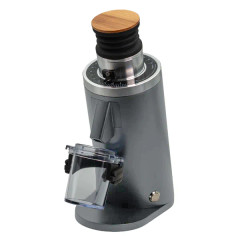
Turin DF54 V4 Single Dose Coffee Grinder Stainless Steel Burrs
Turin
Buy — The DF54 is the article’s default choice because testing measured 0.5 g absolute retention versus the Zero’s 1.9 g, and its large collar simplifies brew-method changes.
This is the version to choose for low retention and frequent changes between beans or brew methods. Its drawbacks are slower, louder grinding and support that depends heavily on the importer.Available at Amazon(paid link) — opens Amazon in a new tab. Price and availability shown there.
Eureka Mignon Zero 55 Single Dose Coffee Grinder
Eureka
It depends — Choose the classic Zero for an espresso-focused workflow prioritizing speed and noise: testing measured 12 seconds and 83.5 dB versus the DF54’s 21 seconds and 86 dB.
Choose the classic 55 mm Zero for a quieter, faster espresso-only workflow and established manufacturer support. Its small adjustment dial and higher measured internal retention make frequent brew-method or bean changes less convenient.Available at Amazon(paid link) — opens Amazon in a new tab. Price and availability shown there.
Eureka Mignon King Size Grind Dial
Eureka
It depends — Consider it for fine espresso adjustment on the classic Zero, with the article’s stated caveat that the dial lacks a rotation counter for returning precisely from coarse settings.
This makes fine adjustments easier to see and control on a classic Mignon Zero. It does not add a rotation counter or solve the grinder’s measured retention disadvantage.Available at Amazon(paid link) — opens Amazon in a new tab. Price and availability shown there.
Sources
Pages consulted while researching this article. None of these are affiliate links.
- Eureka Mignon Zero vs. Zero 65 in a Comparative Test — kaffeemacher.de
- G-Iota DF54 Reviewed: Laboratory Measurements — kaffeemacher.de
- DF54 Review: When Less Is More — coffeechronicler.com
- Eureka Mignon Zero Official Specifications — eureka.co.it
- DF54 V3 vs V4: What Changed? — grindlogic.ca