Miele CM6 vs KitchenAid KF8: Which Should You Buy?
The question
User comparing KitchenAid KF8 and Miele CM6, wants to know which is preferred and why.
The Miele CM6 wins on footprint and hands-off milk hygiene; the KitchenAid KF8 wins on plant-based milk handling, recipe depth, and quieter grinding.
Miele’s CM6 (CM 6360 MilkPerfection) is the one to buy for most people comparing the two, mainly because of size and milk hygiene — it has a noticeably smaller footprint and an automatic milk-line rinse that doesn’t ask permission, at the cost of a louder grind, a plainer button-and-dial interface and a slightly narrower drink menu than the KitchenAid KF8.
That’s the short version. The rest of this breaks down exactly where each machine wins, because “preferred” depends on what you’re actually optimizing for — counter space, milk hygiene, or sheer number of customizable recipes.
The comparison, side by side
| Miele CM 6360 MilkPerfection | KitchenAid KF8 (KES8558) | |
|---|---|---|
| Footprint (W × H × D) | 9.9" × 14.1" × 16.8" | 10.2" × 14.3" × 18.5" |
| Weight | 21.8 lb | 28 lb |
| Water tank | 1.8 L | 2.2 L (74.4 fl oz) |
| Bean hopper | 10.5 oz | 9.5 oz |
| Milk container | 0.7 L glass carafe, not chilled | 26.7 oz stainless container |
| Interface | Buttons and dial | 5-inch touchscreen |
| Base drink types | 12 coffee + 6 tea | 12 coffee (40+ total recipe variants) |
| User profiles | 8 | 6 |
| Grinder | Conical burr, 5 settings, 15 g max dose | Conical burr, smart dosing, 15 g max dose |
| Grinder noise | ~74.8 dB (coffeeness.de measurement) | ~62 dB (Techlicious measurement) |
| Remote app | WiFi Conn@ct via Miele app | None — KF8 isn’t on KitchenAid’s connected-appliance list |
Footprint: the Miele CM6 is meaningfully smaller
The Miele CM 6360 measures 9.9 inches wide by 14.1 inches tall by 16.8 inches deep and weighs 21.8 pounds, according to Home Coffee Expert’s hands-on review — figures that match the machine’s own spec sheet of 251 × 359 × 427 mm. Miele designs the CM6 line to fit under standard wall cabinets, which the KitchenAid KF8 does not manage at 18.5 inches deep and 28 pounds, per figures reported by both Techlicious and independent search aggregation of KitchenAid’s own product pages.
If your counter depth is under 19 inches with an upper cabinet above it, that 1.7-inch difference in depth and the extra clearance the KF8 needs for its rear-mounted water reservoir is the deciding factor before you look at anything else.
Milk system: Miele rinses without asking, KitchenAid asks every time
Both machines automate milk texturing, but the mechanics differ in a way that matters daily. The CM6’s two-tube milk system automatically rinses the pickup line after every milk drink and again at shutdown, with no confirmation prompt — Coffeedant’s review rated the system 9.5/10 for hygiene and noted its stainless pickup tube stays cleaner over months of daily use than typical silicone-tube designs. The tradeoff is that Miele’s 0.7-liter glass milk flask isn’t temperature-controlled, so milk needs to come straight from the fridge and go back in promptly.
The KF8’s 26.7-ounce stainless milk container also rinses automatically on startup, shutdown, and after milk drinks, but it prompts you to confirm the rinse after every milk-based drink — you can tap “Later” to defer it. One reviewer at KitchenAid’s own product-help documentation and independent coverage both describe this as “pushy” but effective at keeping the system clean if you don’t dismiss it repeatedly. The KF8 also has a dedicated plant-based milk mode that lowers frothing temperature and increases aeration for oat and almond milk, which the Miele CM6 does not offer as a distinct setting.
If oat- or almond-milk drinks are a regular order in your house, that’s a real point in the KF8’s favor. If you want milk hygiene handled without any taps required, the Miele wins.
Drink menu and interface: KitchenAid’s touchscreen versus Miele’s dial
The KF8 runs a 5-inch touchscreen with 12 base coffee drinks that expand into 40-plus saved recipe variations across 6 user profiles, plus separate dairy and plant-based milk settings. The Miele CM6 offers 12 coffee recipes and 6 tea presets — a broader beverage type range since it brews tea, not just coffee — across 8 user profiles, but through physical buttons and a dial rather than a touchscreen. Coffeeness.de’s review called the Miele interface “refreshingly simple” compared to touchscreen rivals, while also noting it “can’t compete with Jura” on visual polish or guided navigation.
If tea is part of your routine, that’s a genuine differentiator the KF8 doesn’t answer — it has a hot-water dispense function but no dedicated tea program with brew-time and temperature presets by tea type. If you want the most granular, save-and-recall recipe control and don’t mind learning a touchscreen menu tree, the KF8’s system goes deeper.
Just want the recommendation?
Skip to the picksEspresso quality and grinder
Both machines use a conical stainless steel burr grinder pumping at 15 bar with a 15-gram maximum dose, so the two are closely matched on paper. In practice, independent testing gives a slight edge to the KF8: Techlicious reported “rich, full-bodied shots with consistent crema” across more than 1,400 drinks pulled during testing, beating a DeLonghi Eletta Explore on espresso quality, though still trailing Jura’s E8/S8 machines by an estimated 10-15%. Coffeedant scored the Miele CM6360’s espresso 7.5 out of 10 — “very good for the class” on medium roasts — but flagged that its conservative five-position grind range limits how well it handles light roasts compared to machines with a wider adjustment window, and that it also trails the Jura E8 on straight espresso quality.
Neither machine is the espresso-quality leader in its price bracket; both reviewers point to Jura as ahead on that specific metric. Between the two, if espresso concentrate quality on darker, oilier roasts is the priority, the KF8’s testing track record is the stronger evidence. If you mostly drink light-roast single origins, both machines are a constrained choice and neither is built for that.
Cleaning and maintenance
Neither machine fully automates descaling — that feature is reserved for Miele’s higher-tier CM7750 in its own lineup, according to Coffeedant. Both the CM6 and KF8 instead display an on-screen or indicator-light message when descaling is due and require you to run the cycle manually, a roughly 25-minute process on the Miele per Coffeeness.de. KitchenAid’s own product-help documentation recommends descaling roughly every 200 coffees, with the alert appearing on the touchscreen.
Both machines have a removable brew group for hand-washing. Miele additionally marks its water tank and drip tray as dishwasher-safe, which Coffeeness.de called out favorably against DeLonghi’s more cautious stance on dishwasher use for similar parts; KitchenAid’s KF8 documentation doesn’t make the same dishwasher-safe claim for its equivalent parts.
Noise
If grinder noise matters — an open kitchen, an early riser, a light sleeper nearby — the KF8 measured quieter in independent testing. Techlicious measured the KF8’s grinder at approximately 62 dB, while Coffeeness.de reported the Miele CM6360’s grinder at 74.8 dB, describing it in practice as “exceptionally unspectacular” thanks to the machine’s build quality, but the recorded figure is still meaningfully louder on paper. Neither outlet used identical test conditions, so treat this as directional rather than lab-controlled, but it’s consistent with user reports that Miele’s grinder is on the louder side for its class.
Which one to buy
Buy the Miele CM6 (CM 6360 MilkPerfection) if counter depth is tight, you want milk-line hygiene handled without a confirmation tap every time, or tea is a real part of your rotation — its automatic rinse cycle and under-cabinet-friendly footprint are the two most checkable advantages it has over the KF8.
Buy the KitchenAid KF8 if you drink a lot of plant-based milk drinks, want the deepest recipe customization with saved settings, or care about grinder noise in a shared space — its dedicated plant-based milk mode, 40+ saved recipes, and quieter measured grind noise are real, checkable wins the Miele doesn’t match.
Skip the idea that either one solves espresso quality on its own: both reviewers who tested them independently put Jura’s E8/S8 line slightly ahead on straight espresso extraction, so if that’s your single priority over milk drinks, footprint, or interface, neither the CM6 nor the KF8 is the end of that search.
If you’re deciding between other super-automatics in this bracket, the deciding specs are usually the same three: milk-line automation, footprint against your actual counter, and whether the grinder’s noise profile fits your kitchen’s schedule — not the drink count on the box, since both machines clear 12 base recipes and most buyers never touch more than four of them regularly.
The bottom line
Neither is wrong; the use case separates them:
Top pick
Buy this
Miele CM 6360 MilkPerfection Countertop Coffee Machine
Miele
Independent review measured a 9.9" x 14.1" x 16.8" footprint versus the KF8's 18.5" depth, and its milk-line rinse runs automatically rather than requiring a tap to confirm.
Smaller footprint and a milk system that auto-rinses without a confirmation prompt make this the pick for tight counters and daily milk-drink households, though the glass carafe isn’t chilled and the interface is button-and-dial rather than touchscreen.Available at Amazon(paid link) — opens Amazon in a new tab. Price and availability shown there.The alternative
It depends
KitchenAid KF8 Fully Automatic Espresso Machine KES8558
KitchenAid
Techlicious measured its grinder at roughly 62 dB against the Miele's 74.8 dB, but it needs a deeper, taller counter footprint and its milk rinse cycle requires confirming a prompt after every drink.
The deeper recipe menu, dedicated plant-based milk mode, and quieter measured grinder noise make this the better fit for households that lean on oat or almond milk drinks and want the most saved, customizable recipes.Available at Amazon(paid link) — opens Amazon in a new tab. Price and availability shown there.
Recommended products
Ordered by how well each one fits the situations above. Each link below is a paid link.
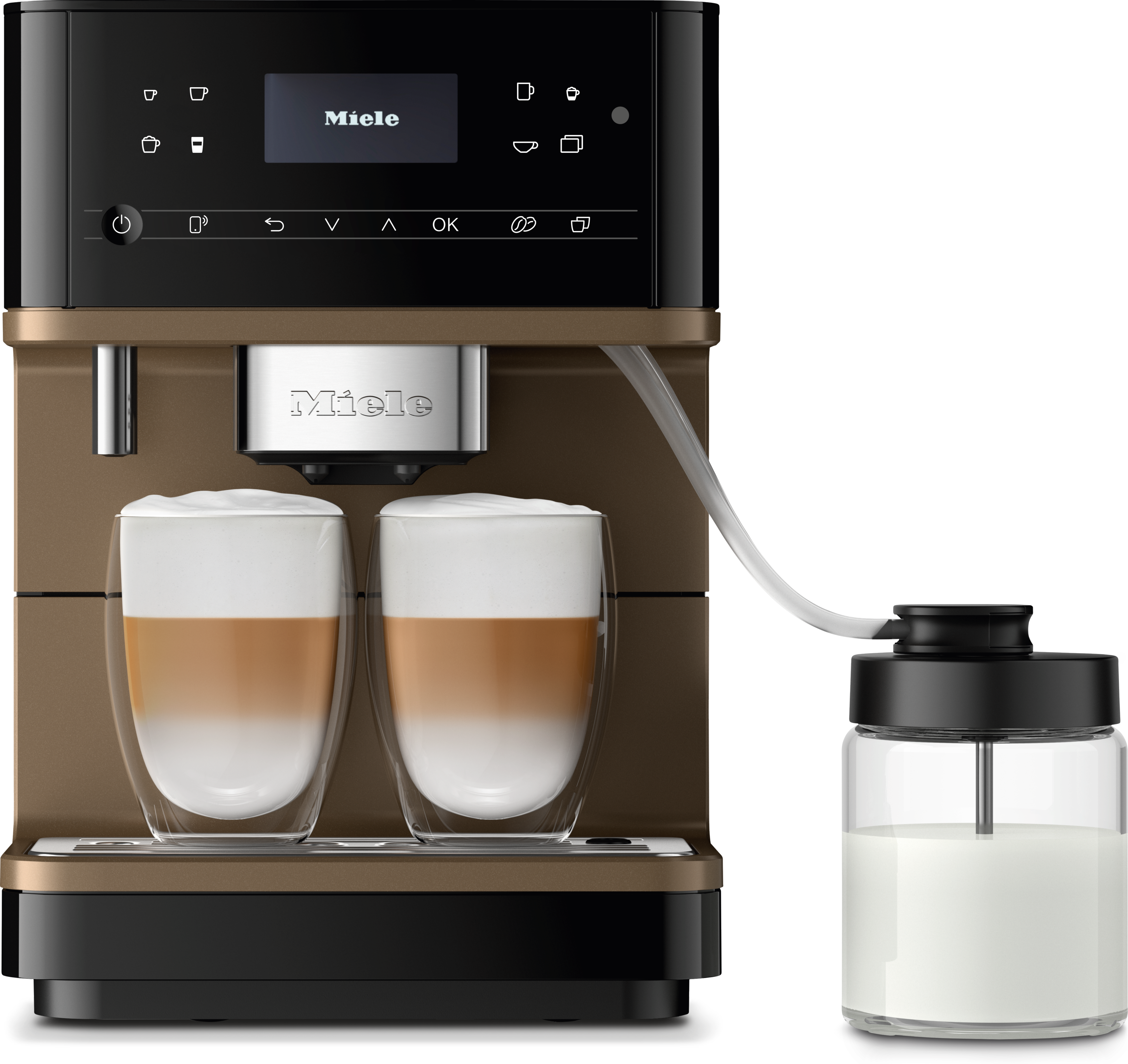
Miele CM 6360 MilkPerfection Countertop Coffee Machine
Miele
Buy — Independent review measured a 9.9" x 14.1" x 16.8" footprint versus the KF8's 18.5" depth, and its milk-line rinse runs automatically rather than requiring a tap to confirm.
Smaller footprint and a milk system that auto-rinses without a confirmation prompt make this the pick for tight counters and daily milk-drink households, though the glass carafe isn’t chilled and the interface is button-and-dial rather than touchscreen.Available at Amazon(paid link) — opens Amazon in a new tab. Price and availability shown there.
KitchenAid KF8 Fully Automatic Espresso Machine KES8558
KitchenAid
Consider — Techlicious measured its grinder at roughly 62 dB against the Miele's 74.8 dB, but it needs a deeper, taller counter footprint and its milk rinse cycle requires confirming a prompt after every drink.
The deeper recipe menu, dedicated plant-based milk mode, and quieter measured grinder noise make this the better fit for households that lean on oat or almond milk drinks and want the most saved, customizable recipes.Available at Amazon(paid link) — opens Amazon in a new tab. Price and availability shown there.
Jura E8 Automatic Coffee Machine
Jura
Consider — Reviewers who tested all three describe Jura's espresso quality as roughly 10-15% ahead of the KF8 and note the Miele CM6 "trails" it as well, though the E8 doesn't match Miele's under-cabinet footprint.
Both Coffeedant’s and Techlicious’s independent testing put Jura’s E8 ahead of both the CM6 and KF8 specifically on straight espresso extraction quality, so it’s worth a look if espresso concentrate is the priority over milk-drink automation.Available at Amazon(paid link) — opens Amazon in a new tab. Price and availability shown there.
Sources
Pages consulted while researching this article. None of these are affiliate links.
- Miele CM 6360 Review: Beautiful, Powerful, But Is It Right for You? — homecoffeeexpert.com
- Miele CM6360 MilkPerfection Review - Coffeedant — coffeedant.com
- Miele CM 6360 Review: The Best Miele Coffee Maker for 2026? — coffeeness.de
- KitchenAid KF8 Review – Real Espresso Control in a Fully Automatic — techlicious.com
- Descaling the Espresso Machine - Product Help | KitchenAid — producthelp.kitchenaid.com
- Fully Automatic Espresso Machine KF8 - Stainless Steel | KitchenAid US — kitchenaid.com
- CM6 MilkPerfection Barista Coffee Machines | Miele — mieleusa.com
- Best KitchenAid Espresso Machine: Which One Should You Buy? — homecoffeeexpert.com