Style Inherited Furniture Without Losing Its Character
The question
how to style inherited furniture
Make inherited furniture feel at home by separating matching sets, repeating one color, and adding simpler textiles, lighting, and art.
Style inherited furniture by giving each piece a useful role, pairing ornate shapes with simpler surroundings, and repeating one of its colors elsewhere in the room. Start with removable additions—cushion covers, a rug, lighting, or framed pictures—before changing the furniture’s finish.
Work in this order:
- Choose the piece you most want to see. Give it a position where you can use it and open its doors or drawers fully.
- Clear its surface and the space immediately around it. Judge the furniture separately from the objects that arrived with it.
- Choose one connecting color. Repeat a color from its wood, upholstery, or hardware in a nearby textile or picture.
- Introduce a simpler shape. Pair a carved cabinet with an uncomplicated frame, or a patterned chair with a plain cushion.
- Photograph the arrangement from the doorway. Remove or relocate whatever competes with the inherited piece before buying more accessories.
These are styling starting points, not measured design rules. For decisions about which pieces belong in which room, the broader guide to decorating with inherited furniture covers that planning stage.
Make a dark dresser or sideboard feel less heavy
A dark wooden cabinet becomes visually dominant when everything around it is equally dark, bulky, or detailed. Start by changing one surrounding surface: a pale wall, a light rug in front, or artwork with a generous light background. You can keep the wood exactly as it is.
For a concrete arrangement, pair a dark mahogany sideboard with an ivory lampshade, a simple black picture frame, and one muted green object. Repeat the green in a cushion elsewhere. The ivory introduces contrast; the repeated green connects the sideboard to the rest of the room. That combination is a suggested palette, not a claim that every reddish wood needs green.
Avoid trying to match wood species by name alone. Two pieces described as oak can have visibly different finishes. Hold a textile sample beside the actual furniture and look at both in daylight and under the lighting you normally use. If the combination looks uncomfortable in either setting, try another sample before committing to a large rug or curtains.
Scale matters more than adding another ornament. As an initial mock-up, try artwork or a grouped display around two-thirds the width of the cabinet. For a 150-centimetre sideboard, that means testing a roughly 100-centimetre-wide arrangement. This is an adjustable styling suggestion, not a mounting standard. Cut paper to the proposed size and hold it against the wall before buying.
Keep the top useful. Put a lamp toward one end, a small grouping toward the other, and leave space between them. If the cabinet stores serving dishes, preserve enough clear surface to set those dishes down.
A wall display can also move family photographs off a crowded top. Consider the Umbra Exhibit Wall Picture Frames, Set of 5, Black, model 1013426-040, when you want to group several small photographs in one contemporary metal display. Umbra’s catalog specifies two 4-by-6-inch photographs and three 5-by-7-inch photographs. Its limitation is equally concrete: those openings accommodate small photographs, so this set cannot replace a large artwork above a broad sideboard. Umbra’s Exhibit specifications
No independent laboratory measurements for this frame set were located during research; the capacities above are the manufacturer’s specifications. The styling recommendation rests on its format, not a tested claim about durability. There is no evidence-backed reason to label this frame set a product to avoid; choose it only when its photograph sizes suit your display.
Let a patterned chair or sofa supply the palette
When inherited upholstery has a strong floral, stripe, or tapestry pattern, treat that pattern as the room’s starting point. Choose one background color and one smaller accent from the fabric. Use the background color for the largest nearby plain textile, and repeat the accent more sparingly.
Just want the recommendation?
Skip to the picksFor example, a chair with burgundy flowers, olive leaves, and a cream background can sit beside a cream curtain and an olive cushion on another seat. You do not need another floral print to explain why the chair belongs.
Keep enough upholstery visible to show that the pattern is intentional. A throw folded over one arm can soften the arrangement; covering the back, seat, and arms with unrelated fabrics usually creates another coordination problem. If the upholstery is sound and comfortable, start with one plain cushion rather than a fitted cover.
A slipcover makes more sense when you dislike most of the visible fabric and intend to use the seating regularly. Check the exact arm shape, back construction, and cushion arrangement before ordering. A generic stretch cover can conceal carved wooden arms or blur the outline that made the inherited chair distinctive.
Give an ornate chair a practical setting: a simple reading light and a small table within reach. Keep the neighboring shapes quiet enough that the chair remains legible. If the frame rocks, joints move, or the seat support has failed, styling cannot make it ready for use; repair comes first.
Reupholstery is a later decision. It can suit an ordinary family piece whose fabric has worn out, but a potentially significant antique needs an assessment before original material is removed.
Break up a matching suite without making it look random
An inherited dining or bedroom suite can feel overwhelming because its repeated shapes dominate every view. You can separate the pieces without losing their connection.
Move a dining sideboard into a living room if its dimensions and storage suit that room. Use a bedroom chest in a hallway only if drawers can open without blocking passage. Keep matching bedside tables together when their symmetry is useful; there is no obligation to separate every pair.
Connect relocated pieces through one repeated detail. A brass-colored frame can echo existing brass handles. A curved lamp base can repeat the outline of a rounded table. Choose one connection rather than reproducing the original room around each object.
For an inherited dining table, retain the chairs if they are comfortable and fit beneath it. A plain runner and a simpler pendant may provide enough contrast. Replacing the chairs purely to make the set look less coordinated introduces fit questions—seat height, arm clearance, and usable table space—that accessories do not.
Before painting or stripping anything, distinguish ordinary unwanted furniture from a piece with an original finish worth preserving. The Canadian Conservation Institute explains that original finishes can carry historical information and cannot be restored once removed. Age alone does not establish value, but uncertainty is a reason to postpone an irreversible treatment. CCI guidance on wooden furniture
Be equally cautious with the familiar advice to brighten inherited wood using restoration polish. CCI advises against commercial restoration mixtures on museum wooden objects because oils, waxes, or silicones can leave buildup and complicate later conservation. That does not establish that every household polish is unsuitable for every finish; it does explain why an unidentified historic finish needs assessment before treatment. CCI guidance on furniture finishes
Finish by checking placement as well as appearance. Keep valued wooden pieces out of direct sunlight and away from heat sources, and place live plants on a separate stand to avoid water damage. Those precautions follow CCI’s care guidance. Then leave the arrangement in place through ordinary use: a cabinet that stores what you need, a chair you actually sit in, and enough clear space around both will tell you more than another decorative purchase.
The bottom line
Start with this:
Top pick
It depends
Umbra Exhibit Wall Picture Frames Set of 5 Black 1013426-040
The set holds two 4-by-6-inch and three 5-by-7-inch photographs, making it suitable for a small-photo display rather than large prints.
Groups small family photographs above inherited furniture, freeing its surface for everyday use. The small photo openings make it unsuitable as a replacement for large artwork.Available at Amazon(paid link) — opens Amazon in a new tab. Price and availability shown there.
Recommended products
Ordered by how well each one fits the situations above. Each link below is a paid link.
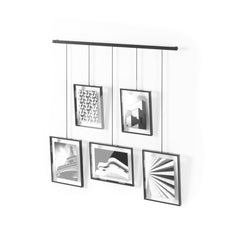
Umbra Exhibit Wall Picture Frames Set of 5 Black 1013426-040
Consider — The set holds two 4-by-6-inch and three 5-by-7-inch photographs, making it suitable for a small-photo display rather than large prints.
Groups small family photographs above inherited furniture, freeing its surface for everyday use. The small photo openings make it unsuitable as a replacement for large artwork.Available at Amazon(paid link) — opens Amazon in a new tab. Price and availability shown there.
Sources
Pages consulted while researching this article. None of these are affiliate links.