Samsung Galaxy Watch FE for Running: Honest Verdict
The question this answersWhere do these come from?
Is the Samsung Galaxy Watch FE good for running?
The Galaxy Watch FE is good for casual runs and 5K training, but inconsistent GPS and daily charging make it a weak marathon-training watch.
Yes—the Samsung Galaxy Watch FE is good enough for recreational running, beginner 5K plans and tracking ordinary workouts. It records the essentials and adds useful heart-rate-zone guidance, but independent tests found enough GPS drift—and battery life is short enough—that pace-focused and high-mileage runners should choose a dedicated running watch instead.
Its strongest case is as an Android smartwatch that can also track runs. It is not the strongest choice when running performance is the main reason for buying a watch.
| Type of runner | Verdict | Deciding reason |
|---|---|---|
| Casual runs of 20–60 minutes | Good fit | GPS, pace, heart rate and cadence are all covered |
| Beginner 5K training | Good with caveats | Useful trends and five heart-rate zones, but imperfect route accuracy |
| Pace-based interval training | Weak fit | GPS and wrist-heart-rate errors can distort short efforts |
| Marathon training | Look elsewhere | Daily charging and inconsistent GPS undermine long-term training data |
| Treadmill running | Reasonable fit | GPS drift is irrelevant, though wrist-estimated distance may differ from the treadmill |
What the Galaxy Watch FE records during a run
The FE is considerably more capable than a basic activity band. Samsung’s official specifications give it GPS, GLONASS, Galileo and Beidou positioning, an optical heart-rate sensor, barometer, accelerometer and gyroscope. The 40mm aluminum case weighs 26.6g without its band, so it is light enough not to become distracting during a run. It also has sapphire crystal over the display and a 5ATM water-resistance rating, making sweat and rainy training ordinary use cases rather than special precautions. Samsung’s launch specification provides the complete hardware details.
During a manually started Running workout, Samsung Health displays and records pace, distance and heart rate. Depending on the workout screen, you can also see elapsed time, calories, cadence, average pace and running asymmetry. Samsung describes the latter features as Advanced Running Analysis.
To capture the full set of metrics, start the session from Apps > Samsung Health > Work out > Running. Samsung warns that some measurements may not be supported during automatically detected workouts, so auto-detection is useful as a safety net—not the best way to record a planned run. Samsung’s workout instructions also specify that VO2 max requires at least 10 minutes at 4km/h on a flat route with a good GPS signal; sweat-loss estimation requires at least 2.5km at 5km/h.
The Personalized Heart Rate Zone feature divides training into five intensity levels. To personalize those ranges rather than use generic zones, Samsung requires an outdoor run lasting more than 10 minutes at a steady speed of at least 4km/h. That easily accommodates beginners and run-walk sessions. Samsung’s Galaxy Watch FE documentation confirms both the five zones and the calibration requirement.
One easily missed distinction matters: Advanced Running Analysis on the FE is not Samsung’s newer personalized Running Coach. Samsung’s current Running Coach documentation identifies the Galaxy Watch8 and Watch8 Classic, with a 12-minute level test and more than 160 training programs. Do not buy the FE assuming it includes that structured coaching system; check the actual Samsung Health menu if a later regional software update claims to add it.
GPS accuracy is the deciding compromise
The FE can produce a perfectly plausible map and distance on an open route, but the available tests do not support treating every kilometre split as authoritative.
Frandroid compared its recorded track with a Google Pixel 7. The overall route was recognizable, but the FE placed parts of the run beyond the road and through neighboring properties. The reviewer’s judgement was that its GPS was acceptable rather than especially precise. Frandroid’s Galaxy Watch FE test includes both recorded tracks.
Tabletowo found a more consequential discrepancy while comparing the FE with a Huawei Watch GT 4 and Strava. In one example, the Galaxy Watch FE recorded 2.83km where the comparison distance was 3.00km. That is a 170m shortfall, or approximately 5.7%. The same review also observed occasional deviations of several metres from the actual path. Tabletowo’s measured comparison is useful because it exposes an error that a clean-looking summary number would hide.
The evidence is not uniformly negative. TechRadar tracked multiple workouts against an Apple Watch Ultra 2 and described the FE’s distance, GPS and heart-rate results as generally good. That review did not publish a repeatable error percentage, however. TechRadar’s test therefore supports “adequate for ordinary tracking,” not “proven accurate under every condition.”
No cited test conducted repeated runs over one certified course, so there is no defensible universal error margin. Buildings, tree cover and sharp turns can also change the result. If a training session depends on hitting exact 400m intervals or holding a tightly controlled race pace, that unresolved variation is enough reason to use a more running-focused watch.
Just want the recommendation?
Skip to the picksFor the cleanest result, manually start Running, enable Location under Settings > Location, and let the watch establish its position before moving. Avoid relying on auto-detection for a session whose first kilometre matters.
Heart-rate trends are more convincing than the route data
Frandroid compared the optical sensor with a Garmin HRM-Pro Plus chest strap during exercise. After the opening minutes, the FE followed changes in intensity reasonably well, although it recorded an unexplained rise at roughly the 12-minute point while the strap remained steady. TechRadar’s comparison with the Apple Watch Ultra 2 was also broadly favorable.
That makes the FE useful for reviewing average effort, observing trends and keeping an easy run inside a broad heart-rate zone. It is less convincing for short intervals where a delayed or false wrist reading can place the entire effort in the wrong zone. The personalized zones do not make the sensor itself more accurate; they make the thresholds more relevant to the runner.
Wear the case snugly enough that it cannot bounce, positioned slightly above the wrist bone. Tattoos, cold skin, loose straps and forceful arm movement can all make optical readings harder to obtain. Anyone using heart rate to enforce medical limits or make high-stakes training decisions should not treat a consumer watch reading as clinical data.
Battery life means planning around the charger
The FE contains a 247mAh battery, and Samsung rates it for up to 40 hours with the always-on display disabled. Independent results were shorter and, importantly, did not agree with one another.
Frandroid measured 32 hours and 30 minutes with the always-on display plus continuous health monitoring enabled. TechRadar obtained only 22 hours even with the always-on display disabled. Different notifications, apps, screen use and workout time can explain some of that gap, but the practical conclusion is the same: expect to charge the FE daily or close to daily.
Neither test published a controlled continuous-GPS runtime for the FE, so claiming that it will cover a specific ultramarathon duration would be guesswork. An ordinary training run should not threaten a charged battery; the greater risk is starting a long run after forgetting the previous day’s charge.
Running without a phone works, with limits
Because the FE has its own positioning hardware, it can record an outdoor route without carrying the paired phone. The Bluetooth version can also play transferred music through Bluetooth earbuds. Its nominal 16GB storage leaves 7.6GB available before additional apps and updates, according to Samsung’s specification.
Samsung’s current music-transfer instructions explain how to put tracks on a Galaxy Watch for phone-free playback. Streaming subscriptions and app support have their own requirements, so download and test a playlist before race day.
Phone-free communication is different from phone-free run recording. A Bluetooth-only FE cannot provide independent cellular calls or messages away from its paired phone and Wi-Fi. LTE versions were released in some markets, but availability and carrier support are regional and require a compatible plan.
Compatibility is another hard boundary: Samsung specifies Android 11 or newer with more than 1.5GB of memory. The Wear OS Galaxy Watch FE does not support iPhones. Some health functions also require a Samsung Galaxy phone, although basic GPS run recording, pace and heart-rate tracking do not depend on ECG or blood-pressure features.
The final buying line
Keep or choose the Galaxy Watch FE if you primarily want notifications, apps, music and Samsung Health, while running a few times per week for general fitness. It supplies far more running detail than a simple step tracker, and its light 40mm case is comfortable for smaller wrists.
Skip it if exact live pace, dependable urban GPS, multi-day battery life or structured marathon training is the priority. A purpose-built running watch is the better tool for those conditions. The FE’s honest position is straightforward: it is a good casual running companion, but only an average running watch.
The bottom line
Two readings, two answers:
Top pick
It depends
Samsung Galaxy Watch FE 40mm Bluetooth SM-R861
Samsung
The FE suits casual running alongside Android smartwatch use, but daily or near-daily charging and a test recording 2.83km over 3.00km limit its appeal for serious training.
Choose this model when smartwatch apps, notifications and casual run tracking matter equally. Its drawbacks are daily charging, a small display and GPS that independent tests found inconsistent.Available at Amazon(paid link) — opens Amazon in a new tab. Price and availability shown there.The alternative
Buy this
Garmin Forerunner 165 Music GPS Running Smartwatch
Garmin
The article recommends a dedicated running watch for pace-focused and high-mileage runners because the FE’s inconsistent GPS and daily charging undermine that use.
This is the more useful alternative when structured training and long GPS battery life matter more than Wear OS apps. The drawback is a narrower general-smartwatch experience and no cellular option.Available at Amazon(paid link) — opens Amazon in a new tab. Price and availability shown there.
Recommended products
Ordered by how well each one fits the situations above. Each link below is a paid link.
Samsung Galaxy Watch FE 40mm Bluetooth SM-R861
Samsung
It depends — The FE suits casual running alongside Android smartwatch use, but daily or near-daily charging and a test recording 2.83km over 3.00km limit its appeal for serious training.
Choose this model when smartwatch apps, notifications and casual run tracking matter equally. Its drawbacks are daily charging, a small display and GPS that independent tests found inconsistent.Available at Amazon(paid link) — opens Amazon in a new tab. Price and availability shown there.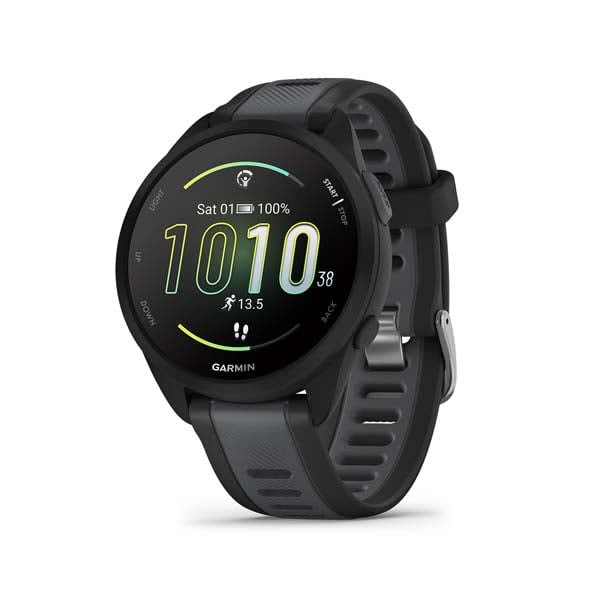
Garmin Forerunner 165 Music GPS Running Smartwatch
Garmin
Buy — The article recommends a dedicated running watch for pace-focused and high-mileage runners because the FE’s inconsistent GPS and daily charging undermine that use.
This is the more useful alternative when structured training and long GPS battery life matter more than Wear OS apps. The drawback is a narrower general-smartwatch experience and no cellular option.Available at Amazon(paid link) — opens Amazon in a new tab. Price and availability shown there.

Sources
Pages consulted while researching this article. None of these are affiliate links.
- First Galaxy Watch FE Empowers Even More Users With Samsung’s Advanced Health Monitoring Technology — news.samsung.com
- Galaxy Watch FE (Bluetooth, 40mm) Specifications and Running Features — samsung.com
- Work Out With Your Samsung Galaxy Watch — samsung.com
- How to Use the Personalized Running Coach Feature on Galaxy Watch8 — samsung.com
- Samsung Galaxy Watch FE Test: GPS, Heart Rate and Battery Measurements — frandroid.com
- Samsung Galaxy Watch FE Review and Distance Comparison — tabletowo.pl
- Samsung Galaxy Watch FE Review — techradar.com
- Play and Control Music on Your Samsung Watch — samsung.com