Garmin Instinct 3 for Backpacking: The Catch
The question
garmin instinct 3 user needs a backpacking watch under about $400 for occasional trips, prioritizing accurate
The Instinct 3 Solar lasts long and tracks distance well, but a measured elevation shortfall makes the COROS Nomad the safer backpacking pick.
Choose the COROS Nomad over the Garmin Instinct 3 when reliable elevation tracking is the deciding requirement. The Instinct 3 Solar 45mm remains a good Garmin-centered choice for occasional trips, but independent testing found a large enough ascent shortfall that it cannot be the unconditional recommendation.
Skip the Garmin Instinct 3 AMOLED 45mm for multi-day backpacking: it has the Solar model’s older heart-rate sensor and breadcrumb-only navigation, while Garmin rates it for 32 hours in GPS-only mode instead of the Solar model’s 40 hours—and it cannot extend that figure with sunlight.
| Product | Verdict | The deciding evidence | The catch |
|---|---|---|---|
| COROS NOMAD GPS Adventure Watch | Buy | 50 hours in all-systems GPS mode, offline maps, and encouraging elevation and heart-rate tests | Large 47.8mm case; no solar charging |
| Garmin Instinct 3 Solar 45mm | Consider | Excellent GPS tracks and 40-hour GPS-only rating | One field test recorded an ascent undercount of up to 500 feet |
| Garmin Instinct 3 AMOLED 45mm | Skip | Same core sensors and navigation as Solar | 32-hour GPS-only rating and no solar extension |
| Garmin HRM 200 Heart Rate Monitor | Consider | Supplies chest-strap data to a compatible watch | Another device to wear, maintain, and pack |
The elevation result changes the recommendation
The Instinct 3 Solar’s horizontal tracking is not the problem. CleverHiker tested it in forests, steep mountains and valleys, then reported that it shortened a control loop by only a few hundredths of a mile. On larger climbing days, however, the watch reportedly undercounted accumulated elevation by as much as 500 vertical feet. The test did not publish that error as a percentage, so it should not be converted into one, but 500 feet is material if ascent is one of the numbers you use to pace a hike or confirm progress along a route. CleverHiker’s Instinct 3 Solar field test
That is what the Instinct 3 Solar gets wrong for backpackers who need dependable cumulative ascent, even though its distance track can be excellent. It is still entirely reasonable when elevation is useful secondary information and a phone or map remains the authoritative navigation tool.
The COROS Nomad has the stronger reported result for this particular priority. Android Central compared it with a Garmin Forerunner 970 during a seven-mile hike and reported no elevation discrepancy, including beneath foliage and beside steep hills. That is one reviewer’s route rather than proof that every Nomad will be exact in every weather system, but it is better evidence for elevation-sensitive buyers than an observed 500-foot shortfall. Android Central’s COROS Nomad accuracy tests
No wristwatch barometer is a survey instrument. COROS itself says that an elevation reading within plus or minus 10 metres is considered accurate for a GPS watch, and cumulative gain can magnify small fluctuations over a long route. COROS’s elevation-data explanation
Calibrate the Instinct 3 before judging its altimeter
The Instinct 3 estimates elevation from pressure changes, so an incorrect starting altitude, changing weather or a blocked pressure port can affect the result. Garmin enables automatic calibration at the GPS starting point by default, but a known trailhead elevation is a better reference when one is available.
On the Solar model, hold MENU, then open Sensors & Accessories > Altimeter. Leave Auto Cal. enabled for ordinary use. To establish a known starting point, select Calibrate > Enter Manually; Use DEM and Use GPS are the other documented choices. Garmin also offers Altimeter Only for an activity involving altitude changes and Barometer Only when elevation is fixed. Garmin’s Instinct 3 altimeter instructions
Calibration can correct the starting reference. It cannot guarantee that cumulative gain will remain exact through a day of changing pressure, nor does it erase the independent test result. If repeated outings over a route with known elevation still produce implausible totals after calibration and the pressure port is clean, contact Garmin support; settings alone cannot establish whether the sensor is defective.
Just want the recommendation?
Skip to the picksHeart rate is good at hiking pace, not infallible
The Instinct 3 uses Garmin’s older Elevate Gen 4 optical sensor. Wareable found it reasonably accurate during steady-paced and stationary workouts when compared with a chest strap, but recorded more trouble during high-intensity activity and recommended an external monitor for heart-rate-based training plans. That pattern suits ordinary hiking better than intervals: sustained walking is easier for an optical sensor than abrupt uphill surges, cold-weather activity or vigorous pole movement. Wareable’s Instinct 3 sensor comparison
The Nomad also misses sudden changes, but its reported averages were close. Against a Garmin HRM 200, Android Central recorded the Nomad one beat per minute lower over a 12-mile run, two beats lower over a four-mile hike, and exactly the same 119-bpm average over a later seven-mile hike. The graphs still showed moments when the optical sensor lagged on sudden climbs. Those results support using either watch for effort trends; they do not make either wrist sensor a replacement for a chest strap when every rapid change matters.
For precise exercise heart rate, consider the Garmin HRM 200 rather than choosing a worse backpacking watch merely because it promises a newer optical sensor. Garmin documents that the Instinct 3 accepts external heart-rate monitors and uses chest data when wrist and chest readings are both available at the start of an activity. Pair one through MENU > Sensors & Accessories > Add New. The disadvantage is obvious on an occasional trip: it adds a strap, battery and contact point that must be kept comfortable. Garmin’s Instinct 3 Solar owner’s manual Garmin HRM 200 pairing documentation
Battery figures that matter on a trail
Garmin rates the Instinct 3 Solar 45mm for 40 hours in GPS-only mode, 28 hours with all satellite systems, and 24 hours with all systems plus multi-band. Solar raises those theoretical figures to 130, 50 and 40 hours respectively, but only under Garmin’s assumed 50,000-lux conditions. The same watch is rated for 28 days in smartwatch mode. Garmin’s Solar battery table
Do not plan a trip around the solar maximum. CleverHiker found that clouds, sleeves, exposure angle and chosen GPS mode made indefinite operation unrealistic; in its testing, solar generally delayed depletion by only a few hours. Treat sunlight as reserve capacity, not the charging plan.
COROS rates the Nomad for 50 hours with all satellite systems, 34 hours using dual-frequency GPS and 22 days in daily use. COROS’s Nomad specifications Wareable’s longer-term test supports the claim: after 18 days containing six hikes and four trail runs, the watch still showed 18% remaining, while two hours of hiking typically consumed about 4%. Wareable’s Nomad battery test
For occasional two- or three-day trips, both Solar and Nomad have enough endurance if they are charged before departure. Nomad supplies more non-solar headroom in its accurate satellite modes; Solar becomes more attractive for sunny trips where even a modest extension matters.
Breadcrumbs are not offline maps
The Instinct 3 can follow uploaded courses, show an elevation profile, save waypoints and retrace a recorded route. It does not display full topographic maps. Garmin Explore can store maps offline on a phone and sync courses, but that does not turn the Instinct’s blank-background breadcrumb line into an on-watch map. Garmin’s Explore documentation
The Nomad displays offline global maps with trail and road context. That is a meaningful advantage at intersecting paths, although it still should not be the only navigation or emergency tool carried into the backcountry.
Choose the COROS Nomad when elevation confidence, offline map context and battery headroom come first. Consider the Garmin Instinct 3 Solar 45mm when Garmin integration, its flashlight, lighter construction and solar assistance matter more than exact accumulated ascent. The Garmin Instinct 3 AMOLED 45mm is the wrong member of the family for endurance-focused backpacking; its brighter display is useful for daily smartwatch wear, but it gives this reader shorter documented runtime without solving the elevation or mapping limitations.
The bottom line
Two good answers to different versions of the question:
Top pick
Buy this
COROS NOMAD GPS Adventure Watch
COROS NOMAD
COROS specifies 50 hours in all-systems GPS mode and 34 hours in dual-frequency mode, while independent hiking tests reported strong elevation and heart-rate results.
Buy this when elevation confidence, offline maps and non-solar GPS endurance lead the decision. Its 47.8mm case is bulky, and it lacks the Instinct’s solar charging and flashlight.Available at Amazon(paid link) — opens Amazon in a new tab. Price and availability shown there.The alternative
It depends
Garmin Instinct 3 Solar 45mm
Garmin
CleverHiker found its control-loop distance short by only a few hundredths of a mile but recorded elevation-gain undercounts as large as 500 feet on bigger climbing days.
Consider it for occasional trips when Garmin integration, accurate horizontal GPS tracks, a flashlight and solar assistance matter more than exact accumulated ascent. The watch provides only breadcrumb navigation, and one field test found a substantial elevation undercount.Available at Amazon(paid link) — opens Amazon in a new tab. Price and availability shown there.
Recommended products
Ordered by how well each one fits the situations above. Each link below is a paid link.
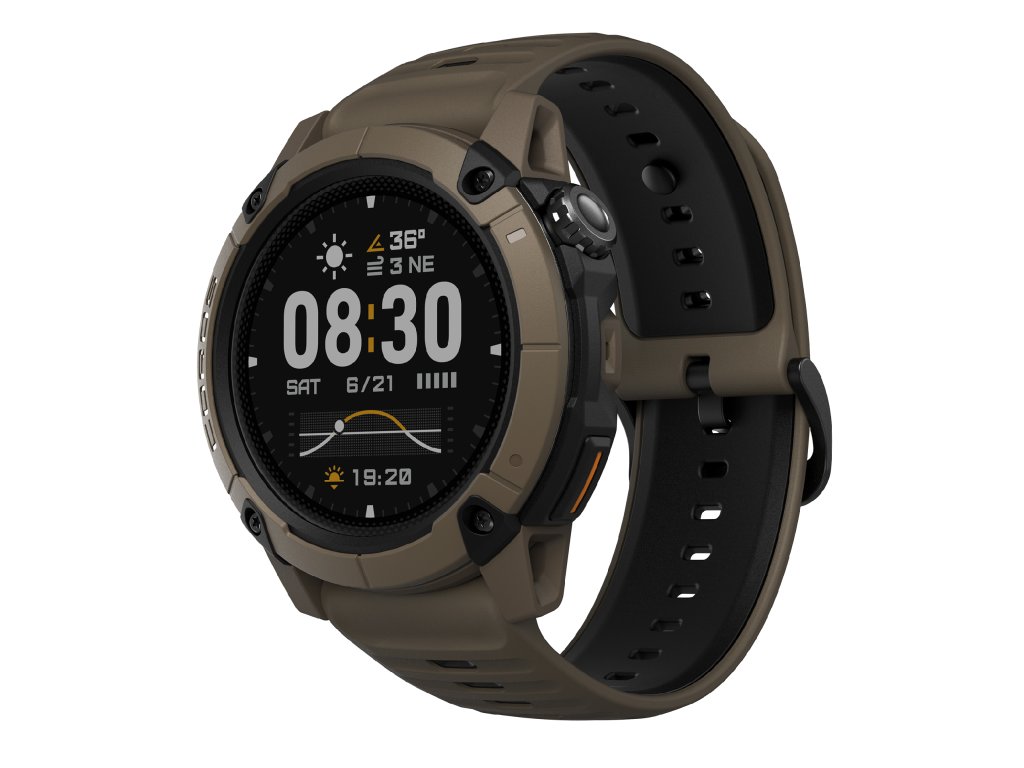
COROS NOMAD GPS Adventure Watch
COROS NOMAD
Buy — COROS specifies 50 hours in all-systems GPS mode and 34 hours in dual-frequency mode, while independent hiking tests reported strong elevation and heart-rate results.
Buy this when elevation confidence, offline maps and non-solar GPS endurance lead the decision. Its 47.8mm case is bulky, and it lacks the Instinct’s solar charging and flashlight.Available at Amazon(paid link) — opens Amazon in a new tab. Price and availability shown there.
Garmin Instinct 3 Solar 45mm
Garmin
Consider — CleverHiker found its control-loop distance short by only a few hundredths of a mile but recorded elevation-gain undercounts as large as 500 feet on bigger climbing days.
Consider it for occasional trips when Garmin integration, accurate horizontal GPS tracks, a flashlight and solar assistance matter more than exact accumulated ascent. The watch provides only breadcrumb navigation, and one field test found a substantial elevation undercount.Available at Amazon(paid link) — opens Amazon in a new tab. Price and availability shown there.Garmin Instinct 3 AMOLED 45mm
Garmin
Skip — Garmin rates it for 32 hours in GPS-only mode versus 40 hours for the Solar 45mm, and the AMOLED model has no solar extension.
Skip this variant for endurance-focused backpacking because its display consumes the battery advantage without improving the heart-rate sensor, altimeter evidence or breadcrumb navigation. It remains suitable for daily wear when the brighter display matters more than trail runtime.Available at Amazon(paid link) — opens Amazon in a new tab. Price and availability shown there.Garmin HRM 200 Heart Rate Monitor
Garmin
Consider — The HRM 200 supports ANT+ and Bluetooth connections, and Garmin documents that the Instinct 3 uses chest-monitor data when chest and wrist readings are both available.
Consider this only when precise activity heart rate matters enough to justify wearing and maintaining a chest strap. The Instinct 3 can use its external data, but it adds another battery-powered item to the kit.Available at Amazon(paid link) — opens Amazon in a new tab. Price and availability shown there.
Sources
Pages consulted while researching this article. None of these are affiliate links.
- Garmin Instinct 3 Solar GPS Watch Review — CleverHiker — cleverhiker.com
- COROS NOMAD Review — Android Central — androidcentral.com
- Garmin Instinct 3 Review — Wareable — wareable.com
- Instinct 3 Solar Series Battery Life Information — Garmin — www8.garmin.com
- Instinct 3 AMOLED Series Battery Life Information — Garmin — www8.garmin.com
- Instinct 3 Solar Series Owner's Manual — Garmin — www8.garmin.com
- COROS NOMAD Specifications — COROS — coros.com
- COROS Nomad Review — Wareable — wareable.com