KINGrinder P0 for AeroPress: What It Gets Right on a Budget
The question
The user has a budget-bound hand-grinder selection question with a direct product ask and budget constraint.
The KINGrinder P0's burr and click range cover AeroPress fine, but a smaller-than-advertised hopper and plastic body set the real limits.
The KINGrinder P0 grinds fine enough and coarse enough for AeroPress — its adjustment range covers the AeroPress click zone with headroom on both the espresso and pour-over side — but it wasn’t built or marketed as an AeroPress-specific grinder. Two real limits decide whether it’s a smart budget pick or a false economy: a hopper that holds less in practice than the spec sheet claims, and a plastic body reviewers repeatedly flag as the first part to wear out.
No independent lab publishes grind-distribution or timing data for grinders in this price bracket the way RTINGS or NotebookCheck does for electronics. What follows combines KINGrinder’s own specification chart with hands-on use reported by RoastAroma, Tom’s Guide, and Honest Coffee Guide.
What the P0’s burr and adjustment actually cover
The P0 uses a 38mm SUS420 stainless steel conical burr — the same burr KINGrinder fits to the K0, its next model up. KINGrinder’s own listing calls it a “5-burr” design; that’s shorthand for five cutting flutes ground into a single conical burr, not five separate burrs.
Adjustment is internal — a threaded collar you turn, not an external dial with printed numbers — stepped at 30 clicks per rotation, with each click moving the burr 0.0333mm. According to KINGrinder’s published settings chart, the full range runs roughly 0 to 1,400 microns across several rotations from zero. Zero itself is a fully closed burr used only to find your reference point, not a usable grind setting.
AeroPress sits inside the range; espresso does not
KINGrinder’s settings chart, reproduced by Honest Coffee Guide, gives a click range for each brew method:
| Brew method | Click range | Rotations from zero |
|---|---|---|
| Espresso | 17–35 | ~1 |
| AeroPress | 30–89 | ~1–3 |
| Pour-over | 39–86 | ~1.5–3 |
| Filter machine | 28–83 | ~1–3 |
| French press | 65–120 | ~2–4 |
AeroPress overlaps both espresso and pour-over here, which matches how people actually use it: some recipes run closer to espresso-fine with a long steep before pressing, others run closer to pour-over coarseness with an immediate plunge. The P0’s range covers that whole span without hitting either end of the burr’s travel.
Espresso is a different case. RoastAroma’s hands-on review and KINGrinder’s own guidance both steer away from espresso on the P0 — the conical burr shows “inconsistent grind texture for espresso despite conical design,” and channeling under 9 bars of pump or portafilter pressure punishes that inconsistency in a way AeroPress does not. AeroPress is brewed at roughly the pressure of a hand press through a paper or metal filter, which is far more forgiving of an uneven grind. If espresso is also on the list, the P0 is the wrong grinder regardless of budget — see the K6 note below.
The 20g-or-25g hopper question, and what an AeroPress dose needs
KINGrinder’s own product page lists a 25g maximum grind capacity. RoastAroma’s hands-on review measured a practical 20g before beans start working past the hopper lid. That five-gram gap is worth knowing about: plan around 20g, not the number on the spec sheet.
Just want the recommendation?
Skip to the picksFor AeroPress, that gap rarely matters. Standard AeroPress recipes — including the recipe printed on AeroPress’s own packaging — run 11g to 18g of coffee per brew. A two-scoop inverted recipe around 20g fits at the practical limit, while a 22g dose may require a second pass. Where the gap does matter is competition-style AeroPress recipes pushing 25g to 30g for a concentrate — those need two grinding passes at the practical 20g capacity.
Switching settings means re-zeroing, not turning a dial
The P0 uses what KINGrinder calls interior adjustment: there’s no external ring with numbers you can glance at and trust between sessions. To change grind size, you turn the internal collar clockwise until it stops — that’s your zero point — then count clicks counter-clockwise to your target setting. KINGrinder’s own documentation for this mechanism warns that “the number on the numerical dial may not be the same as the number of clicks from the grind setting,” meaning any printed markings are a rough guide rather than a saved setting you can return to.
That’s real friction if you use the P0 for AeroPress one day and pour-over the next: you’re re-zeroing and recounting clicks each time rather than spinning a marked dial back to a number you wrote down. Grinders with external adjustment remove this step, which is one of the things the extra cost of a grinder like the K6 actually buys.
Where the plastic body shows up
The P0’s body is ABS plastic; only the burr and grind chamber are metal. RoastAroma’s review describes the hopper lid as prone to popping off, and both Tom’s Guide and RoastAroma separately flag the plastic handle coupling as a known wear point after months of daily grinding. None of this changes grind quality directly — burr geometry is set by the burr, not the housing — but it’s the reason RoastAroma reports owners who “wish they’d saved the extra [money] and gone straight to” a metal-bodied grinder. Durability, not grind performance, is what the plastic costs you.
If you’re grinding once a day for one person, this is a minor risk. If you’re grinding for a household, traveling with it constantly, or expecting years of daily use, the handle coupling is the part likely to fail first.
Comparing the P0 against the two obvious step-ups
| Grinder | Verdict | What decides it | The catch |
|---|---|---|---|
| KINGrinder P0 | Consider | 38mm burr covers the full AeroPress click range (30–89) at the lowest cost of the three | ABS body, interior-only adjustment, ~20g practical capacity, not usable for espresso |
| KINGrinder P1 | Skip | Same 38mm burr, same 20g hopper, same 30-clicks-per-rotation adjustment as the P0 | Costs more for no measurable gain in AeroPress or pour-over performance |
| KINGrinder K6 | Consider | 48mm burr, external stepped dial (no re-zeroing), a meaningfully larger hopper | Costs noticeably more and is bulkier to carry than either P-series model |
The P1 upgrade buys almost nothing for this use case
RoastAroma ran the P0 and P1 head to head and found identical burrs, identical 20g hoppers, and identical stepped micro-adjustment on both. The only differences were price and a marginal espresso score (2/5 for the P1 versus 1/5 for the P0) that still leaves espresso off the table for both. For AeroPress and pour-over specifically, the review’s own conclusion was blunt: put the price difference into fresh, roast-dated beans instead — better beans move the cup more than the P1’s upgrade does. If your budget was going to stretch to the P1 “just in case,” that money buys more against green-to-roasted freshness than against grinder capability here.
When the K6 is the better budget, not the P0
The K6 steps up to a 48mm conical burr, external stepped adjustment (turn a marked dial instead of re-zeroing an internal collar), and a hopper rated well above the P0’s. It also carries KINGrinder’s own recommendation for espresso, drip, and French press — brew methods the P0 is explicitly not built for. That combination costs noticeably more than either P-series model and adds bulk that works against the P0’s main selling point, portability.
The K6 is worth that jump only if your budget can clear the higher cost and at least one of these is true: you want espresso from the same grinder, you switch between fine and coarse settings often enough that re-zeroing the P0 is a genuine annoyance, or you’re grinding larger single-brew doses than a 20g hopper comfortably handles. If none of those apply, the extra capability sits unused, and the P0’s lower cost and smaller footprint are the better fit. For exact click settings and dosing once you’re grinding a larger AeroPress brew on a K6, see KINGrinder K6 and AeroPress XL: Fit, Dose and Settings.
What this comes down to
If AeroPress and pour-over are the only brew methods on your list, and you’re comfortable re-zeroing a collar rather than turning a marked dial, the P0’s burr and click range genuinely cover the job — the limiting factors are durability and hopper size, not grind capability. If espresso is also on the list, or you expect heavy daily use that will find the plastic handle coupling’s weak point, spend past the P-series entirely rather than stepping only as far as the P1.
The bottom line
Two of these work — the difference is which situation you are in:
Top pick
It depends
KINGrinder P0 Manual Coffee Grinder
KINGrinder
Right for AeroPress-and-pour-over-only use on a tight budget; KINGrinder's own guidance excludes it from espresso.
Its 38mm burr and click range cover the full AeroPress zone at the lowest cost of any KINGrinder model, but the hopper holds closer to 20g than the advertised 25g and the body is ABS plastic.Available at Amazon(paid link) — opens Amazon in a new tab. Price and availability shown there.The alternative
Skip this
KINGrinder P1 Manual Coffee Grinder
KINGrinder
RoastAroma's own P0-vs-P1 comparison found no measurable capability gain for AeroPress or pour-over, only a higher price.
Marketed as the step up from the P0, but it shares the same burr, hopper size, and adjustment mechanism.Available at Amazon(paid link) — opens Amazon in a new tab. Price and availability shown there.
Recommended products
Ordered by how well each one fits the situations above. Each link below is a paid link.

KINGrinder P0 Manual Coffee Grinder
KINGrinder
Consider — Right for AeroPress-and-pour-over-only use on a tight budget; KINGrinder's own guidance excludes it from espresso.
Its 38mm burr and click range cover the full AeroPress zone at the lowest cost of any KINGrinder model, but the hopper holds closer to 20g than the advertised 25g and the body is ABS plastic.Available at Amazon(paid link) — opens Amazon in a new tab. Price and availability shown there.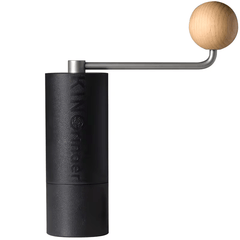
KINGrinder P1 Manual Coffee Grinder
KINGrinder
Skip — RoastAroma's own P0-vs-P1 comparison found no measurable capability gain for AeroPress or pour-over, only a higher price.
Marketed as the step up from the P0, but it shares the same burr, hopper size, and adjustment mechanism.Available at Amazon(paid link) — opens Amazon in a new tab. Price and availability shown there.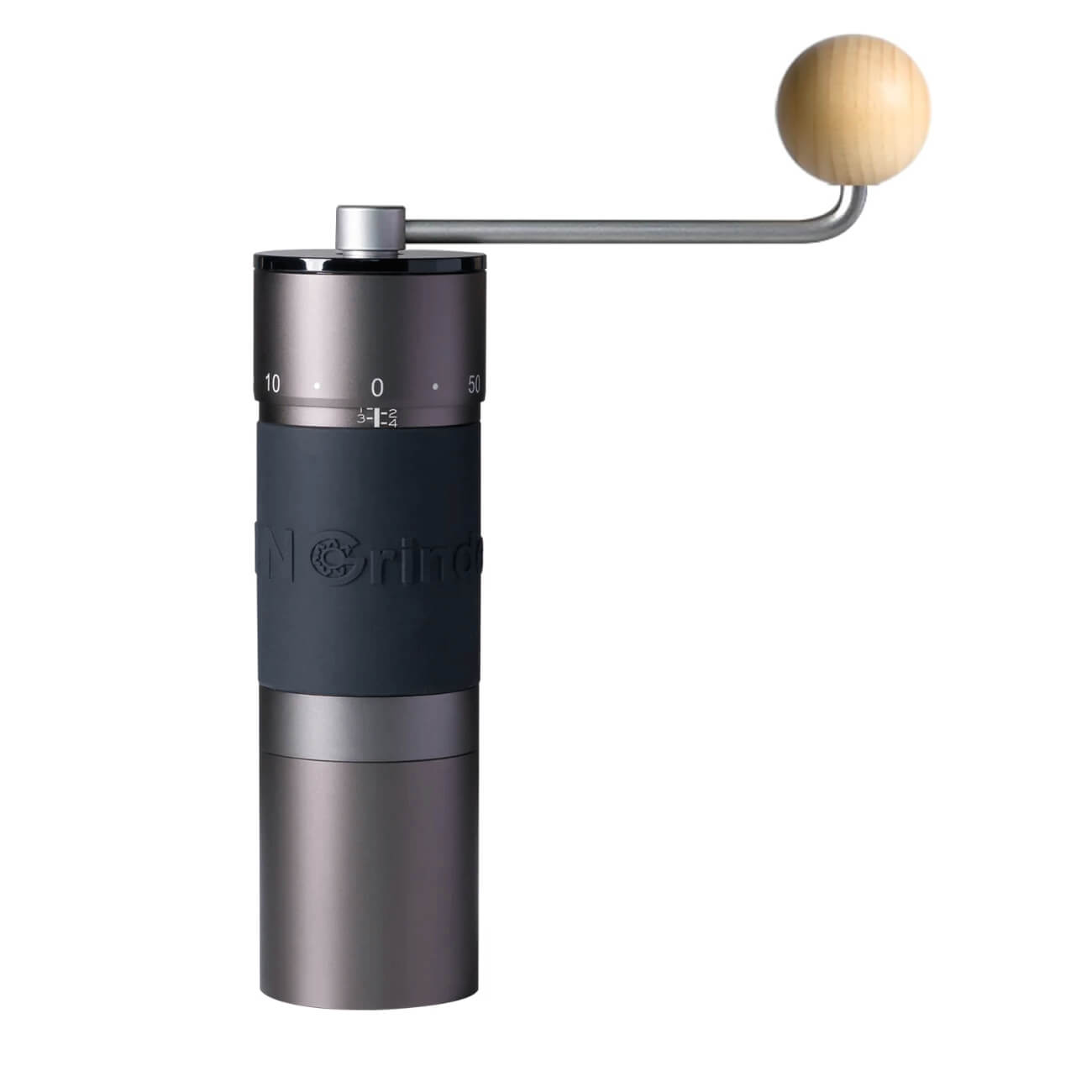
KINGrinder K6 Manual Coffee Grinder
KINGrinder
Consider — Worth it only if espresso is also on your brew list or frequent grind-size switching makes the P0's re-zeroing step a real annoyance.
A 48mm burr, external stepped dial, and larger hopper that also make it usable for espresso, but it costs meaningfully more and loses the P0’s pocket-sized portability.Available at Amazon(paid link) — opens Amazon in a new tab. Price and availability shown there.
Sources
Pages consulted while researching this article. None of these are affiliate links.
- Kingrinder P0 Review (2026): Specs, Price & Who It's For — roastaroma.com
- Kingrinder P0 vs Kingrinder P1 (2026): Which Should You Buy? — roastaroma.com
- KINGrinder P0 Manual Coffee Grinder - Official Product Page — kingrinder.com
- KINGrinder | Grind Setting | Interior Adjustment — kingrinder.com
- KINGrinder P0 grind settings — honestcoffeeguide.com
- KINGrinder Ultimate Guide: P0/P1/P2, K0/K1/K2/K3/K5, K4 and K6 — singledosegrind.com
- My morning coffee just got even fresher with this $22 coffee grinder — tomsguide.com