Kali IN-8 V2 vs Focal Alpha 80 Evo: Which Wins?
The question
kali audio in 8 v2 vs focal alpha 80 evo
Choose the Kali IN-8 V2 for flexible mixing setups; choose the Focal Alpha 80 Evo for deeper specified bass without a subwoofer.
Choose the Kali Audio IN-8 V2 for mixing when placement flexibility matters most; choose the Focal Alpha 80 Evo when deeper specified bass extension without a subwoofer is your priority. The Kali is the default recommendation here, but the Focal has a defensible advantage: its published bass response reaches lower when both speakers are compared at the same tolerance.
Neither deserves a blanket warning. The choice turns on bass extension, cabinet orientation and connections—not a proven across-the-board sound-quality victory. This comparison draws on manufacturer documentation and attributed independent measurements; it does not claim hands-on testing.
| Deciding specification | Kali Audio IN-8 V2 | Focal Alpha 80 Evo |
|---|---|---|
| Driver arrangement | 3-way: 8-inch woofer, coaxial 4-inch midrange and 1-inch tweeter | 2-way: 8-inch woofer and 1-inch tweeter |
| Manufacturer frequency range, ±3 dB | 45 Hz–21 kHz | 38 Hz–22 kHz |
| Cabinet dimensions, H × W × D | 45.1 × 25.4 × 28.5 cm | 39 × 29.6 × 33 cm |
| Supported cabinet orientation | Vertical or horizontal | Vertical |
| Analog inputs | Balanced XLR/TRS; unbalanced RCA | Balanced XLR/TRS; unbalanced RCA |
Specifications come from Kali’s IN-Series documentation, Focal’s product specifications and the manufacturers’ placement instructions cited below.
Choose Kali when the desk dictates placement
The IN-8 V2 uses a dedicated midrange driver with the tweeter at its centre. Its woofer hands over at 280 Hz, and the midrange crosses to the tweeter at 2,800 Hz. This architecture separates bass reproduction from the midrange while keeping the midrange and treble acoustically close together. That is a useful design argument for choosing the Kali, although three drivers alone do not prove that a speaker is more accurate. Kali IN-Series specifications.
The decisive practical difference is orientation. Kali explicitly accommodates horizontal placement, including a boundary setting for a speaker lying horizontally on a console bridge. Focal specifies vertical placement for the Alpha 80 Evo. The Focal Alpha 80 Evo is the wrong choice for a setup that requires speakers on their sides: its manual requires vertical orientation, while the Kali supports horizontal use. Kali user guide, Focal Alpha Evo user manual.
Measure the available space before treating either as the smaller speaker. Upright, the Focal is shorter, but it is wider and deeper. The Kali suits a narrower space beside a display; the Focal suits a lower height allowance. Allow room for the rear connectors as well as the cabinet itself.
The Kali also offers placement presets covering stands, desks and different wall distances. These give you a documented starting point when the room constrains positioning. They are preset compensation, however, rather than an automatic measurement of your room. Select the setting matching the actual installation before making further tonal adjustments. Kali placement and boundary EQ instructions.
Choose Focal when bass extension comes first
The easy mistake is comparing Kali’s headline 37 Hz with Focal’s 38 Hz and calling their bass extension effectively identical. Kali specifies 37 Hz at −10 dB, whereas Focal’s 38 Hz belongs to its ±3 dB frequency range. Kali’s corresponding ±3 dB range begins at 45 Hz. On the manufacturers’ comparable specifications, the Focal reaches lower. Kali specifications, Focal Alpha 80 Evo product sheet.
That makes the Alpha 80 Evo the stronger candidate if you produce bass-heavy music, want to postpone adding a subwoofer, and can accommodate upright cabinets. The qualification matters: these are manufacturer specifications, not measurements of both speakers under identical conditions. They establish the published bandwidth difference without proving which produces cleaner bass at a particular listening level.
Just want the recommendation?
Skip to the picksNeither specification promises flat reproduction throughout the lowest audible octave. If your decisions depend on content well below either speaker’s stated range, choosing the Focal does not remove the need for another way to check that content. Conversely, when a properly integrated subwoofer already handles the lowest frequencies, the Focal’s extension advantage becomes less influential in this purchase.
Focal provides bass adjustment of ±6 dB and treble adjustment of ±3 dB. These controls offer broad tonal adjustment; they do not establish that a room-induced bass problem has been corrected. Focal product sheet.
What the independent measurements actually establish
Erin’s Audio Corner measured the IN-8 V2, specifically the Second Wave model, using a Klippel Near-Field Scanner. In its instantaneous compression test, Erin reported that internal DSP began limiting output somewhere above the 96 dB at one metre test level. That is a useful limit to understand before treating a published peak SPL number as sustained, full-band output. It does not mean every musical peak above that level is unavailable. Erin’s IN-8 V2 measurements.
Erin also cautioned against equalising the Kali’s on-axis response into a flat line. The review recommends trying a slightly off-axis listening position, reporting that its measurements support Kali’s suggested 10-degree offset and suggesting experimentation around 20 degrees. For a buyer, this means aiming deserves attention before interpreting a treble dip as something to boost with EQ.
The Focal evidence has different limits. Audiofanzine’s Manuel and Dimitri measured approximately 3 dB more output at 10 kHz from the Alpha 80 Evo than their Genelec 1030A reference pair. However, they used a DPA vocal microphone, lacked an anechoic room and disclosed a residual level mismatch of about 1 dB. That result describes their comparison; it cannot establish a universal Focal treble error or a direct disadvantage against the Kali. Audiofanzine’s Alpha 80 Evo test.
The sources cited here therefore do not provide a matched laboratory shootout. Claims that one is categorically smoother, more detailed or less fatiguing would exceed this evidence. The recommendation rests on documented design and installation differences, with those measurement limits kept visible.
Check the inputs before choosing your pair
Both speakers accept familiar studio connections, but their sockets do not behave identically. Kali explicitly says not to connect XLR and TRS sources simultaneously to the same speaker. Its RCA input is disabled by default and requires DIP switch 8 to be enabled. If you plan to keep several playback devices connected, those details can decide the purchase. Kali connection instructions.
Focal allows three sources to remain connected, with all three inputs active simultaneously. Its manual recommends powering only one source at a time to avoid unwanted interference, so this arrangement should not be mistaken for a source selector. Focal also provides automatic standby that can be disabled. Focal installation instructions.
Buy the Kali IN-8 V2 when your priorities are flexible orientation, placement presets and a dedicated coaxial midrange/tweeter. Consider the Focal Alpha 80 Evo instead when its lower published bass cutoff, shorter cabinet or ability to keep three sources connected solves a specific need. Before ordering, confirm the exact generation and whether the listing contains one speaker or a stereo pair.
The bottom line
The choice turns on one thing:
Top pick
Buy this
Kali Audio IN-8 V2 8-inch Powered Studio Monitor Black
The IN-8 V2 supports vertical and horizontal placement and provides boundary EQ presets for desk, stand and wall configurations.
The default choice for mixing setups needing horizontal placement or documented desk and wall compensation presets. Its published ±3 dB bass range starts higher than the Focal’s.Available at Amazon(paid link) — opens Amazon in a new tab. Price and availability shown there.The alternative
It depends
Focal Alpha 80 Evo 8-inch Powered Studio Monitor
Its manufacturer specifies 38 Hz at ±3 dB versus the Kali’s 45 Hz, but the manual requires vertical orientation.
Choose it when deeper specified bass without a subwoofer or a shorter cabinet matters most. It requires vertical placement and occupies more width and depth than the Kali.Available at Amazon(paid link) — opens Amazon in a new tab. Price and availability shown there.
Recommended products
Ordered by how well each one fits the situations above. Each link below is a paid link.

Kali Audio IN-8 V2 8-inch Powered Studio Monitor Black
Buy — The IN-8 V2 supports vertical and horizontal placement and provides boundary EQ presets for desk, stand and wall configurations.
The default choice for mixing setups needing horizontal placement or documented desk and wall compensation presets. Its published ±3 dB bass range starts higher than the Focal’s.Available at Amazon(paid link) — opens Amazon in a new tab. Price and availability shown there.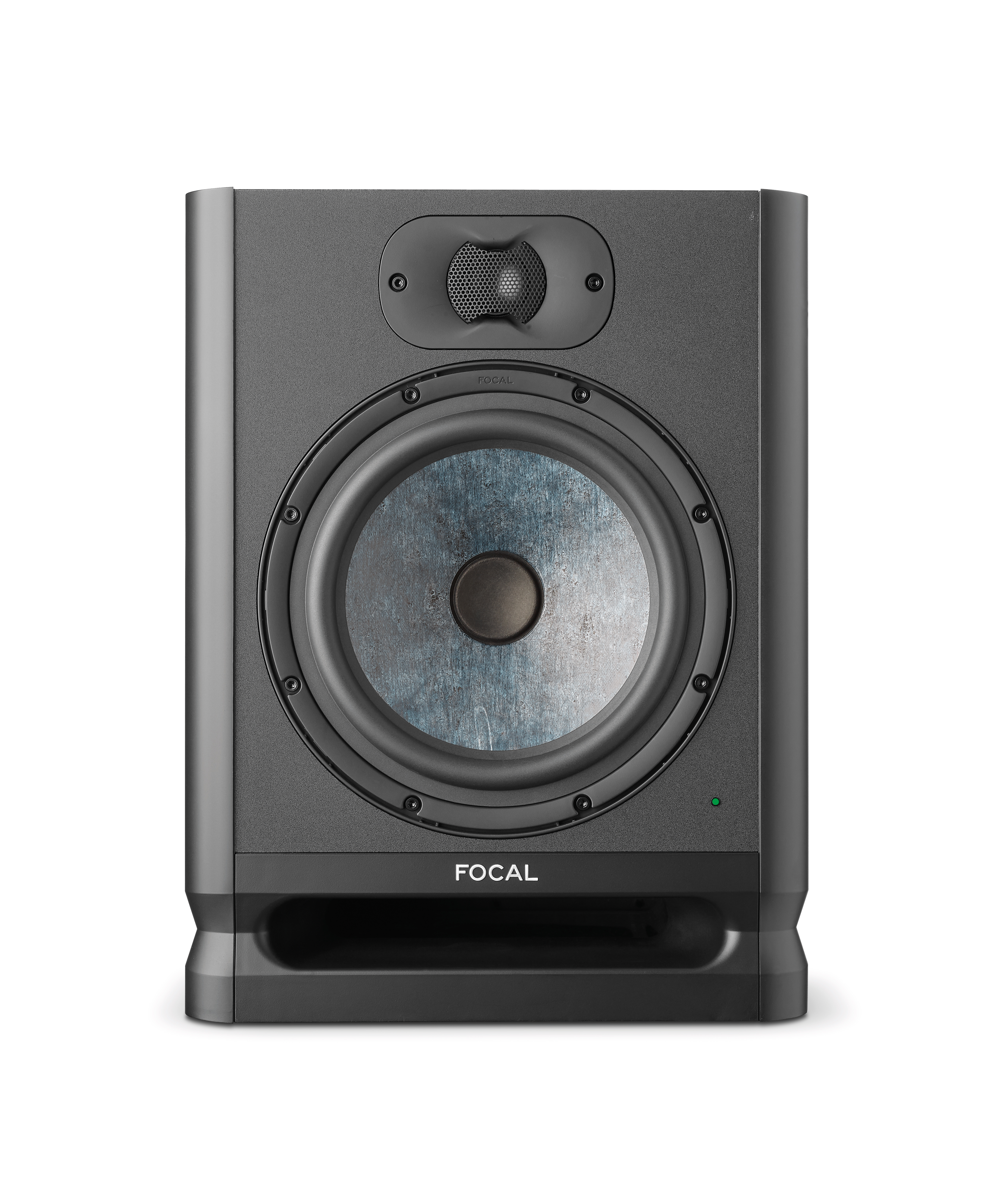
Focal Alpha 80 Evo 8-inch Powered Studio Monitor
Consider — Its manufacturer specifies 38 Hz at ±3 dB versus the Kali’s 45 Hz, but the manual requires vertical orientation.
Choose it when deeper specified bass without a subwoofer or a shorter cabinet matters most. It requires vertical placement and occupies more width and depth than the Kali.Available at Amazon(paid link) — opens Amazon in a new tab. Price and availability shown there.
Sources
Pages consulted while researching this article. None of these are affiliate links.
- Kali Audio IN-Series: IN-5 and IN-8 V2 specifications — kaliaudio.com
- Kali Audio IN-Series 2nd Wave User’s Guide — kaliaudio.com
- Focal Alpha 80 Evo official specifications — focal.com
- Focal Alpha 80 Evo Product Sheet — dam.focal-naim.com
- Focal Alpha Evo User Manual — dam.focal-naim.com
- Erin’s Audio Corner: Kali Audio IN-8 V2 measurements and review — erinsaudiocorner.com
- Audiofanzine: Focal Alpha 80 Evo comparative measurements and review — fr.audiofanzine.com