Godox MS300V for Home Portraits: Right Light, or Too Much?
The question this answersWhere do these come from?
pengen beli lampu godox khusus buat portoan dirumah bukan buat dibawa ngejob. tipe apa ya yang bagus
The Godox MS300V is a sound pick for a home portrait studio; the MS200V is enough in small rooms, and the SK400II-V only matters for big modifiers.
The Godox MS300V is a good choice for portraits at home. Its 300Ws gives enough power for most softboxes in a spare room, and it costs little more than the 200Ws MS200V next to it. Skip it only if your space is tiny and your modifiers are small (the MS200V is enough), or if you want TTL or high-speed sync, which no Godox MSV-series head offers.
What the MS300V is
The MS300V is a compact 300Ws monolight. Retailer and manufacturer-derived listings give these figures:
- Bowens mount
- 10W LED modeling lamp, adjustable from 5 to 100%
- Power range from 1/32 to full
- Flash duration of roughly 1/800 to 1/2000 s
- Recycle time of about 0.1 to 1.8 s (one listing says 1.3 s, so treat the figure as approximate)
- Built-in 2.4 GHz Godox X-system receiver with 32 channels and 16 groups
- Anti-preflash, which helps with cameras that fire a metering pre-flash
- Weight of about 1.3 kg
No independent lab has published measurements for this model that we found. The numbers above are the maker’s and retailers’ own, and the guide number is quoted inconsistently across listings (about 58 in some, and a different unit in others). Comparisons with the MS200V and SK400II-V below rest on those stated specs and on reseller and blog commentary, not on a test bench.
The older MS300 problem the V was meant to fix
Most of the hands-on write-ups that exist cover the original MS300, which used a halogen modeling lamp. Adam Gasson’s review reports an overheating problem around that lamp, and a DPReview forum thread titled “Godox MS300 - a few surprises” reports output at the lowest power settings drifting by around a third of a stop between shots. The V swaps the halogen for a 10W LED lamp, which removes the main heat source, but we found no long-term owner reports on the V itself, so its durability is unproven rather than confirmed. Retailer-hosted owner comments also mention fan noise at full power, which matters little at the low settings a home portrait uses.
MS300V, MS200V or SK400II-V
| Verdict | What decides it | The catch | |
|---|---|---|---|
| Godox MS300V | Buy | 300Ws, guide number about 58 | Manual only, no HSS |
| Godox MS200V | Consider | 200Ws, guide number about 53 | Short on power with big modifiers |
| Godox SK400II-V | Consider | 400Ws, guide number about 65 | Larger and heavier; check the V suffix |
CameraStuff’s MSV-series guide recommends the MS300V when you want an extra stop for larger sets, bounced light off V-flats or a deep parabolic softbox. One portrait roundup (Lynn Barsigian Photography) says the MS200V is usually enough for head-and-shoulders work in a small room, and that regular use of modifiers above about 36 inches, or shooting outdoors in midday sun, points to the MS300V or SK400II-V. Reviewers on those pages are not lab testers, so read these as reported experience, not measurements.
Just want the recommendation?
Skip to the picksWhen the MS200V is the better buy
Studio flash is far brighter than a home portrait needs at close range. In a small room with a 24 to 36 inch softbox a metre or two from the subject, you will run the MS200V or MS300V well below full power. If that describes your setup, the cheaper head is enough and the MS300V’s extra stop goes unused.
Choose the MS300V instead if any of these apply:
- You want a large octabox or a deep parabolic modifier.
- You want to bounce light off a wall or a V-flat, which costs a lot of light.
- You want a small aperture such as f/8 for sharpness or group shots.
- You want headroom to add a second light later without outgrowing the first.
When the SK400II-V is worth the extra
The SK400II-V suits full-length work, large modifiers and longer throw distances. For a home studio it is usually surplus. It is also easy to order wrongly: the plain SK400II is listed with a different (halogen-style) modeling lamp and a faster 0.1 to 1.0 s recycle time, so check which version the listing is for.
What no MS-series head does
Be clear about the limits before buying. The MS300V is manual. That means no TTL, and you set power yourself. There is no high-speed sync, so outdoor fill at wide apertures in bright sun is out. For controlled indoor portraits manual is a benefit, because consistency between shots is what you want. For action or outdoor work, look at a battery-powered Godox speedlight or the AD-series instead.
What else the kit needs
The head alone will not take a photograph. You need:
- A trigger. The head has a receiver built in, but changing power from the camera needs a Godox X-system transmitter, such as the X2T, in the version for your camera mount. A sync cord or the optical slave also works, with less convenience.
- A modifier. The Bowens mount takes most softboxes, umbrellas and beauty dishes. A 60 to 90 cm softbox or an umbrella with a diffuser is the usual starting point.
- A stand. A sturdy light stand with decent load rating is needed, since a head with a softbox is top-heavy.
The verdict
For portraits at home, not for paid mobile work, the MS300V is the sensible single light: portable enough, quiet to operate, and powerful enough to stay useful as your modifiers get bigger. There is no honest “skip” among these three; they are all sound Godox heads. The MS200V is the right call only for a very small room, and the SK400II-V only for bigger sets than most home studios have.
The bottom line
Two of these work — the difference is which situation you are in:
Top pick
Buy this
Godox MS300V 300Ws GN58 Compact Studio Strobe Flash Bowens Mount Monolight | LED Modeling Lamp, 2.4G Wireless, 0.1-1.8S Recycle Time, Flash Light for Studio,Portrait,Commerce Photography(MS300 Upgraded)
EACHSHOT
300Ws with a Bowens mount, built-in 2.4 GHz Godox X receiver and an LED modeling lamp gives roughly one stop more headroom than the MS200V for a small price step.
The pick for home portraits: enough power for 36-inch-plus softboxes, bounced light and stopped-down apertures, and compact enough for a spare room. Drawback: it is manual-only, with no TTL and no high-speed sync.Available at Amazon(paid link) — opens Amazon in a new tab. Price and availability shown there.The alternative
It depends
Godox MS200V Compact Studio Strobe Light, 200W 2.4G Studio Flash Monolight
Godox
200Ws (guide number about 53 against about 58 for the MS300V) is fine for head-and-shoulders work but runs short with large modifiers or when overpowering bright ambient light.
The cheaper alternative to the MS300V. Choose it if the room is small and you will use modifiers of roughly 24 to 36 inches. You give up about a stop of headroom.Available at Amazon(paid link) — opens Amazon in a new tab. Price and availability shown there.
Recommended products
Ordered by how well each one fits the situations above. Each link below is a paid link.
Godox MS300V 300Ws GN58 Compact Studio Strobe Flash Bowens Mount Monolight | LED Modeling Lamp, 2.4G Wireless, 0.1-1.8S Recycle Time, Flash Light for Studio,Portrait,Commerce Photography(MS300 Upgraded)
EACHSHOT
Buy — 300Ws with a Bowens mount, built-in 2.4 GHz Godox X receiver and an LED modeling lamp gives roughly one stop more headroom than the MS200V for a small price step.
The pick for home portraits: enough power for 36-inch-plus softboxes, bounced light and stopped-down apertures, and compact enough for a spare room. Drawback: it is manual-only, with no TTL and no high-speed sync.Available at Amazon(paid link) — opens Amazon in a new tab. Price and availability shown there.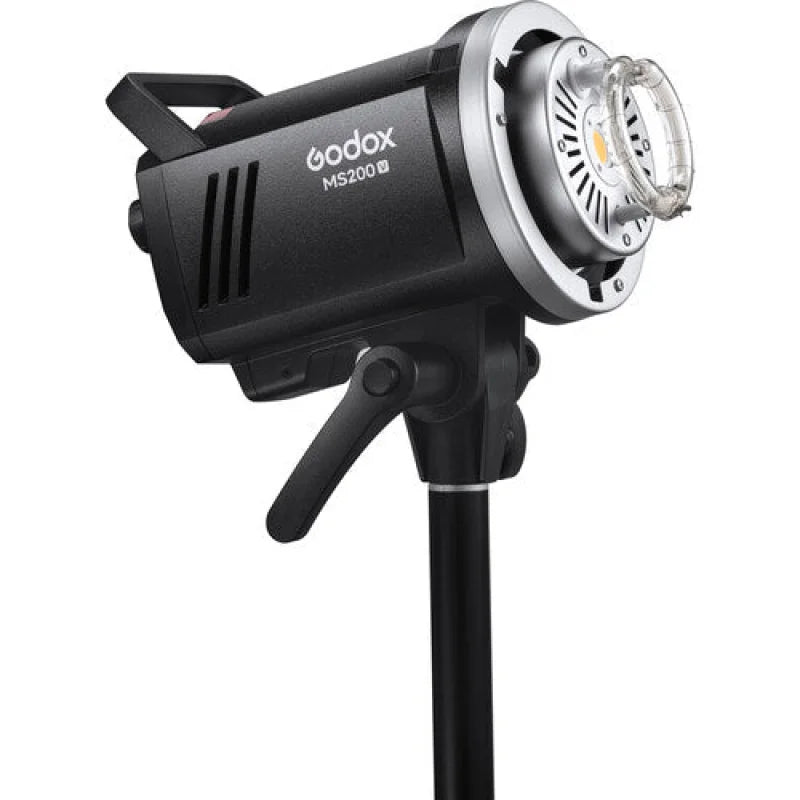
Godox MS200V Compact Studio Strobe Light, 200W 2.4G Studio Flash Monolight
Godox
It depends — 200Ws (guide number about 53 against about 58 for the MS300V) is fine for head-and-shoulders work but runs short with large modifiers or when overpowering bright ambient light.
The cheaper alternative to the MS300V. Choose it if the room is small and you will use modifiers of roughly 24 to 36 inches. You give up about a stop of headroom.Available at Amazon(paid link) — opens Amazon in a new tab. Price and availability shown there.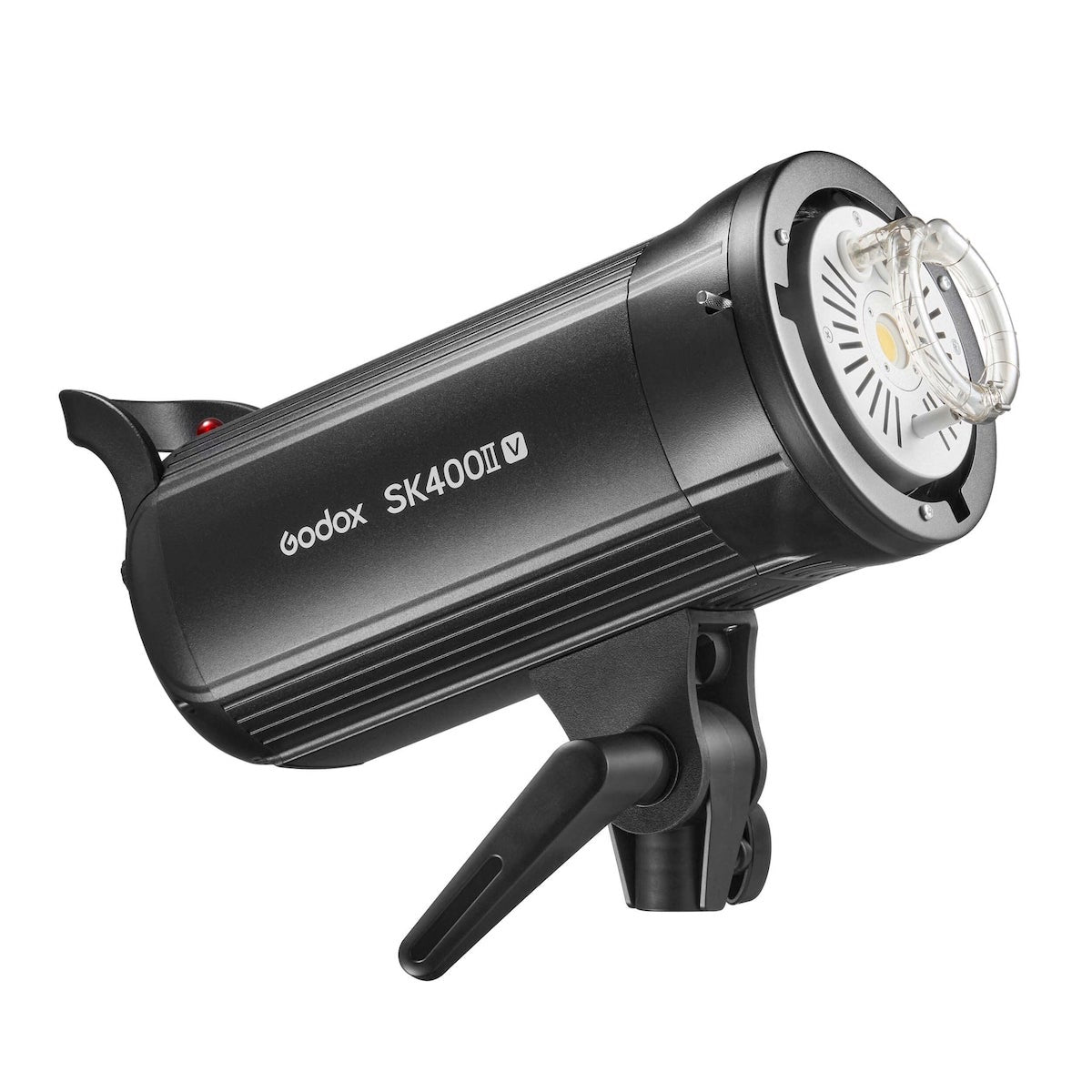
Godox SK400II-V 400Ws Photo Studio Strobe Monolight with Bowens Mount & LED | GN65, 0.1-1.5s Recycle Time, Bowens Mount, 10W LED Modeling Lamp for Studio Product Photography, Portraits Shooting, 110~120V
Godox
It depends — 400Ws (guide number about 65) only pays off with big modifiers or long distances, and the plain SK400II uses a different halogen modeling lamp, so the V version must be confirmed.
The step-up rival to the MS300V for full-length shots, large octaboxes or sets that need more reach. It is heavier and bulkier, so it is more than most home setups need.Available at Amazon(paid link) — opens Amazon in a new tab. Price and availability shown there.
Godox X2T-S TTL Wireless Flash Trigger for Sony, 2.4G X System
Godox
It depends — The MS300V has a receiver built in but no remote power control without a Godox X-system transmitter, and the transmitter must match your camera brand.
A complement to the MS300V, not a rival. It lets you change flash power from the camera instead of walking to the head. Buy the version for your camera mount.Available at Amazon(paid link) — opens Amazon in a new tab. Price and availability shown there.
Sources
Pages consulted while researching this article. None of these are affiliate links.
- Godox Studio Light Essentials: Kick-start your Dream with the MSV-series Kits (CameraStuff) — camerastuff.co.za
- 10 Best Studio Monolight Flash Systems for Portrait Photographers — lynnbarsigianphotography.com
- Godox MS300 Review (Adam Gasson) — adamgasson.com
- Godox MS300 - a few surprises (DPReview forums) — dpreview.com